On Feb. 5, nearly 16 years after then-U.S. President Barack Obama and then-Russian President Dmitry Medvedev sat at a gold-trimmed table in Prague Castle to sign their “historic” nuclear arms control agreement, New START quietly expired.
It was the last remaining bilateral nuclear arms pact between Washington and Moscow. But Franklin Miller, a former senior Pentagon official who advised multiple administrations on nuclear deterrence, dismisses fears that a new arms race is on the horizon. “The New START was a treaty for its time, but that time has passed,” he says in an interview with Independence Avenue Media.
The Kremlin, which has already modernized its nuclear arsenal, would like to tie Washington to previous caps. But Miller says the United States needs to modernize its nuclear forces too to form a simultaneous deterrent against Russia and China.
Russia, which spent an estimated 5% of its GDP on its war in Ukraine last year, would likely struggle to pay for new nuclear warheads, giving the U.S. an opportunity to upgrade its arsenal before negotiating a new deal on better terms, says Miller. “But the idea that the sky is falling because the treaty expired is just simply wrong,” he tells IAM.
The following interview, conducted on Feb. 10, has been edited for length and clarity.
Kiryl Sukhotski, Independence Avenue Media: President Donald Trump rejected Vladimir Putin’s offer to extend the New START treaty for a year. Instead, the U.S. administration wants a totally new, fresh deal, and we’re hearing that there are some talks going on between U.S. and Russian officials. So what do you make of this approach?
Franklin Miller, former senior Pentagon official and special assistant to the U.S. president: Well, I think that the president was exactly right to let the treaty expire. The treaty was created for a different time and place. The treaty was created in 2010-2011, and the world is very different now. Russia wasn’t a military threat to the United States then. It is now. China wasn’t a growing military power in the Pacific then. It is now.
And so U.S. deterrence requirements have changed. We need to be able to deter Russia and China simultaneously. The treaty gives us warhead levels which are somewhat below those levels that we need to deter Russia and China simultaneously. So undoubtedly, Putin was happy to keep us at a level below our requirements, and we need to grow somewhat.
There are some other problems with the treaty. The treaty was written, as I said, in 2010 [and ratified in 2011]. Putin has had his army and air forces create a series of weapons that were designed not to be covered by the treaty. So while the U.S. has been capped by the treaty, Putin has allowed his forces to grow in three different systems, which are utterly uncapped by the treaty. So again, the United States was disadvantaged by that.
Putin stopped the inspections and verification protocols of the treaty in 2022. He’s asking us to trust him just to stay at the levels that he would like us to stay at, the 2010-2011 levels, without verification. Of course, this is a man who’s already broken eight arms control treaties with the United States.
And then finally, when you think about how this all plays out, this doesn’t cover any of the regional nuclear weapons, the Russian short-range and medium-range nuclear weapons that threaten our allies in Europe and in Asia, of which Russia has a great many, several thousand, and the United States has a much, much smaller number, maybe 10% of that. …
Certainly, at the end of Trump’s first term, he tried to get some sort of trilateral discussion going with China, Russia, and the United States. That didn’t go anyplace. He also tried to engage with the Russian Federation on short- and medium-range nuclear weapons and got nowhere.
So it’s time to back up, ask whether people are serious about arms control, and if they are, then we have to cover all ranges of nuclear weapons. We have to have new inspection protocols and somehow have to take account of China as well as Russia.
IAM: So indeed, as you said, President Trump said that he wants to replace the New START, which was a bilateral agreement, with a new trilateral, which now should include China. Do you think that there could be dangers here of a new buildup where China and Russia will cooperate between themselves against the United States?
Miller: Well, it’s an interesting question. I think, first, we have to recognize that it may be a trilateral treaty, or there may be two parallel bilateral treaties. We just don’t know yet. That’s the first thing. The second thing is, whatever the Chinese are doing has nothing to do with the New START whatsoever.
The Chinese are very secretive. They are deliberately opaque. They have never announced what the intent of their program is, or the size that they’re building to. So we’re only left to guess that. But whatever it is, Xi Jinping is driving it. And it appears to be going on without any relationship to what the U.S. is doing, or the Russians are doing. So that’s sort of the first point.
The second point, I think, is that beginning about 2011, just about when the treaty was [ratified], President Putin began a major overhaul, modernization if you will, of Russia’s strategic nuclear forces — and he has boasted on many occasions in the past two years that he has modernized 95% of Russia’s nuclear forces.
So he’s done. He’s invested in his nuclear forces. He doesn’t need any more. And indeed, because of the enormous cost of the war in Ukraine and the cost of some of the sanctions on Russia, his economy is not in a position to support a major expansion of Russian strategic nuclear forces anyway.
So yeah, the Russians might complain a little bit and they might put more warheads on some missiles — what we would call “uploading.” But I don’t think there’s a large risk that Russia is going to start “racing,” because racing suggests that they’re doing more than what they did, and they just completely modernized their force in 15 years. That leaves the United States.
IAM: So you’re saying that despite some experts fearing that we could be on the brink of a new arms race when there are no guardrails anymore and everybody can ramp up the warheads, you believe this will not be the case?
Miller: Yeah. I believe this will not be the case. … The Russians have already spent a tremendous amount of money modernizing their force, going to what they think they need. So there’s no obvious reason for them to add more warheads except to try to scare or intimidate the West. They can do that. They can add some more warheads. That doesn’t really create an arms race.
For the United States, it’s a very different problem. The force that we have in the field today is the product of President Ronald Reagan’s administration. So the forces are getting old, they’re getting near the end of their design life.
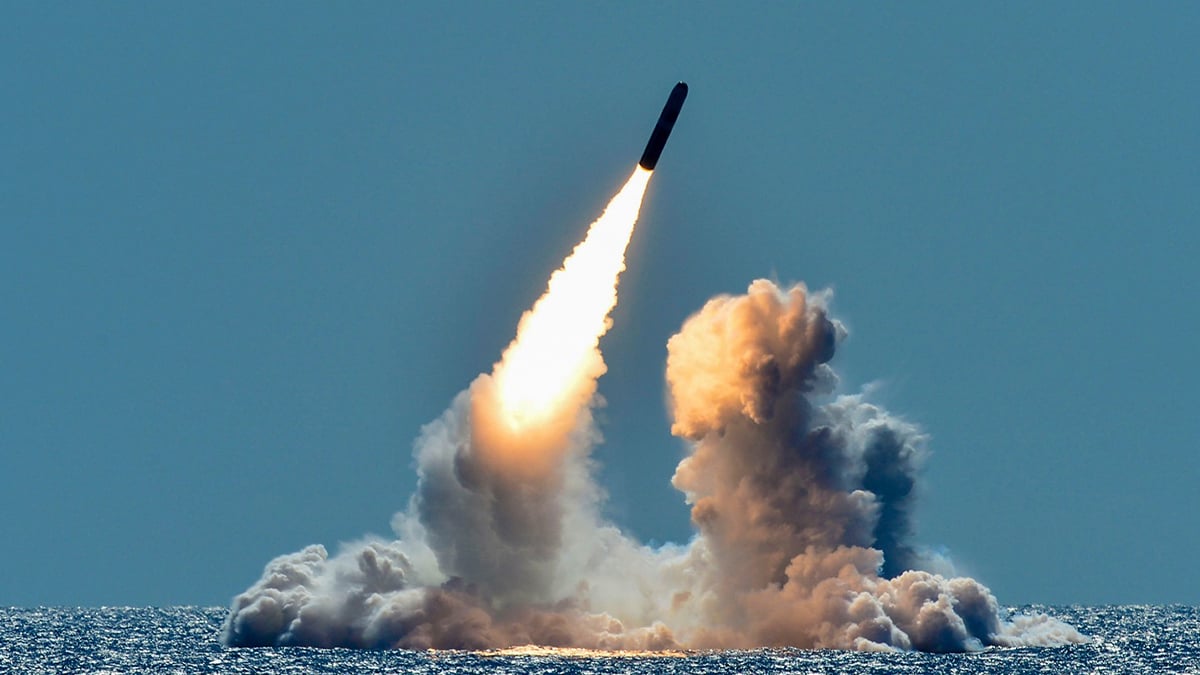
In 2011, Congress forced President Barack Obama to agree to modernize the U.S. nuclear forces. In the 15 years that Russia was modernizing, building up its nuclear forces, the United States has not added one single new nuclear system to its arsenal. The first new strategic submarine, the Columbia class, will not be in the water until about 2030-2031. The new B-21 bombers will not be operational until the late 2020s. The new ICBM, Sentinel, will not be deployed probably until the early 2030s.
So what does the U.S. have to do? The U.S. does have to add warheads to some of its existing missiles to be able to deter Russia and China simultaneously. It’s not a huge number, a couple of hundred maybe — but what that means is we have to take warheads that are in storage and put them on our existing submarine missiles and some land-based missiles. The Russians will object because they don’t want us to be able to deter Russia and China simultaneously.
They will threaten an arms race, which many American arms controllers will say, “My goodness, this is a problem, no guardrails.” But there’s not much behind that threat. So I’m comfortable saying that the president’s decision to get out of the New START and to begin the program of uploading warheads onto U.S. forces until we’ve reached our requirements is the right thing to do. …
I think a treaty would be helpful. I think it would be helpful to calm fears around the world as to where the U.S.-Russia relationship, or the U.S.-China relationship, is going. But it’s not the kind of thing that seems to me absolutely critical to U.S. national security. So we can get there. We will get there.
But the idea that the sky is falling because the treaty expired is just simply wrong. That was a scare tactic that was used by the American arms control community and by people like [Russian Foreign Minister Sergey] Lavrov and [former Russian President Dmitry] Medvedev trying to scare the United States into saying: no, we’re going to stay with New START limits even though the treaty expired. It seems it didn’t work.
IAM: Obviously, negotiating a new treaty will take some time. All the previous nuclear arms treaties between Washington and Moscow took years to negotiate because you need to discuss all the provisions for verification and all that. So that new deal also can take maybe several years. But what you’re saying is that this is not really an issue?
Miller: I think that’s right. And I think you may have said it early on, no treaty is better than a bad treaty. We took a long time to negotiate with the Soviet Union regarding getting rid of the Euromissiles, but we finally got there. We eliminated an entire class of missiles in the world: ground-launch cruise [missiles], Pershing II, SS-20. So it was worth getting there.
The START Treaty and START II took a little bit of time. But again, those were very good treaties with very good inspection protocols and verification. So we can take the time now to create a new treaty. … But we’ve got to get it right, we’ve just got to get it right.
IAM: Do you think the Kremlin will be interested in that new treaty, and will be amenable to all those new provisions that the United States wants to include there?
Miller: The beginning Kremlin position will be, “Nyet, I don’t want to be involved, you just have to get back to New START, and New START was perfectly OK.” And there’s a history of this. If you were involved in U.S.-Soviet and U.S.-Russian arms control as I was, the first Russian response is always no, go back and come back with terms that are more favorable to me.
But when Moscow starts to see the United States put new systems in the field in the late 2020s and the early 2030s, Moscow will have a very high incentive to want to have a new treaty. And it’s only then that they’ll be serious about this. Right now, because all of the very new systems we’re talking about are five years away from entering the force, Moscow is not particularly interested in an arms control deal. They would prefer us to simply put caps on our modernization programs, now that Putin has finished modernizing his forces. And I think that’s something the president will be wise to reject.
IAM: Russia is talking more about nuclear weapons. Russia has said repeatedly that it may use nuclear weapons in response to NATO aggression, even conventional NATO aggression. Obviously, Russian propaganda has been saying for several years that actually its war in Ukraine is a response to NATO aggression. There are fears that the red line about using nuclear weapons could be fading somewhat. Are you concerned?
Miller: Yes and no. First, I reject any notion that NATO, with 32 nations, is going to commit aggression against Russia. That’s simply not possible. Thirty-two nations can’t get together to wage a war of aggression. Not possible. Second, I think that it has been a long-standing Russian policy to try to intimidate the West, our Asian and our European allies, by threatening the use of nuclear weapons.
It’s easy to say that, but if you are sitting in Moscow and you know that if you start using nuclear weapons, it will start a nuclear war and you don’t know where that war is going to end — but you do know that Russian soil will be affected, that there will be nuclear weapons used against Russia — that’s a very serious thing to suggest.
It’s easy to make a threat, but to follow through on that threat and risk the destruction of your country is something entirely different. I think people in the West need to get serious about saying, Putin doesn’t want a nuclear war. Putin wants us to give in to what he wants, but Putin is not an idiot. He doesn’t want to risk the possibility of nuclear weapons being used against Russia.
Related stories: