Brian Whitmore is a contributor writing for Independence Avenue Media. The views expressed are the author’s and do not necessarily reflect those of Independence Avenue Media.
Thirty-five years ago this week, on Aug. 24, 1991, Ukraine won its de jure independence. And for the past 12 years, it has been fighting a war with Russia to defend and preserve its de facto independence.
This year’s Independence Day is the 13th consecutive time Ukrainians have marked the holiday amid armed conflict with Russia and the fifth since the full-scale invasion in 2022. What that effectively means is that for more than one-third of its existence as an independent state, Ukraine has been at war with a large, aggressive, and imperialistic neighbor determined to extinguish its hard-won sovereignty.
Russia’s war against Ukraine — and Ukraine’s spirited resistance — is therefore a continuation of Ukraine’s independence struggle of more than three decades.
Writing on Substack, Marta Dyczok, an associate professor of history and political science at Western University and a fellow at the University of Toronto’s Munk School of Global Affairs, noted that 35 years ago “Ukraine’s actions led to the end of an era — without Ukraine the USSR imploded and the Cold War ended.”
Dyczok, who covered the battle for independence as a journalist in 1991, added that today, “Ukraine once again finds itself at the center of this changing European and arguably global order, resisting Russia’s full-scale invasion and, in the process, transforming how modern wars are fought.”
The roots of this struggle, and the current war, lie in the divergent paths Russia and Ukraine took following the breakup of the Soviet Union in 1991. In contrast to Russia, which abandoned its half-hearted cosplay of democracy as soon as it got too difficult and too inconvenient, Ukrainians stuck with democracy even when it was hard. And for Russia, which fears a vibrant democracy on its borders, this was intolerable. In this sense, Ukraine’s battle for independence from Russia has been inseparable from its commitment to democracy.
This contrast between Ukraine and Russia became clear as day just a few short years after the Soviet collapse.
In the early 1990s, Ukraine and Russia were experiencing identical political crises — power struggles between the president and the parliament. In that chaotic and dizzying early post-Soviet era, there wasn’t really a road map for how to resolve such crises. Both countries were still using heavily amended versions of their Soviet-era constitutions and the ground rules for a separation of powers had yet to be established.
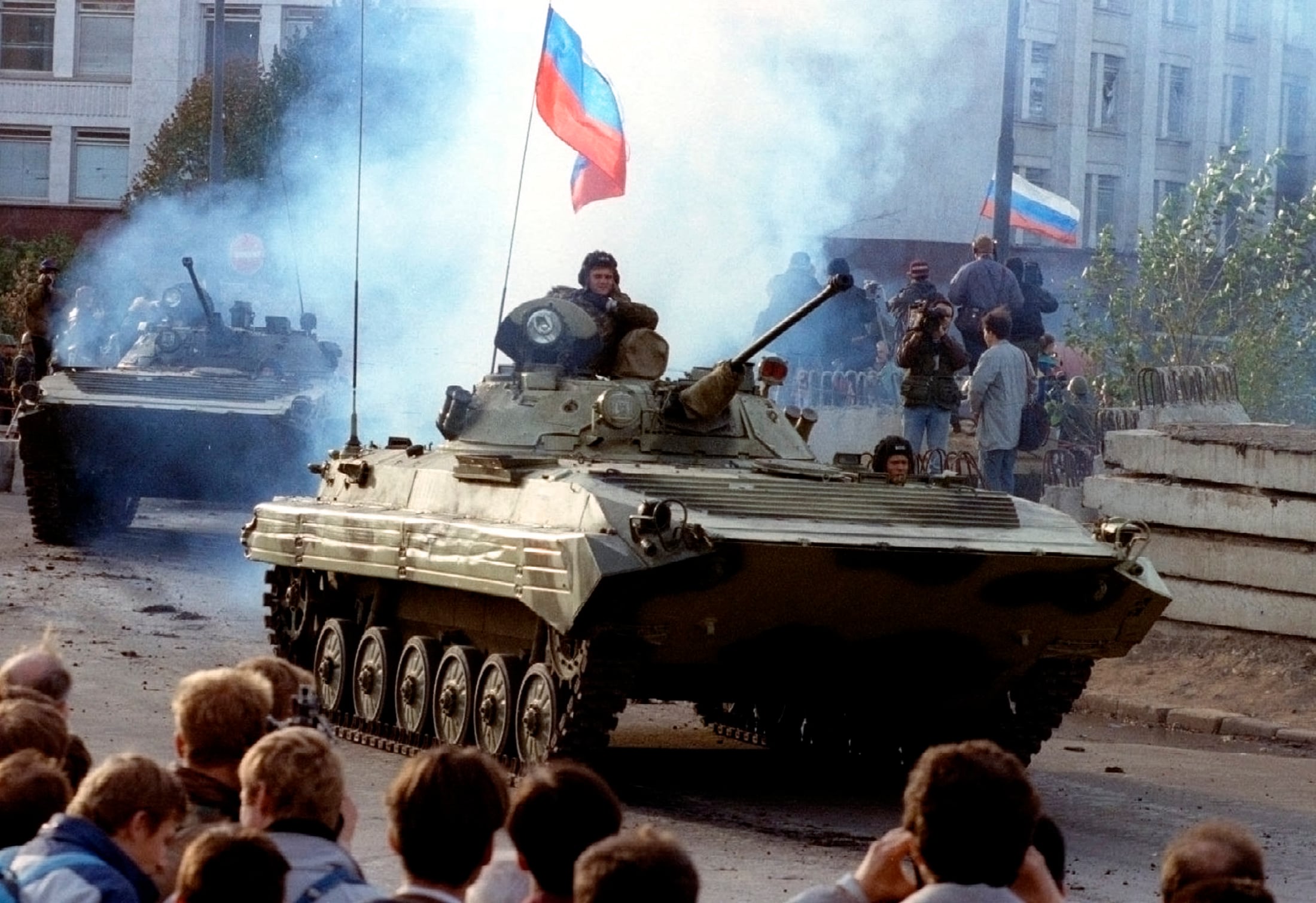
In Russia, the executive-legislative power struggle was resolved through the force of arms.
On Sept. 21, 1993, Russian President Boris Yeltsin dissolved parliament, sparking a crisis. Members of parliament responded by barricading themselves in the building and impeaching Yeltsin. Then, on Oct. 4, 1993, Yeltsin sent in the tanks and shelled the legislature into submission.
The bombing of the Russian parliament established the dangerous precedent that political disputes could be resolved by force. The Russian presidency turned into an unaccountable behemoth — one that Vladimir Putin would ultimately use to the fullest.
The end result was a superpresidency, a decorative pocket legislature, and a system in which the rule of law was trumped by an older principle: Might makes right.
So how did Ukraine resolve its formative power struggle between the executive and the legislature? They let the people decide. President Leonid Kravchuk and the Ukrainian parliament, the Verkhovna Rada, agreed to hold early elections — for parliament in the spring of 1994 and the presidency that summer. With a fresh mandate from the electorate, the new president and parliament then hammered out a new constitution.
On July 10, 1994, Ukrainian voters rejected Kravchuk, the incumbent, and elected his challenger, Leonid Kuchma. And then Kravchuk did something remarkable for the former Soviet Union. He stepped down peacefully and without incident, allowing Kuchma to take power.
The precedent was set that Ukraine would have free and fair elections — and power would be transferred peacefully. As a result, every Ukrainian election since has been competitive and only one incumbent, Kuchma in 1999, has been reelected.
Ukrainian democracy would be tested again in 2004 when the election was rigged for Kuchma’s handpicked successor, Viktor Yanukovych, and Ukrainians took to the streets in Kyiv in the mass uprising now known as the Orange Revolution. The rigged result was overturned in the courts and the pro-Western candidate, Viktor Yushchenko, won a revote. The message was reinforced: the will of the people is sacrosanct.
Ukrainian democracy faced perhaps its hardest test when the pro-Moscow Yanukovych won the presidency in 2010 and attempted to move Ukraine both closer to Russia and in a more authoritarian direction. When Yanukovych abruptly abandoned an association agreement with the European Union in late 2013, it sparked the mass uprising known as the Revolution of Dignity. After his security forces used lethal force against demonstrators Yanukovych fled the country for Russia and was subsequently impeached.
We know the rest of the story. Russia annexed Crimea, started a war in the Donbas region, and launched its full-scale invasion in 2022.
Ukraine’s ability to resist Russian aggression, imperialism and colonialism has since become the linchpin for the former Soviet Union to truly become post-Soviet.
But the significance of Ukraine’s 35-year struggle to maintain its independence is much deeper. It is the story of an old European nation preserving its very young statehood as a modern European democracy. “It is hard to overlook what Ukrainians have done to defend the idea of democracy. In a basic sense, this is what the war is about,” University of Toronto historian Timothy Snyder wrote in the Kyiv Post.
And for this, we should all be grateful. As I noted just days after Russia invaded: “We all owe a great debt to the Ukrainians. They are reminding us why democracy matters. They are reminding us that it is worth fighting for. And they are reminding us that in this era of fake news and alternative facts, the truth still matters.”