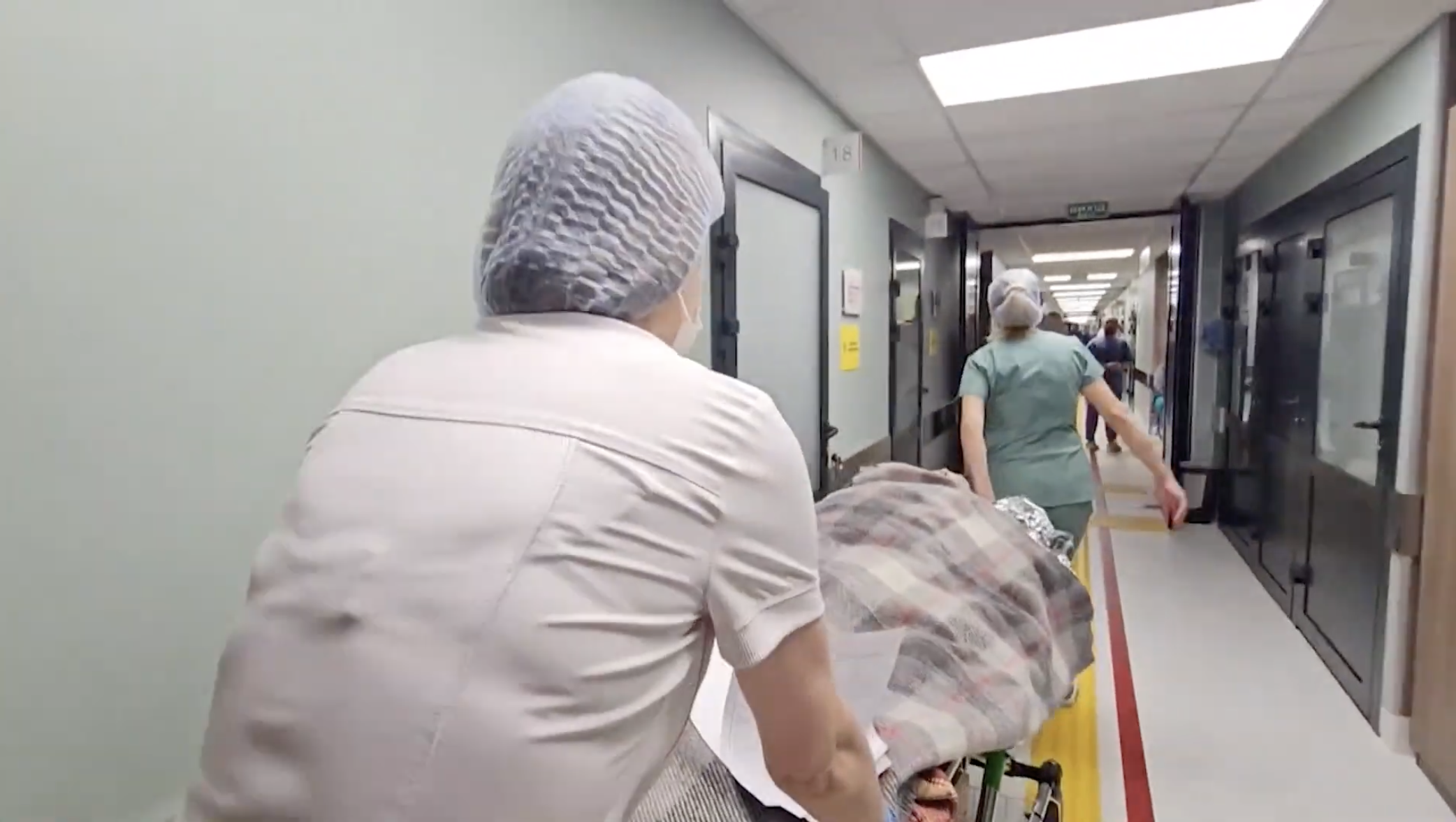
They wear surgical masks instead of camouflage and carry scalpels instead of guns. But when Russian attacks hit Kharkiv, about 30 kilometers from the Russian border, the surgeons and staff at Kharkiv Regional Clinical Hospital, the city’s largest general hospital, respond like front-line defenders.
Even if the facility itself is struck, their mission in an emergency is clear: Keep fighting to save lives.
Footage shot by Independence Avenue Media inside the hospital on Oct. 16, the day a Russian drone killed two people and injured more than 20 others at a flea market in the Shevchenkivskyy district, shows multiple medical staff near an injured woman and waiting stretchers in a paneled room. Within an hour of the strike, 11 patients arrived at the hospital, triggering an emergency response. Critical cases were rushed into surgery.
Natalia Klymenko was among them. She was selling children’s toys at the flea market when the drone struck, sending a tiny piece of shrapnel through an artery in her thigh. Her friend and coworker, a 71-year-old woman, was one of the two people killed.
“It happened in an instant,” a recovering Klymenko, her lower lip still black with bruising, recalls six days later in her hospital room. “I was lying on the pavement. I’m so grateful to the doctors and ambulance crews for getting us here so quickly.”
The video shows cardiovascular surgeon Oleksii Prokopov and his team extracting the shrapnel, about the size of a seed, and using plasma and blood transfusions to stabilize Klymenko’s condition.
After another local Russian attack, teams performed 18 operations nearly simultaneously, the hospital’s acting head of surgery, Oleh Volchenko, says. One involved some 16 surgeons successfully operating on a civilian with “penetrating abdominal and chest wounds, a damaged femoral artery and an injury to his left eye.”
Doing so requires stamina and steely nerves because medical staff never know if the hospital will be the next target. Nearly 90% of the city’s 49 hospitals have been attacked since Russia’s full-scale invasion of Ukraine began in 2022, according to Mayor Ihor Terekhov. The United Nations’ World Health Organization estimates that more than 3,200 such strikes have occurred across Ukraine since 2022 — reports Russia has rejected as false.
Most recently, a Nov. 20 strike on Kharkiv’s Meshchaninov emergency hospital left four patients injured.
Repeated shelling of the 850-bed Kharkiv Regional Clinical Hospital, which has 529 physicians, led to plans to build a new, roughly $54-million underground regional hospital complex. The main structure is complete, with work now focusing on the “engineering systems,” according to Kharkiv Regional Military Administration head Oleh Syniehubov.
The aim is to protect the hospital’s role as the main medical responder to civilian casualties, including from locations closer to the front line.
That role is critical for civilians like 36-year-old Eduard Akhtyrskyy, whose abdomen was ripped open when a Russian bomb struck Slovyansk, a few hours’ drive southeast of Kharkiv, roughly 10 miles from the front line.
The blast, which occurred as Akhtyrskyy and his mother were waiting in their car at a traffic light, ripped apart the muscle, fat and membrane covering Akhtyrskyy’s internal organs. Military surgeons treated them first, then sent Akhtyrskyy and his mother, who also was injured, to the Kharkiv Regional Clinical Hospital. There, surgeon Andrii Poliukhovych and other medical staff used Akhtyrskyy’s own thigh tissue to rebuild his abdominal wall.
“Because of the war, we have to perform reconstructive surgeries quite often. But this was the first time we’d repaired an injury this large,” says Poliukhovych.
Still recovering in the hospital, Akhtyrskyy, who also sustained wounds to his right arm and shoulder, says that whether or not he would survive was unclear for “a couple of days.”
“Surgeons brought me back from the dead,” he adds.