On June 8, 2026, the U.S. House of Representatives approved H.R. 7668, the Countering China’s Control of the Caucasus Act.
The legislation requires the secretary of state to prepare a classified report assessing Russian and Chinese influence and intelligence activities in Georgia.
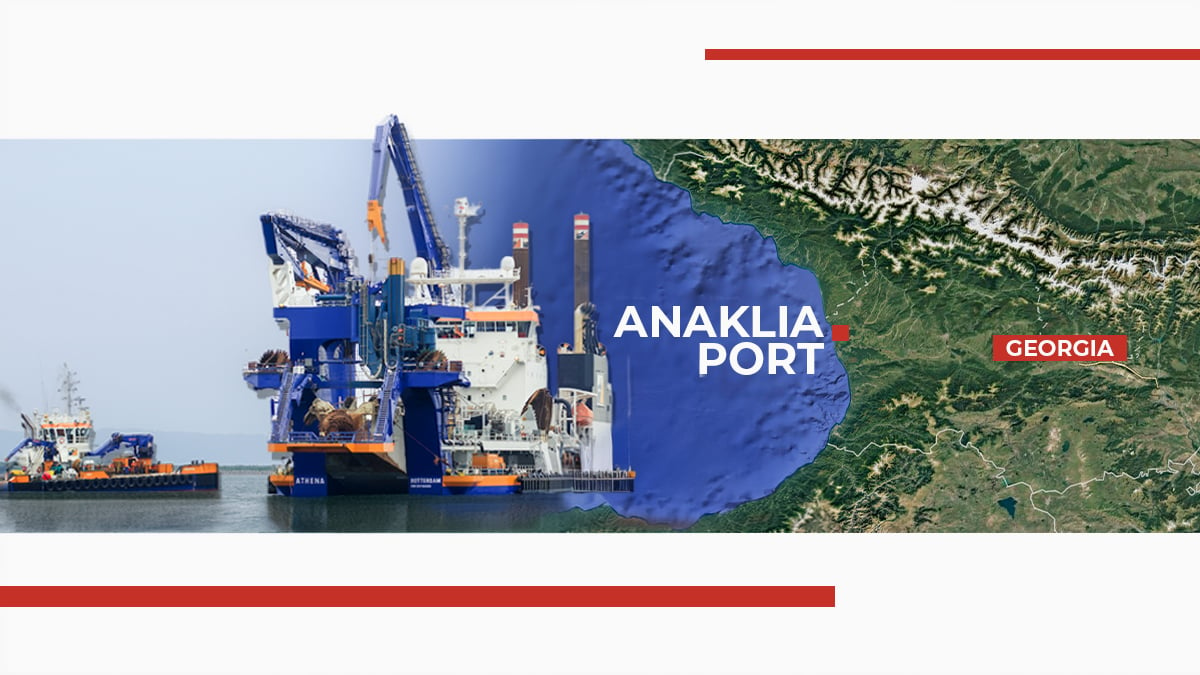
Among the projects likely to draw scrutiny is a proposed Anaklia deep-sea port.
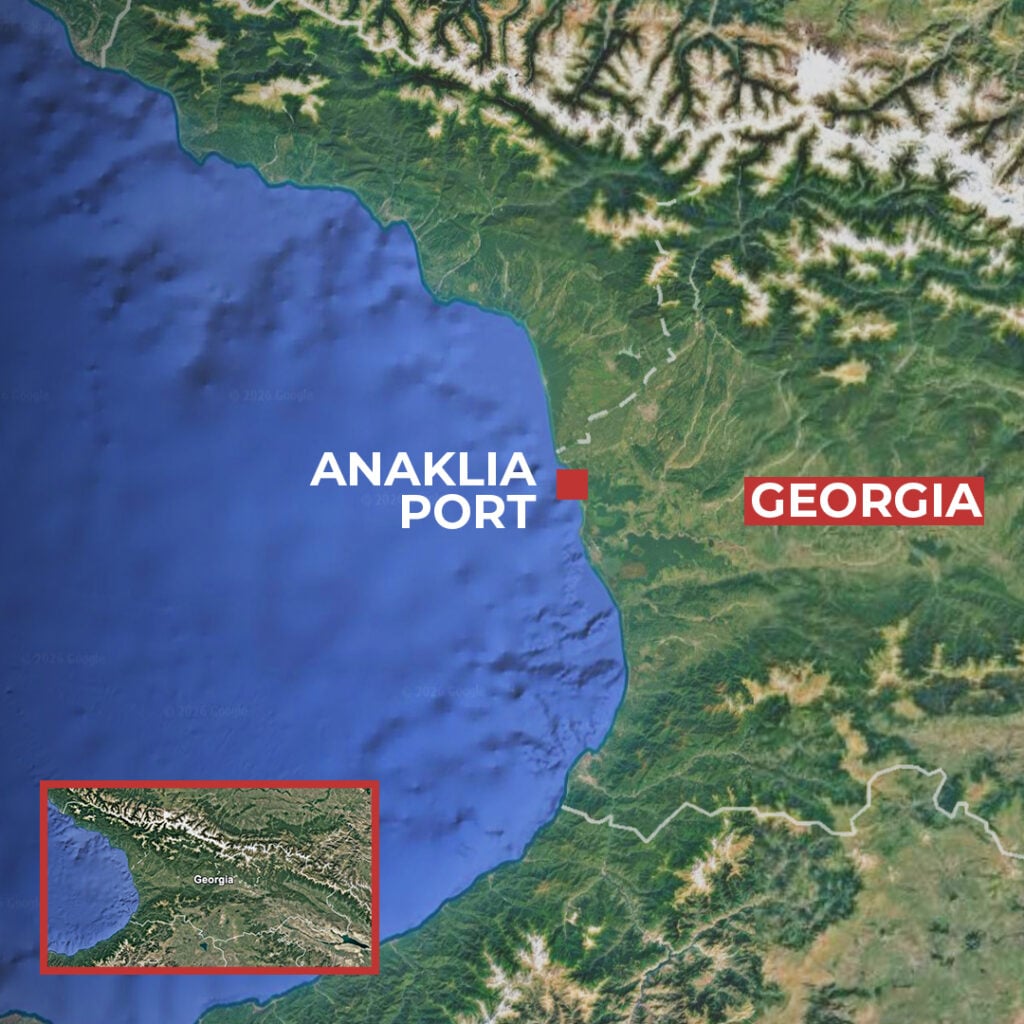
Located just 4 kilometers from Russian-occupied Abkhazia, the long-delayed project was once envisioned as Georgia’s flagship contribution to the Middle Corridor route — a way to connect Asia to Europe while bypassing Russia. Instead, it has become a symbol of Georgia’s shift away from the West.
The Road to Anaklia
Often described as Georgia’s “project of the century,” Anaklia was envisioned as the country’s primary gateway to the Black Sea. It would be Georgia’s first deep-sea port, allowing massive cargo ships to dock. Instead, years of delays have left the project in limbo.
Soviet authorities first identified the site as a promising location for a deep-sea port in the mid-1980s, but the Soviet Union’s collapse and the uncertainty that followed put the project on ice. It was revived in 2011, during the final years of Mikheil Saakashvili’s presidency.
But Bidzina Ivanishvili, the former prime minister and honorary chairman of the ruling Georgian Dream party, was skeptical of the project. When he came to power in 2012, it was shelved again — at least temporarily.
In 2016, the government revived the project and awarded a new tender to the Anaklia Development Consortium, led by Georgian banker Mamuka Khazaradze’s TBC Holding and two American firms — Conti Group and SSA Marine.
But in July 2019, just weeks after Khazaradze announced that he planned to found an opposition party, prosecutors filed charges in a money-laundering case against him. In January 2020, the government terminated the contract, saying the consortium was not fulfilling its terms. The consortium protested this decision, but two international tribunals have sided with the Georgian government.
Khazaradze has alleged the project was ultimately halted to serve Moscow’s interests, saying that a fully operational Anaklia port could have diverted cargo flows away from Russia. In December 2022, Georgian Dream announced it would relaunch the project under a new structure: the state would retain a 51% stake, while an investor would receive the remaining 49%.
The Chinese Bid
On May 29, 2024, then-Economy Minister Levan Davitashvili announced that a Chinese-Singapore-led consortium, consisting of China Communications Construction Company and its Singaporean subsidiary, China Harbour Investment, was the leading bidder in the tender process for Anaklia.
“We will announce the Chinese consortium as the winner in the next few days,” Davitashvili said at the time.
Now, more than two years later, no contract has been signed.
When Davitashvili’s successor, Mariam Kvrivishvili, visited China in April 2026, Prime Minister Irakli Kobakhidze said developments could be expected “in the near future.” He later added that negotiations with the Chinese side should conclude by the end of 2026.
Tina Khidasheli, a former defense minister and current head of Civic IDEA, an NGO, told Independence Avenue Media that the consortium has never been formally declared the winner of the tender. She says Georgian Dream has deliberately prolonged the process to keep its options open.
“They left themselves room to bargain with the Americans,” Khidasheli said. “They were constantly waiting for communication from Washington and deliberately dragged out the process.”
The government, however, insists the project remains on schedule. Kvrivishvili recently told the pro-government television channel Imedi that the first phase of the project is being completed and that an investor partner would join during the second. She did not directly answer a question about who the investor would be, but said negotiations with the Chinese consortium are continuing.
“We are in ongoing talks with the consortium and are clarifying several key components that are critical for our country,” she told Imedi. “We are optimistic that these negotiations will conclude successfully.”
Roman Gotsiridze, an economist and former longtime opposition deputy, says that negotiations have stalled over several key Chinese consortium demands, which he argues are onerous.
Among them, he says, are financial guarantees, compensation if cargo volumes fall below expectations, and a commitment not to expand ports in Batumi and Poti, which could compete with Anaklia.
Independence Avenue Media contacted the Chinese consortium for comment but has not received a response.
Moscow’s Preference
Russia had been critical of Western participation in the Anaklia port project, but no similar backlash has emerged against the Chinese-led configuration.
Gotsiridze argues that the Kremlin sees benefits in the China-Singapore consortium — particularly compared to the alternative.
Georgia has become an important channel for trade that helps Russia mitigate the effects of Western sanctions imposed after Russia’s invasion of Ukraine. And Gotsiridze argues that Chinese participation would effectively lock out Western investors.
“One of the Chinese demands,” Gotsiridze told Independence Avenue Media, “is that if the Georgian government decides to sell its 51% stake, Beijing gets the right of first refusal.”
MORE: As Moscow Weakens, the South Caucasus Grows Closer to the West
Washington’s Shifting Stance
Washington once strongly supported the Anaklia project.
In June 2019, Mike Pompeo, then-secretary of state in the first Trump administration, told then-Prime Minister Mamuka Bakhtadze that the port would “strengthen Georgia’s ties with free economies and prevent it from falling under Russian or Chinese economic influence.”
But more recently, the bipartisan Helsinki Commission warned that “China’s growing presence in the Black Sea, in collaboration with Russia, makes the region less safe and restricts free trade.”
In March 2026, State Department official Peter Andreoli visited the Anaklia construction site alongside representatives of Georgia’s Economy Ministry.
Washington made no public statement following the visit, but it fueled speculation that Tbilisi was attempting to pique U.S. interest in the project as part of a broader effort to improve bilateral relations and secure relief from U.S. sanctions imposed on Ivanishvili in 2024.
Khidasheli, the former defense minister, says Washington remains interested.
“Anaklia is the only project that could revive the Trump administration’s interest in Georgia,” she told Independence Avenue Media. “Georgian Dream understands politically the moment they hand Anaklia to the Chinese, they burn every bridge back to Washington.”
In April, Georgia’s parliament speaker, Shalva Papuashvili, said government efforts to attract American investors in the port project have repeatedly failed.
A Missed Opportunity
Khidasheli links Anaklia to the U.S.-brokered agreement between Armenian Prime Minister Nikol Pashinyan and Azerbaijani President Ilham Aliyev on the construction of a transit corridor known as the “Trump Route.”
“As soon as the Caucasus appeared on the Trump administration’s radar, our offer should have been to treat the entire transit system as one package,” she said.
“That Oval Office signing with Pashinyan and Aliyev should have been trilateral — and included Georgia. These corridors don’t start or end without us.”
Rep. Joe Wilson, a South Carolina Republican and a vocal critic of Georgian Dream, who co-sponsored the just-passed House bill, has repeatedly criticized the intention to award the tender to the Chinese. In an interview with RFE/RL in April, Wilson said China would use the port to control access to rare earths and rare minerals from Central Asia.
House Foreign Affairs Committee Chairman Brian Mast, R-FL, pointed to the Anaklia project to illustrate Washington’s growing unease with Chinese involvement in Georgia’s strategic assets.
“Competition is good,” he said. “But when it comes to critical infrastructure like this, our partners should take into consideration the risk posed by the PRC.”
Hours after the House passed the bill, which will now be considered by the Senate, Tbilisi and Beijing announced an upgrade in bilateral relations to a Comprehensive Strategic Partnership, further developing the framework established in 2023.
A day later, Kobakhidze, the prime minister, praised economic cooperation with China and expressed hope for its further development. Meanwhile, Georgian Dream has rejected objections in Washington to the country’s relationship with China, pointing to Trump’s own friendly summit with Xi Jinping in Beijing in May.