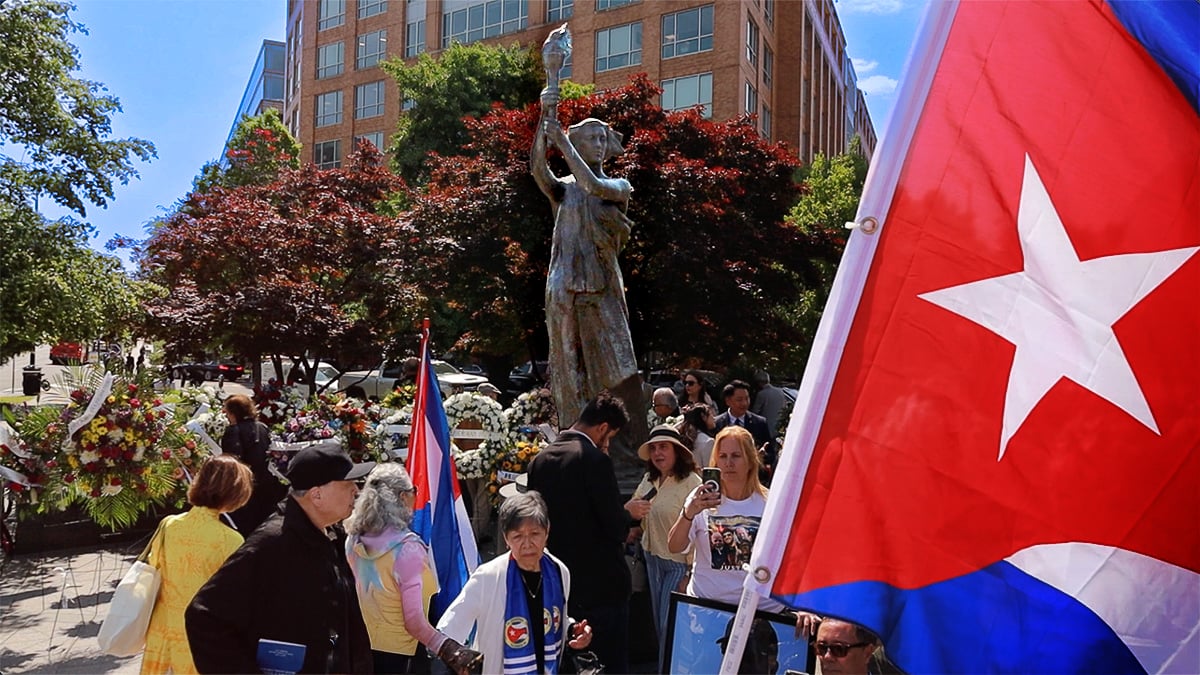
At the Victims of Communism Memorial in Washington, as each country was called, representatives stepped forward in silence to honor victims of communist regimes — a ritual that has become central to the annual Roll Call of Nations.
The ceremony, organized by the Victims of Communism Memorial Foundation, brings together diplomats, diaspora communities and human rights advocates. Each wreath laid marks not only those killed under communist rule — estimated at more than 100 million — but also, organizers say, the more than 1 billion people still living under such systems.
For many who attended, the event is not simply commemorative.
“For us, it’s not necessarily remembering the past,” said Alesya Semukha-Greenberg of the Belarusian-American Association. “It’s remembering the past and living through the current.” She described Belarus as a continuation of the Soviet system, with many of the same structures still in place.
Across the gathering, those experiences are often described in personal terms — shaped by repression, exile and loss.
“For us, Georgians, this is particularly important,” said Salome Tsereteli-Stephens, president of the Georgian Association in the United States, recalling how Soviet policies affected her family, including forcing them into exile.
Participants also drew connections between those histories and present-day conflicts, particularly Russia’s war in Ukraine.
“The communist regime was about denying national identity, history, and language,” said Valeriya Chunikhin of United Help Ukraine. “This is what Ukraine is fighting for — its right to exist as a sovereign country.”
U.S. Rep. Joe Wilson praised Ukraine’s resistance, saying he was “grateful for the people of Ukraine that they have resisted.”
The representative from South Carolina, who has been critical of Georgia’s ruling Georgian Dream party, also spoke about the importance of maintaining democracy there.
“We’re so grateful for the people of Georgia, who understand that there should be fair and free elections in Georgia, and it should not be controlled by dictators.”
But organizers said their concerns extend to how communism is understood today. Eric Patterson, president of the foundation, pointed to polling showing that many young Americans view socialism or communism positively.
“What’s worrying is that 62% in a poll last year of American young adults and teenagers think that socialism or communism are good ideas, including for our own country,” he said. “And what I try to explain to them is this: First of all, it is a secular materialist philosophy, a way of thinking that doesn’t value the human person, the fundamental rights, because it just sees people as tools or just chemicals and atoms that can be manipulated by elites. And second, as Martin Luther King said about communism, [it] comes to power and stays in power by violence, lies, and murder.”
For those whose families experienced communist rule, however, the distinction between ideals and reality is clearer.
“I think that we have seen the romanticization of ideas of communism under the disguise of equality, which is a completely different thing,” said Veronika Metonidze of the Georgian Association. “It’s very important to distinguish the normal striving for democracy and equality within society and the ideas of communism that are not about equality but about control.”
Semukha-Greenberg, the Belarusian-American participant, put it more directly.
Under communism, “You can have equality in poverty. You can have equality in lack of rights. When everybody is equal in not having these things,” she said.
See the full story below: