Nearly eight decades after its founding, NATO is facing an existential crisis.
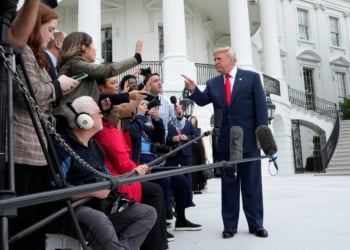
U.S. President Donald Trump, angered at what he says was insufficient support from alliance members during U.S.-Israeli military operations in Iran, has threatened to withdraw the U.S. from the 77-year-old defensive alliance.
“It would actually be a pretty devastating blow to deterrence across the alliance,” says Julianne Smith, who served as U.S. ambassador to NATO in the Biden administration.
Smith tells Independence Avenue Media that “there is now a trust deficit in the alliance.”
“A number of European allies are talking about the fact that they can’t really trust the United States. They find us to be very unpredictable.”
It is an assessment that would have been unthinkable for much of NATO’s 77-year history.
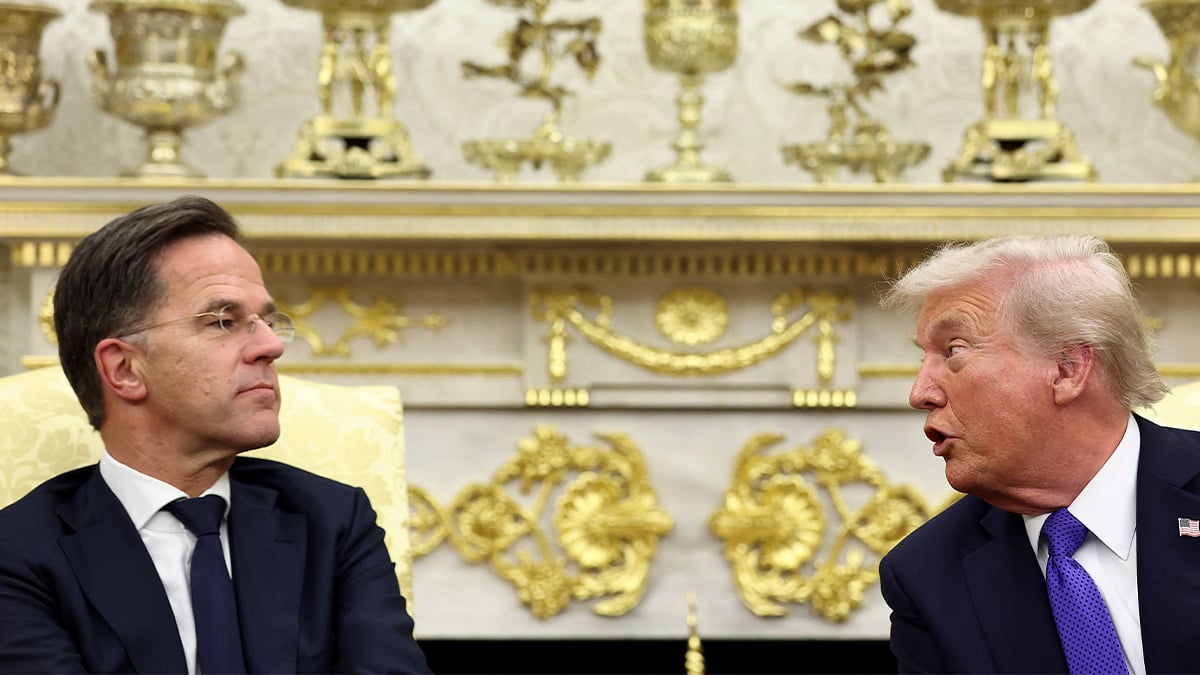
On the heels of a shaky ceasefire in Iran, NATO Secretary-General Mark Rutte, who has made a point of avoiding criticism of the president, visited the White House on April 9 for a closed-door meeting with Trump that reportedly lasted two hours.
The visit was aimed at soothing the president, who had demanded that U.S. NATO allies use their militaries to force Iran to reopen the Strait of Hormuz.
Tehran had been blocking the strait since the start of the Iran War on Feb. 28, leading to skyrocketing global oil prices.
European allies had not been involved in the planning for the war, and many have said the demands were impractical and unwarranted.
Trump does not appear to have been swayed by Rutte’s visit.
“NATO WASN’T THERE WHEN WE NEEDED THEM, AND THEY WON’T BE THERE IF WE NEED THEM AGAIN,” he wrote on Truth Social, following the meeting.
Speaking on CNN, Rutte said it was “a very frank, very open discussion,” but declined to answer directly when asked whether Trump had threatened to leave the alliance.
The alliance had already been rattled through the first 15 months of Trump’s second term as he withdrew direct U.S. military support for Ukraine, disparaged NATO’s contributions to the war in Afghanistan and threatened to seize Greenland from ally Denmark.
It is against that backdrop that we sat down with Smith for a wide-ranging conversation on the state of the alliance — why European allies did not join American operations in Iran, whether the damage to trans-Atlantic trust can be repaired, what a U.S. withdrawal would actually mean in practice, and how the war in Ukraine has reshaped the very meaning of collective security.
The following interview, recorded on April 8, 2026, has been edited for length and clarity.
Ia Meurmishvili, editor-in-chief, Independence Avenue Media: What does NATO mean to the United States from your vantage point?
Julianne Smith, former U.S. ambassador to NATO: Well, large numbers of Americans, a majority of Americans, still treasure this alliance. It’s 77 years old. Some people would describe it as a little rusty, a little creaky in its old age. But I think most Americans understand that it has a tremendous amount of value. If you ask your average American, what does NATO mean to you, I think fundamentally the phrase that comes to mind is stronger together, that the United States can’t solve all the world’s problems and that we need NATO allies to work together, to exercise and train together, to be prepared for all sorts of contingencies and address future challenges.
So in most of the polling data in the United States, we have about 70% to 80% of the population approving our membership in the NATO alliance, even though the alliance is over seven decades old. [An April 2026 Pew Research Center survey put the number at 59%, with strong support among Democrats and flagging support among Republicans]
IAM: Recently, there’s been much debate about — especially after the start of Iran War — whether NATO allies were there with the United States. And it’s not just the president who said that a few times, but also his supporters are saying the same thing. How do you explain that? Why is it that NATO allies did not help when the president requested it in Iran?
Smith: Well, first of all, it’s hard to talk about Europe in general because of course, Europe is made up of lots of different countries. And there were some countries that said we would prefer that the United States not use our bases for offensive operations in Iran. But not everybody said that.
The most important ally in terms of U.S. basing is Germany. And Germany allowed the United States to use all of our presence in Germany to execute this war. And so I just want to make sure that when we’re talking about Europe, we can differentiate between those that were cooperative and those that were less so.
In terms of why Europeans didn’t come running when the president reached out and asked for help, I would say a couple of things: One, is it’s been a tough year for the trans-Atlantic partners. They feel like this administration hasn’t really extended a hand, hasn’t talked favorably about Europe, hasn’t really heralded the trans-Atlantic relationship as the most important relationship for the United States. They’ve been frustrated over claims to take Greenland. They’ve been frustrated that the U.S. has stopped providing security assistance to Ukraine. And they were frustrated that they weren’t called to hear exactly what the strategic objectives were in Iran. They weren’t consulted on the front end in any way, shape or form. So that’s the first reason. The state of the relationship really hasn’t been great.
The second reason is that they weren’t exactly sure what the requirements were. First if you don’t understand what the U.S. is doing — Is it regime change? Is it the oil? Is it the nuclear weapons? Is it something else? The Strait of Hormuz — it’s hard to determine how you’re going to help. And they also heard the president say that he didn’t need the help of European allies. So I think a lot of them were a bit confused. Do you want our help? Do you not want our help? What’s going on here?
The third reason is this wasn’t really a NATO operation. NATO is a defensive alliance. It has rarely taken on offensive operations. Article 5 is there for “an attack on one is an attack on all.” This wasn’t an attack on the United States. This was the United States and Israel pursuing an intervention in Iran.
And so many allies, while they’re contemplating whether or not they can help now keep the Strait of Hormuz open, I think they thought that that was a mis-framing in some ways.
Lastly, European allies did stand with the United States for 20 years in Afghanistan. And quite recently, the U.S. president has kind of belittled those contributions. He has said that European allies kind of stayed behind the fence. They didn’t all fight. And that’s just simply not the case. Many allies, particularly Denmark, actually on a per capita basis lost a number of soldiers. So there are a lot of reasons why European allies didn’t come running. Could we now find a moment where we can all come together to keep the strait open? I think that’s possible. Europeans have mine clearance capabilities. They have a lot of assets that they could provide. But I don’t anticipate this actually being a NATO mission per se.
President Donald #Trump sharply criticized #NATO allies for failing to back U.S. military action against Iran and said a U.S. exit from the alliance is now "beyond reconsideration."
— Independence Avenue Media (@indavemedia) April 4, 2026
Here are some of the things Trump has said about NATO during his second term in office. pic.twitter.com/78UIQgmR5j
IAM: Based on everything that you just listed — some of those complications in the relations between Washington and NATO — do you think the relationships can be repaired?
Smith: Well, this past year has been a year of some good news and bad news for the NATO alliance. The good news, let’s start there, is that President Trump was able to get all the allies to commit to spend 5% of their GDP on defense. This is good news. Americans want Europeans to spend more on their own national defense. And so let’s celebrate the fact that Europeans are doing more. They’re rapidly spending hundreds of billions of euros on their own defense.
But the bad news is that there is now a trust deficit in the alliance where a number of European allies are talking about the fact that they can’t really trust the United States. They find us to be very unpredictable. We’re hot and cold. They don’t know what our next move is.
They claim that they’re not really properly being consulted. They feel like they’ve read about some things in the newspaper instead of being brought in at the front end, as we often do with allies. And I think the Greenland episode was really damaging to the alliance. I mean, to have the most powerful member of the alliance talk about taking the sovereign territory of another ally, Denmark, really sent a shockwave throughout the alliance. I’m not sure you can repair that overnight.
Could you repair it over time? Yes, I believe you could. But what worries me a little bit is this president keeps coming back to NATO. Every few months we hear him make some derogatory comment about the alliance when in essence I think he could celebrate the very big win that he had just last summer in getting allies to spend more.
So am I worried that the United States is going to walk away from the alliance? No, I don’t think the president is going to suddenly announce that we’re leaving. Could he slowly disengage and be less active in the alliance? Possibly, depending on how the relationship goes in the weeks and months ahead. And we’ll just have to see how that plays out.
IAM: Is it possible for the United States president to withdraw the U.S. from the alliance?
Smith: So this is really interesting. We have legislation in the United States that states that the United States president cannot remove the United States unilaterally from the NATO alliance without Senate approval. And what’s ironic about that legislation is one of the key senators to get that legislation through was actually then-Sen. Marco Rubio, who of course now is both the secretary of state and the national security advisor. But my concern is that the Trump administration and the president himself, have shown an interest in sometimes ignoring or belittling congressional authority or legislation.
So I worry that perhaps he could, if he wanted to leave the alliance, but I’m not sure he will make that announcement. But if we reach that point, I think one of the ways in which he could do that is that he may declare executive privilege or that he has the authority as president to, in essence, remove the United States from NATO’s founding treaty. So technically, the answer to your question is no, the United States cannot do this unilaterally without approval of Congress. And I don’t think the Senate would approve the United States leaving NATO.
But there is another path where, again, he just declares that he has the power to do this and he tries to do it. So it’s hard to predict exactly where this is. I hope that the positive relationship that he has with the current secretary-general will help us weather the storm. Mark Rutte has an exceptionally positive relationship with the president. I think that will continue. He happens to be in Washington right now meeting with the president, and that’s good news. That’s good news. Each time he engages with the president, it seems to cool the temperatures.
NATO Secretary General Mark Rutte joined The Lead just moments after his White House meeting with President Trump and described the conversation as a ‘very frank, very open’ discussion and said President Trump is 'clearly disappointed' with NATO allies pic.twitter.com/abuhHFn1Ug
— The Lead CNN (@TheLeadCNN) April 8, 2026
IAM: How is it in practical terms, what happens if the president declares that the U.S. is no longer a member of the treaty, then what happens?
Smith: NATO is 77 years old. No country has ever left the alliance. We have had France exit the [integrated military command structure in 1966]. So France left many decades ago one portion of the alliance, but we’ve never had an ally just run for the exit. There is a process for this. It would take about a year for NATO to go through the motions to remove the United States, assuming that the president had Senate approval and this was actually happening. But then it’s a bigger question about what does the future of the alliance look like? American leadership has been at the core of this alliance since its founding. President Truman was present at the creation and helped create this institution, this body.
It’s hard to imagine the alliance really existing without the United States. I suppose technically that’s possible, but the United States is the biggest, most important contributor and it provides indispensable leadership. And while Europeans are spending a lot more on defense, it’s going to take them many years before they can adequately provide for their own security.
So without the United States providing critical enablers like airlift or air-to-air refueling or intelligence to the alliance, I really don’t think NATO would be in a position to defend itself against any potential Russian threats. So my personal view is that if the United States left the alliance, it would actually be a pretty devastating blow to deterrence across the alliance. And it’s something that I hope won’t happen in the future for that reason.
IAM: What happens to the U.S. troops that are stationed in Europe under NATO right now?
Smith: So there are a couple of different issues here. The U.S. has about 100,000 troops based in Europe, and some of those troops are part of NATO commands. They would likely detach themselves from those missions, but I actually would not expect the United States to simultaneously remove all 100,000 troops from Europe unless the president wanted to do something extraordinarily rash. But I can’t imagine a world in which the United States would remove all of its troop presence from Europe.
Now there’s a bigger question and that is SACEUR, which is the Supreme Allied Commander Europe — this is the four-star American general who commands all NATO forces. That position from the day NATO was created has always been reserved for an American four-star general.
And if we were to leave the alliance, we obviously would no longer be able to put forward an American to hold that position. And we would be faced with a situation where other NATO allies, Canada and Europe, would have to come to some agreement as to who would be commanding NATO forces. And that’s an extraordinarily difficult question because of the relationships across Europe. You may find a situation where France doesn’t want its troops commanded by a German. German troops maybe don’t want to be commanded by a British commander. I mean you can imagine Greek and Turkish views on this. You can imagine Polish views on this. Each country has a slightly different twist on how they would view putting their troops under another nation’s command. And what worked so well is that everyone seemed equally comfortable by putting their troops under U.S. command. It was kind of the glue that kept NATO together.
And my worry with opening up the door now, having an American exit stage right, and now a squabble over who would come next — I mean they would no doubt come to some sort of solution, assuming they decided to keep the doors open to the alliance. But let me just say this, it would be very political and it would be very complicated.
Given the past histories in Europe, it’s not easy to determine who should command NATO forces. Having the American in the chair in some ways was the easy part. And that would be gone, obviously.
IAM: Do you think the current situation and the tension between Washington and Brussels has any impact on the future of enlargement [policy] of NATO?
Smith: Yes, it does. What’s happening right now is that the current members of the alliance are very focused on us, on the United States. And in some ways, it serves as a distraction, because there are lots of other issues for the alliance to focus on — notably the future of enlargement. And there are many countries waiting in the wings that have been extraordinarily patient in their path to NATO membership. Georgia and Ukraine come to mind but they’re not alone. Bosnia would be another country that has been waiting in the wings.
There are others that have aspirations for membership.
Because of the tension in the relationship, the concern about whether or not the United States will stay in this alliance and the fact that the secretary general has had to make several visits, quite unusually so, to Washington to ensure that U.S. commitment is steady and consistent and that we are all unified, really detracts from that wider set of questions.
As does the war in Ukraine. That obviously is all consuming as well. And European allies, if they’re not focused on us, they’re trying to figure out right now how they can purchase equipment from us or from someone else to send to Ukraine.
So those two issues, the Ukraine war and the tension in the relationship right now, I fear detract from some of the good work that the alliance can do in other areas. And this doesn’t just apply to enlargement. I would argue that we haven’t seen as much work lately for NATO to be working with its Indo-Pacific allies. I haven’t seen as many announcements on cybersecurity over the last year, some of the other areas in terms of future challenges where the alliance traditionally operates, I think it’s not that work isn’t being done, but it is in the shadows behind some of that other tension.
IAM: Ukrainians and Europeans are often saying that Ukraine is defending Europe and the free world from Russian imperialism. What’s your view on that? What’s the role Ukraine’s fight against Russia is playing in European security now and how do you see the future of that?
Smith: Well, I personally feel bothered when people refer to Ukraine as a security consumer — that this is a country that needs a lot of security assistance and really is there to receive more from all of us. There’s an element of truth to that, obviously. Since the war started in 2022 European countries, Canada, the Indo-Pacific countries, and the United States have all moved heaven and earth to provide assistance to Ukraine. But I don’t think it’s fair to call Ukraine a consumer, because Ukraine is providing security by fighting Russians in real time.
READ MORE: With Expanding Deep Strike Capabilities, Ukraine Takes Aim at Russia’s Oil
Ukraine is providing security to all of Europe. And now what we find is in the last month, Ukraine has been a security provider outside of its own neighborhood. Having [Ukrainian] President Zelenskyy travel to the Gulf and sign these defense cooperation agreements with Gulf allies, I think was the biggest piece of evidence that this is a country that is not only providing for security in Europe, but it is providing for security in other regions, including the volatile Middle East region, where its expertise on drone warfare and counter-drone capabilities are second to none. They are absolutely world-class capabilities that are unmatched. They have more real-time battlefield experience in this regard than virtually any other country in the world.
READ MORE: Ukraine Takes Its Drone Playbook to the Gulf
So I think we owe Ukraine a debt of gratitude here for not only providing security for Europe by pushing back on Russian aggression in real time, but by now providing very valuable tactical skills and know-how to the rest of the world. And so this should completely change the framing. No one really should be out there calling Ukraine a security consumer when it is providing so much security in real time.
IAM: Not too long ago, the head of the German defense ministry said that he’s doing everything in his power to make sure that German defense forces are ready for a potential conflict with Russia by 2029. Not that the conflict would start in 2029, but by 2029, he wants his country to be ready. How realistic is the threat from your vantage point of a big war happening between NATO or Europe and Russia?
Smith: Well, it’s hard to predict exactly to what degree Russia would pursue aggression on NATO territory in terms of conventional warfare. But what we know is that each and every month for years, Russia has used other gray zone tactics to try and divide our societies from within, to erode the credibility of Article 5, to divide Europe from the United States and create instability and basically erode the unity and resolve that all of us have shared around Ukraine. And Russia has used a variety of tactics. They like to do things like cyber security attacks. We’ve seen flying into NATO airspace. They like acts of intimidation. We’ve seen incidents of some 20 different drones flying into Polish airspace. Undersea cables being cut. There’s a whole host of hybrid tactics. It’s the classic Russian playbook.
Just based on that, it seems that Russia has a desire to erode the unity and credibility around the NATO alliance and they will use multiple tools at their disposal.
Will they actually send troops into NATO territory? I can’t predict that with any certainty, but I think what we do know is they have the motivation to cause trouble across the European continent and they won’t stop developing new ways to do that, often just below the Article 5 threshold. I think the Germans and others are right to ready themselves. Russia has learned a lot through this war in Ukraine. They’ve lost a lot, but they’ve learned a lot. They’ve learned a lot about drone warfare. They too have new capabilities. Iran has given Russia the Shaheds for them to use in Ukraine, which they use all the time. And so we have to ask ourselves, how do we best prepare ourselves?
And I think Germany’s right to accelerate.Germany’s not waiting until 2035 to develop the capabilities that it needs to potentially cope with Russian aggression. It’s rapidly moving out and trying to develop those capabilities by 2029 because I think they believe rightly that Russia is on its way to some sort of provocation in the future. It’s hard to know if the war in Ukraine will end soon, but could Russia reconstitute its forces and come back? I think that’s possible. So we have to ready ourselves for those contingencies. And by readying ourselves, the Europeans do need to make more investments in their own security.