As Iranian drones and missiles strike airports, oil infrastructure, and military facilities across the Middle East, the United States and its Gulf partners are confronting a problem Ukraine has faced for years: how to stop large numbers of relatively cheap attack drones without exhausting stocks of much more expensive interceptors.
After years of defending its cities and critical infrastructure against Russian attacks built heavily around Iranian-designed Shahed-type drones, Kyiv has accumulated something that these other countries, until recently, lacked — practical experience. It has learned not just how to shoot such drones down, but how to do so at sustainable cost.
Valerii Zaluzhnyi, Ukraine’s former commander in chief and current ambassador to the United Kingdom, wrote in a November 2025 column that warfare is gradually becoming cheaper thanks to technological advances, even as total strike capabilities continue to grow.
Iran has been able to exploit this successfully through its asymmetric drone strikes. This author warned about that risk in a July 2025 piece for The National Interest, arguing the Gulf states should not become too reliant on expensive air defense systems while remaining vulnerable to drone attacks.
Ukrainian President Volodymyr Zelenskyy’s tour of Saudi Arabia, the United Arab Emirates, and Qatar in March 2026 underscores that shift. Ukraine is no longer approaching the Gulf simply as a source of diplomatic support or financing. It is presenting itself as a defense partner with battlefield knowledge that is now in demand.
Defense deals have been signed with Saudi Arabia and Qatar, and a deal with the UAE is still being negotiated.
While not all details are clear, Ukraine says the 10-year defense sector agreement with Qatar “provides for joint defense industry projects, the establishment of co-production facilities, and technological partnerships between companies.”
I met with the Amir of the State of Qatar, Sheikh Tamim bin Hamad Al Thani @TamimBinHamad, in Doha. The Prime Minister, Sheikh Mohammed bin Abdulrahman Al-Thani, was also present at the meeting.
— Volodymyr Zelenskyy / Володимир Зеленський (@ZelenskyyUa) March 28, 2026
We discussed issues that could further strengthen the protection of life in both… pic.twitter.com/33vWX3BvgA
Saudi Arabia, meanwhile, “gets access to Ukraine’s combat-proven interceptor technology, co-production agreements, and specialists who have been doing this under live fire every single night,” Deborah Fairlamb, founding partner of Ukraine-focused venture capital firm Green Flag Ventures, tells Independence Avenue Media.
Drones changing defense arithmetic
Gulf states have run into the same arithmetic Ukraine faced when Shahed-type drones first appeared in the fall of 2022: using expensive interceptor missiles that can cost several million dollars — or scarce fighter jets and helicopters — against strike drones estimated to cost roughly $30,000 to $50,000 is a losing exchange that can add up over time.
“The solution must be proportionate,” Heiner Philipp, an engineer with Technology United for Ukraine, tells Independence Avenue Media. “The West cannot produce enough PAC-3 missiles to protect from 10,000 or more drones per month.“
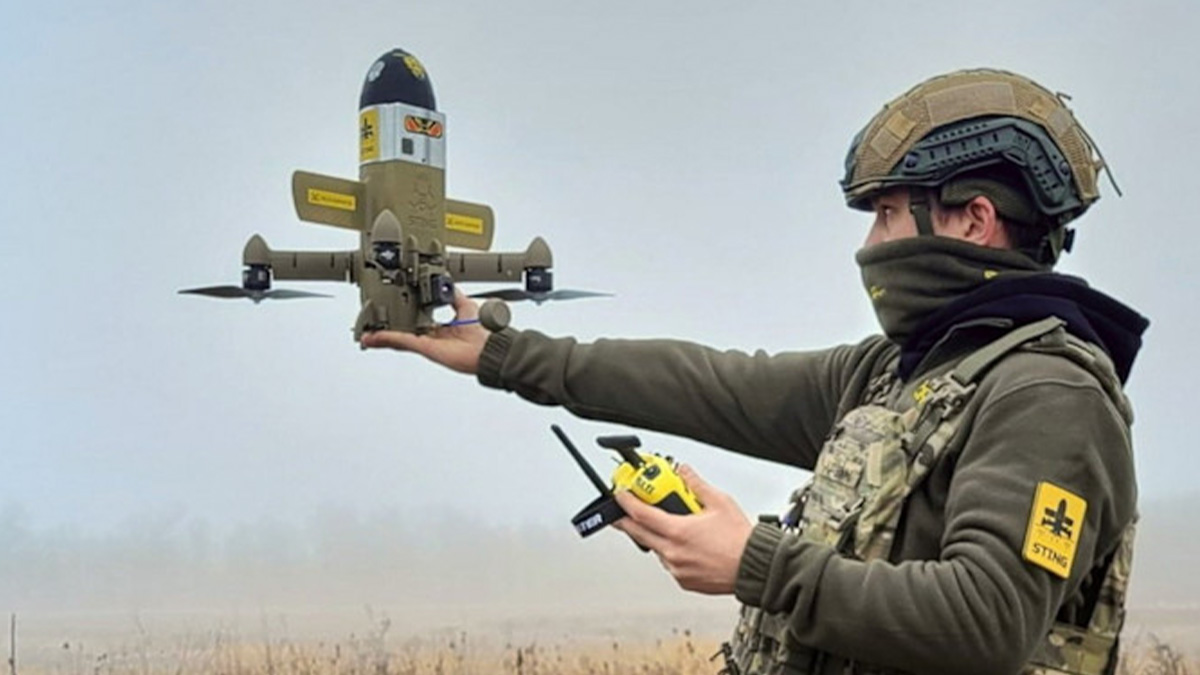
Over time, Ukraine has built a cheaper layered response that includes detection networks to help locate, identify and track drones, alongside domestically produced low-cost interceptor drones in the sky and machine guns on the ground. Internationally supplied missiles like Patriot systems are largely reserved for Russian ballistic missiles.
Roy Gardiner, an open-source weapons researcher, tells Independence Avenue Media that Ukrainian interceptors can cost between $800 and $3,000. This can “dramatically improve the cost calculus” and can be supplied in much greater volume, he says.
Private sector tensions
There is also a broader commercial and strategic opportunity here. Ukraine wants to turn battlefield innovation into foreign partnerships, defense-industrial growth, and eventually export revenue.
Mark Savchuk, advocacy manager at the Ukrainian NGO PR Army, tells Independence Avenue Media that “Iran has effectively become a marketing campaign for Ukrainian drone technology.”
But that has created some tension inside Ukraine’s wartime drone economy. Defense analyst Olena Kryzhanivska tells Independence Avenue Media that Kyiv cannot afford to spare large quantities of interceptor drones while Russian strikes continue at home.
And Zelenskyy complained in a March call with journalists that Ukrainian firms have already built “about 10 factories” abroad without Kyiv’s knowledge — a sign that foreign demand may be emerging faster than Kyiv can fully control.
But with the drone industry growing quickly, it may now be possible to produce enough to go around — particularly if Ukraine gets something in return.
“At current production levels, Ukraine could supply on the order of 50,000 interceptor drones without compromising its own defense,” says Dmytro Kavun, co-founder and president of Dignitas Ukraine, a U.S.-based nonprofit that focuses on defense technology innovation in Ukraine. “With additional investment and scaling, that number can grow significantly.”
Gardiner, the open source researcher, says about 1,000 interceptors a day would be reasonable.
Zelenskyy has said that the state should retain control over arms exports so priority is given to Ukraine’s Defense Forces before foreign customers. It may be reasonable for the government in Kyiv to coordinate production so that frontline needs are met. The danger, however, is that the state ends up playing favorites, potentially creating inefficiencies in the private sector by preventing some firms from exporting even when they are able to do so.
Exporting ‘expertise’
Ukraine, though, is also exporting something less tangible: battlefield knowledge. As Jon Sweet, a former U.S. Army intelligence officer, puts it, “Their innovation and adaptation — through tactics and weapons development — has made them a valued commodity in today’s drone warfare environment.”
Bryan Pickens, a former U.S. Army Green Beret who fought alongside Ukrainian special forces, tells Independence Avenue Media that the skills Ukraine has developed are as important as the technology.
“We need Ukraine to help professionalize Western warfighters — to teach them how these systems are used and how to defend against them,” he says. “Ukraine could supply a large number of interceptors, but that alone does not solve the problem if the receiving side does not know how to use them.”
Zelenskyy, who has also recently visited Kuwait, Jordan and Syria for defense talks, has said that he sent about 200 anti-drone specialists to the Middle East following the start of the Iran War.
Whatever the specifics of the deals, for Ukraine the benefits are obvious. Deeper defense ties with the Gulf could help finance the war effort against Russia, strengthen the defense industry, and lay the groundwork for a postwar role for Ukraine as a serious exporter of drones and counter-drone systems.
And states that once saw Ukraine mainly as a recipient of defense aid are now treating it as a provider of security expertise.