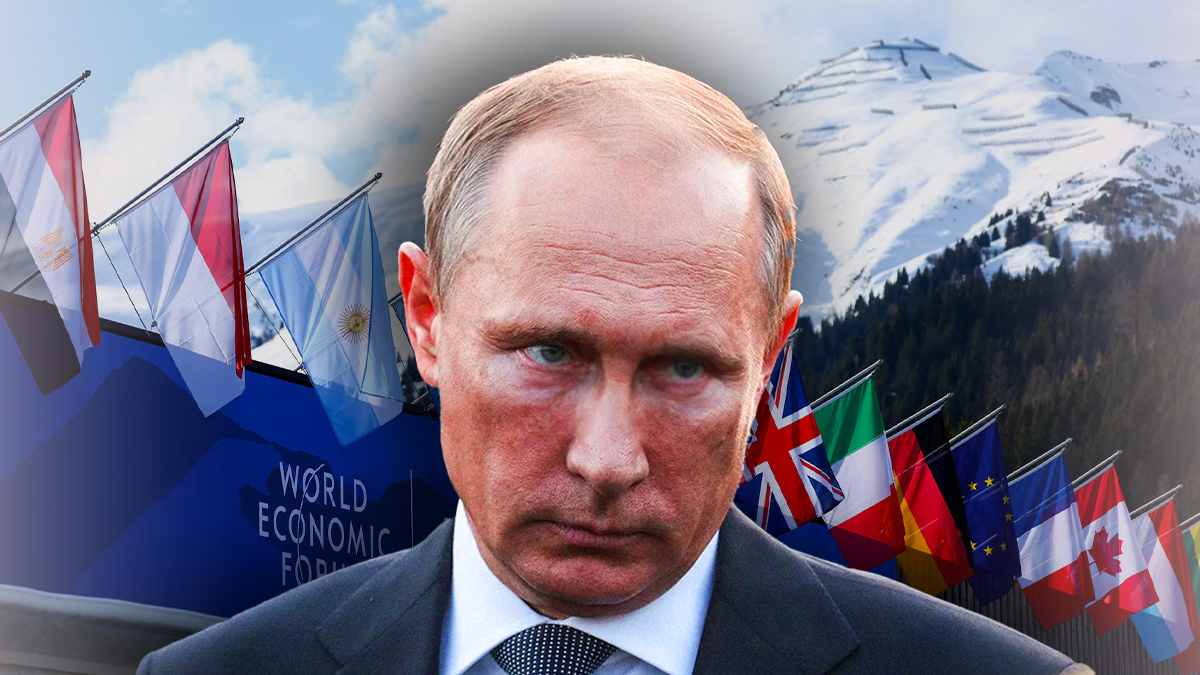
In 2000, an American journalist at the World Economic Forum’s annual meeting in Davos, Switzerland, asked a simple question about the man who assumed the Russian presidency weeks prior: “Who is Mr. Putin?”
In the 10-plus years that followed, the answer to that question went something like this: Putin is a Davos man, the leader of a booming economy whom everybody wants to strike a deal with. Every year, Russia’s top government officials and leading businesspeople showed up for the Swiss Alps gathering.
Not anymore.
Twenty-six years later, Russia is in the midst of its disastrous war in Ukraine, its economy is under heavy Western sanctions, and the only deal with Russia anyone is talking about in Davos is a peace deal with Ukraine.
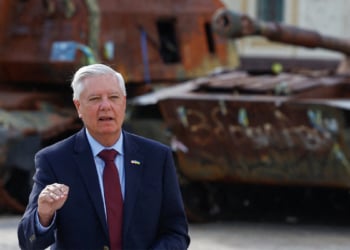
“Look, Vladimir Putin is a murderer. He’s a liar on his best day. And what we are seeing in Ukraine are his worst days. … You can’t trust him,” said U.S. Senator Thom Tillis, speaking on the Davos stage this month.
“Beyond Ukraine and the United States, we also have to have eyes on it from NATO allies, particularly those in the area, to make sure that we have a lasting and fair peace,” the North Carolina Republican said. “But I think we have to look at everything that Vladimir Putin says and run it through a truth filter because he simply can’t be trusted. So this agreement has to be very specific, and there have to be consequences for violating it,” he said, referring to a potential peace deal for Ukraine.
Tillis was scathing in his assessment of Putin: “Russia does want to re-create the empire. Putin is afraid of losing relevance. He’s losing relevance because he’s a failure, and he’s failing the Russian people. He’s failing in Ukraine.”
This year in Davos, hundreds of political leaders discussed Russia without anyone from Russia involved. The question was: how to deal with a country that is no longer a partner but rather a threat to everyone in the room?
The spotlight then moved from Moscow to Russia’s neighbors, who warned attendees about what Putin and Russia might do next — or even might do to them.
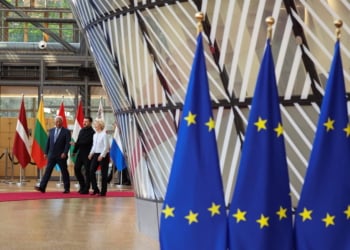
“I would like to move away or to push away the illusion that if the peace deal will be done — I hope it will be, sooner or later -— Russia will refuse to have imperialistic ambitions,” Lithuanian President Gitanas Nausėda said.
“I don’t see any signals that it might happen, because the Kremlin’s regime is as it is,” Nausėda continued. “And even the change of the Kremlin’s regime probably will not mean radical changes in the policy of Russia, because from time to time, I hear what the Russian opposition leaders are talking about. Actually, they are presenting the same ideas, and those ideas are first of all the expansionist policy of Russia.”
Hard times ahead for Russia?
With Russia absent from the room, Davos delegates discussed the state of its wartime economy. Russia’s neighbors, including European Union members, have supported crippling sanctions against Moscow.
But the Russian economy did not collapse; instead, it enjoyed a moderate wartime boom. The ruble strengthened by approximately 44% against the U.S. dollar in 2025, and Putin is still able to finance his war in Ukraine. That all may start to change this year, however.
“The information we receive is of course not very encouraging for the state of the Russian economy,” President Nausėda said. “And I think the Russian economy is deteriorating and has had a lot of macroeconomic problems and disbalances.”
Nausėda went on to say it was only a matter of time before Russia experiences stagflation — a combination of economic stagnation and high inflation.
Russia’s key interest rate is at 16%, down from 21% a year ago. The International Monetary Fund predicted this month that the Russian economy would grow 0.8% this year — compared with 4.1% in 2024. In contrast, for 2026, the IMF forecast U.S. growth at 2.4%; China, 4.5%; and Ukraine, 4.5%.
Moldova on edge
Leaders of the countries bordering Russia have called on the EU to keep piling on sanctions, but as Moldovan Prime Minister Alexandru Munteanu said at Davos, the impact on Russia’s aggressive posture may not be quick.
“It’s not the question whether it’s going to collapse. The question is when it’s going to happen, a question of timing,” Munteanu said. “And I’d say that in the case of Russia, if we look deeper, Putin has a very unique type of population which is very docile and at the same time very supportive.”
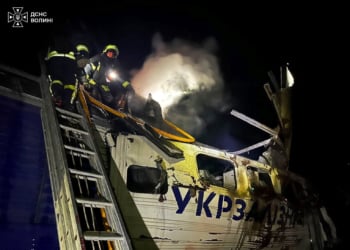
Moldova is feeling heat from Moscow: The Kremlin attempted to interfere in the Moldovan elections just a few months ago — a widely accepted claim that Russia denies. Russian missiles and drones bound for Ukraine have also repeatedly violated Moldova’s airspace.
U.S. Senator Tillis underscored at Davos the importance of protecting Moldova against potential Russian threats, noting that Russia’s success in Ukraine immediately threatens Moldova and the Balkans.
“We have a relationship with Moldova,” Tillis said. “Thank God they won the elections there. Russia tried to do everything else through hybrid warfare that’s occurring across the globe. They did everything they could. It’s a very positive sign that the Moldovan people got what they wanted out of their election.”
Targeting Belarus
Another country talked about in Davos this year was Belarus, Russia’s close ally in its war against Ukraine. Exiled pro-European democratic leader Sviatlana Tsikhanouskaya represented Belarus at the meeting.
Although the U.S. had held talks with Belarus’ authoritarian president, Alexander Lukashenko, last year, resulting in massive releases of political prisoners including her own husband, Tsikhanouskaya called on the West to stand firm and impose more sanctions on her country to stop the war.
Lukashenko did not release people because he suddenly became humane, Tsikhanouskaya said. “He does this because sanctions do work and isolation works.”
She warned that lifting sanctions against the Belarusian regime would only strengthen Russia: “When we are talking about weakening Russia, we don’t need to forget about the countries that are supporting Russia in this war. And Lukashenko’s economy is definitely working for Russia,” she said.
“About 200 Belarusian enterprises are producing military stuff for Russia’s war,” she said. “Most Russian missile complexes use Belarusian chassis. Belarusian banks are used for military contracts. So it’s very important to harmonize sanctions against the Belarusian regime and Russia to avoid usage of these loopholes.”
Lithuania’s Nausėda agreed with Tsikhanouskaya that the West needs to — in his words — “punish” Belarus the same way it punishes Russia.
“You can imagine: They are producing enormous amounts of guns, ammunition, equipment — and do you think they will leave those goods idle when the peace deal is over? I don’t think so, because we know the origin of Russia, know their ideas, the messianism idea first of all, and I think it is a matter of concern. This is a problem not for the next one or two years. It might be the problem for the next 10 years,” Nausėda said.
Emergence of Ukraine
If that pressure on Belarus works, Tsikhanouskaya hopes to be back in Davos someday to represent the free and democratic Belarus. The same hope was harbored once by former member of the Russian parliament Ilya Ponomarev, who attended Davos in Russia’s boom years and later became the only Duma member to vote against Russia’s annexation of Crimea.
Ponomarev fled Russia soon afterward, leading various anti-Putin initiatives. He visited the forum in Davos this year, and Independence Avenue Media caught up with him in Washington later to ask him how the perception of Russia has changed.
He described how Russia, formerly a Davos darling, now was the forum’s ghost — still much talked about, but mostly in terms of how to negate Moscow’s harmful moves.
“It is a threat, and as a threat, it would affect world prices. It would affect policies of particular states. It created the whole new market of defense tech worldwide. It fuels a lot of cryptocurrency transactions. It affects global drug trafficking,” Ponomarev said. “So Russia today presents a lot of factors of influence in everyday life all across the planet, with just one minor remark: This influence is not positive.”
In the years since he fled Russia, Ponomarev became a Ukrainian citizen and now wears the same green sweatshirt made famous by Ukrainian President Volodymyr Zelenskyy. Now that Russia has faded from Davos, the attention has moved to Moldova and Belarus, and even more so to Ukraine, which Ponomarev says is becoming the stable Western partner that Moscow aimed to be.
“Ukraine is no longer a passive victim, is no longer a passive factor, is no longer an object — but it becomes more and more of a factor and a subject of global politics. Everybody understands that Ukraine right now possesses technologies that can help Baltic countries, that can help Eastern European countries to defend themselves against Russia,” Ponomarev said.
Observers noted this was possibly the most watched Davos forum in 20 years. And as Russia is no longer in the limelight, other former Soviet countries – now independent states – are keen to break from Moscow completely and take their own space.
You may also like: Ukraine Is the Tip of the Spear: Matt Pottinger on Deterrence, US-China Relations, and What Comes Next