
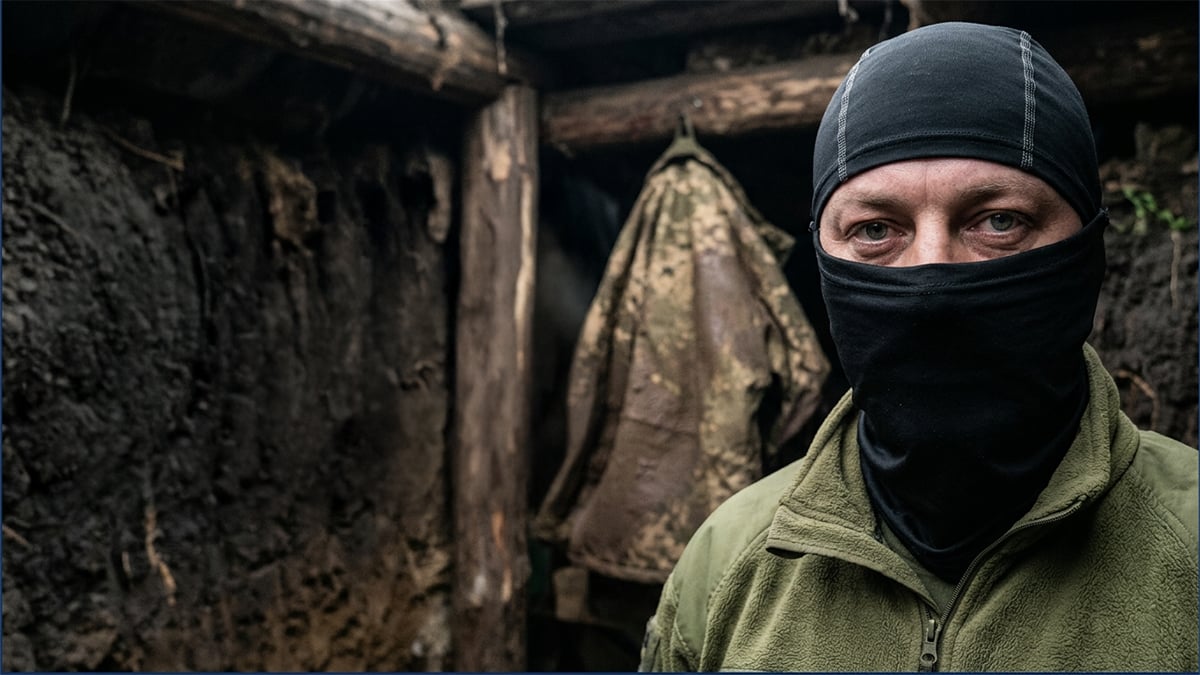
A day on Ukraine’s front lines is not just about mortars and missiles. In exclusive video for Independence Avenue Media, six Ukrainian soldiers show it’s also about contending with mud and mice, preserving adequate supplies of food and water and maintaining mental health.
“You’re under constant stress,” says one of the soldiers, a young man identified only by the call sign “Balu” for security reasons. “Sometimes you just want simple things. You want something hot to drink, something hot to eat. To sleep in a normal bed.”
Nothing about these soldiers’ living conditions, filmed over several weeks at an undisclosed front-line location, suggests “normal.” The men are mostly volunteers who have been fighting since Russia’s full-scale invasion began in February 2022. During the autumn rains, which turn roads into seas of mud, they routinely scoop mud and water out of the dugout where they live. They have nowhere else to dry off.
“When it rains, our clothes take more than a day to dry. When they’re covered in mud, we just shake it off and put them back on,” says Balu, his face concealed by a black balaclava marked “Kansas.” “If they don’t have time to dry, of course, we wear them wet.”
And once the mud dries out, the mice move in, seeking a warmer, drier residence with easy food. “Whatever you didn’t hide, the mice eat,” says Balu.
In a combat zone, that’s not a minor threat. The drones, unmanned ground vehicles and trucks that deliver food and water to troops are all potential Russian strike targets. In April, photos of emaciated front-line soldiers led to investigations that revealed food-supply failures in four brigades.
Independence Avenue Media’s footage does not depict such problems. When this video was shot, the six-man unit had a week’s worth of frozen beef, veal, fish and “a little chicken” as well as sauerkraut, processed meat, grain, pasta, sugar and canned goods. Their supplies are replenished weekly. The soldiers themselves must supply pick-me-ups like chips, cookies, candy and additional coffee.
Preserving that food is a challenge in a dugout with no refrigeration and limited space. Some mouse-accessible goods, like potato chips and cookies, are stacked on wooden shelves, with pears, apples and oranges in open containers on the ground. An unheated corner with deep shelves doubles as a refrigerator for bags of frozen food. To avoid spoilage, the soldiers say they eat the meat as soon as they can.
The men joke that these supplies make a “festive meal” when they are not fighting. The surrounding woods can help diversify their meals. They provide wild mushrooms and herbs for the typical Ukrainian dish of pan-fried mushrooms and potatoes, cooked on a portable gas canister, which gives off less heat than an open fire and is harder for Russian thermal sensors to pick up.
They Were Forced to Sew Russian Uniforms In Captivity — Now They’ve Started A Clothing Brand
Water for washing cookware — or for soldiers to drink and to keep clean — is restricted. Bottled drinking water is rationed to 1.5 liters (51 fluid ounces) per soldier per day in fall, but soldiers sometimes must use that to wash themselves, too.
“S]oldiers try to use one bottle of water to wash themselves once a day, or every three days, or whenever possible, even every five days,” explains Balu.
Empty military ammunition containers are used to store rainwater in case bottled water supplies get too low. Since October, the military has been giving troops water-purification tablets in their field-ration kits for such situations.
Balu says that when possible the six soldiers work out regularly with kettlebells or pull-up bars and parallel bars made from tree limbs. “We try to stay in shape,” he says. “Mentally, it makes it easier.”
Thoughts of home, though, persist. “You miss everything. You miss your child going to kindergarten, going to school, starting first grade. You miss some of their achievements. You can’t help your wife with even the simplest things,” Balu explains. “And of course, no one will ever give us that time back. But we know why we’re here.”