
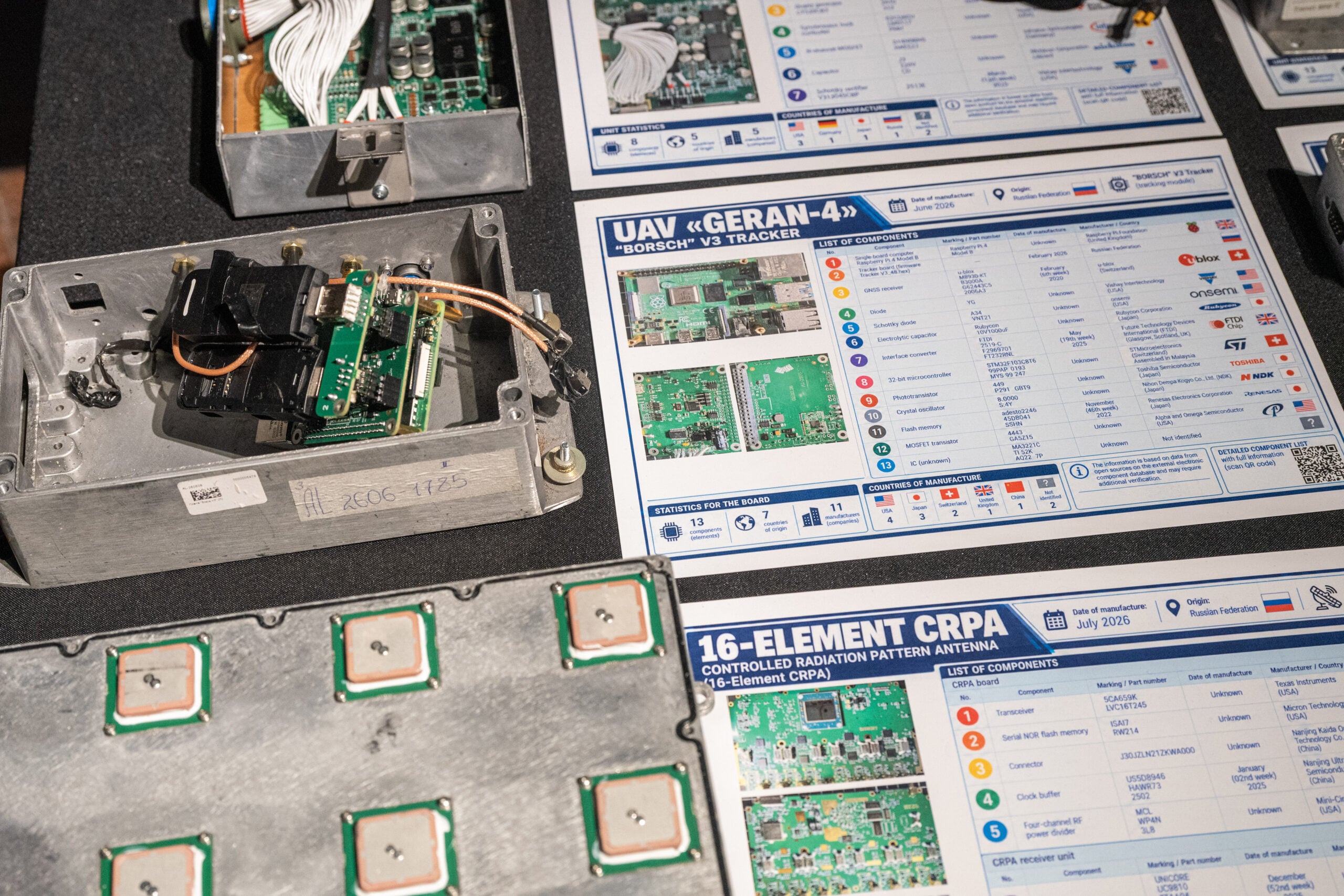
As Ukraine heads into the fifth winter of Russia’s full-scale war, Kateryna Bondar, a senior fellow at the Center for Strategic and International Studies (CSIS) and a former adviser to the Ukrainian government, says the drone attacks on its cities have become more sophisticated and nearly nonstop.
Russia now combines slow Shahed-type drones with faster jet-powered ones and missiles, in waves large enough to exhaust Ukraine’s air defenses.
Russia has realized it cannot win on the battlefield, so it is trying to destroy Ukraine from within by targeting its economy, logistics and energy system, and by putting psychological pressure on the population, Bondar says. According to her analysis, Russia’s Geran drones receive a major technological update roughly every 90 days. She says about 70% of the electronics in Russian weapons come from Western companies and reach Russia through third countries.
The same supply chain, Bondar argues, explains the stalemate. Russians and Ukrainians, she says, “are eating from the same bucket,” buying the same Chinese components and assembling the same drones, so nobody has an advantage. She describes China as one of the biggest beneficiaries, because the orders show it what is in demand and how the technology is evolving. In her view, the U.S., which keeps Chinese parts out of its military, has to build its industrial base from scratch, a challenge she calls doable but one that takes time and investment.
Bondar also assesses Ukraine’s interceptor drones, calls the Pentagon’s drone program only a partial solution, says Europe is not united in its response, and expects the next major shift in drone warfare to be toward autonomy.
This interview was recorded on Oct. 28, 2026, and has been edited for length and clarity.
Kartlos Sharashenidze, Independence Avenue Media: Kateryna, as Ukraine heads into the fifth winter of Russia’s full-scale war, what worries you the most about the latest wave of drone attacks?
Kateryna Bondar, senior fellow with the Wadhwani AI Center at the Center for Strategic and International Studies (CSIS): The drone attacks have, of course, accelerated, and they have become more sophisticated and basically nonstop, especially in big cities such as Kyiv, Odesa, Dnipro, Kharkiv, basically all the big cities of Ukraine.
Russians now employ an even broader variety of systems, and they combine different types of weapon systems together. Previously, these were just the usual slow drones. Now they’re combining them with jet-powered drones, which are much faster, and of course these attacks are combined with cruise missiles and ballistic missiles. All these attacks come en masse, they are very massive, which means they exhaust Ukrainian air defenses, and it’s really hard to intercept some of the incoming threats. That’s partially due to new technical challenges, such as the increased speed of the drones, but also due to the absence of interceptors, due to political reasons.
IAM: Let’s take a step back and look at how we got here. Russia began using Iranian-designed Shahed drones back in 2022 and now produces its own versions under the Geran name. How different are today’s Gerans from those early Shaheds?
Bondar: Russians are very strategic about their approach to the Shahed/Geran type of drone. Yes, they did buy the technology from Iran, of Shahed type drone, but since then they have localized production of many components and replaced many of them with Russian systems.
They established separate production lines for this type of system, actually two. One is in Alabuga [in Tatarstan], which everyone is talking about, and the other is in Izhevsk [in Udmurtia]. These are two parallel production lines, which also has its benefits.
But in fact, they have been working on different parts of the system and kept iterating and improving them in an answer to improvements from the Ukrainian side, improvements in electronic warfare, improvements in tactics of air defenses, improvements in scale of Ukrainian air defenses.
The major, crucial thing that Russians improved is the communication system. It is very important because when Ukrainians developed electronic warfare and they can jam a signal between a drone and operator in Russia, it becomes uncontrollable. A communication system is crucial. The navigation system is crucial for a drone to orient in space and understand where it is and follow the path which it was assigned and route which was given.
The Russians worked on technological developments, but also on tactical implementation. First, the drones were flying directly — their trajectory was straight and very predictable. It was easier to intercept them. Then they started to turn and maneuver. Then they changed their altitude because previously they were flying quite low, and you could just shoot them down from a machine gun.
But in answer to the increase in the number of Ukrainian air defense groups and mobile air defense groups, the Russians started to fly these drones at higher altitudes, where machine guns couldn’t reach them, and they were just diving on the target.
It’s a constant cat-and-mouse game. Unfortunately, it’s war, it’s not a game, but this is how innovation happens, this is how iteration happens. Each side comes up with something new and a countermeasure to a new measure from a different side.
Our analysis has shown that iteration — a major update in technology from the Russian side happens every 90 days. Every three months we have a major improvement of the system.
IAM: How much of a difference are these improved Gerans making for Russia on the battlefield? How important is this advance to its war effort?
Bondar: I think it is a major improvement and a major weapon system that Russia is betting on because Russia realized right now that it cannot win on the battlefield. It cannot capture the country on the battlefield in a conventional war.
They changed their military strategy to destroying the country from inside, destroying its economy, destroying its logistics, transportation system, energy system, and also putting huge psychological pressure on the population. When you’re living constantly under attacks, it’s hard not to fall into depression, and it affects people a lot.
The Shahed drone — now they’re called Geran, the Russian version of Shahed — is one of the major, crucial weapon systems in this new strategy. That’s why Russia also has made a bet on mass production, because one drone doesn’t make a difference. But if you produce them en masse and you send them in waves, this is where we see a big difference.
IAM: What does it take for Russia to mass-produce these drones? Western sanctions should make it harder for Russia to develop and produce them during the war, right? Who is helping Russia with technologies and components, and how much can it produce on its own?
Bondar: It’s hard to say how much Russia actually produces on its own because this ratio constantly changes. As you rightfully mentioned, sanctions should work, but unfortunately, we see almost 70% of components in Russian weapon systems, including Geran drones, come from abroad.
There is a big portion which comes from China. Initially it was Iran, so they were producing from Iranian components, then China. But the most crucial and important components which are responsible for navigation, communication and system operation are electronic chips, and they all come from the West.
We see that almost 70% of electronics of memory hardware comes from Western companies. This is U.S.-headquartered companies, Switzerland, Japan. It’s a big issue. But it doesn’t mean that these countries supply directly to Russia. As you mentioned, there are countries which help to bypass sanctions and these are mostly post-Soviet countries, a lot of things going through Hong Kong and Russian allies in Central Asia, the post-Soviet space, such as Kazakhstan, Turkmenistan and also with the help of China.
IAM: Ukraine says it’s getting better at stopping some of the faster, jet-powered drones. What is starting to work? Are the new interceptor drones making a difference for Ukraine?
Bondar: Ukraine is trying to come up with all sorts of different solutions. It doesn’t mean that Ukraine focuses only on one solution, such as drones or interceptor drones, because it’s a Western model of innovation where we have a lot of companies, we have a lot of startups, and they come up with their own solution. Basically it’s like a free-market competition, which gives an advantage because you have many more ideas, creativity, and innovation. I think whatever works best, Ukraine will just start buying at scale and producing at scale.
And, of course, one of the major streams is interceptor drones — quadcopters which can fly faster, but unfortunately, they cannot fly for a long time because of the battery limits. But Ukrainians are also experimenting with jet-powered interceptors: the same technology but smaller and they’re trying to make it cheaper because in this war the price tag also plays a major role when we’re talking about mass production and large-scale production.
So, different types of interceptor drones; there are also innovative things like small missiles, which companies are also trying to make small, trying to make cheaper, so they’re comparable in price with the target itself. We don’t intercept a $50,000 Shahed drone with a $3 million missile.
And there are new things — maybe not so new, but they’re entering into operations — such as laser systems and other systems that I don’t want to discuss yet but I think we won’t find one single solution. It will also be a combination of different technologies deployed maybe in layers or altogether, but it’s hard to find one game-changer or silver-bullet solution. I don’t like these words, but this is what many people are expecting. I don’t think that is going to come anytime soon but a different combination of interceptors and air defenses probably will solve the problem, and I hope quite soon.
IAM: And, Ukraine has had striking success with its own drones, including strikes deep inside Russia. You mentioned the differences between the Ukrainian and Russian drone industries. In Ukraine, there are small, family-owned companies working on drones. More broadly, how has Ukraine built up its drone capabilities during the war, and where do you see its development heading next?
How Small Businesses Help Build Ukraine’s Drone Arsenal
Bondar: I think we will see a consolidation of the Ukrainian defense industry because, as you rightfully mentioned, we have a lot of manufacturers. On the one hand, it gives you a choice of innovation and solutions, but on the other hand, nobody can scale. When there are so many manufacturers, the military cannot buy equally huge amounts from everyone.
That’s why companies have already started to merge with each other.
Also, we will see consolidation across domains, which means companies which produce aerial drones will probably buy companies which produce ground systems or maritime systems. That would allow them to make systems for cross-domain missions and would allow these systems to be interoperable with each other and talk to each other and work together in one mission.
So, I think that’s a trend that we’re already seeing. I think it will just accelerate in the near future.
Everything is moving into a robotic, machine-operated future where we will see more autonomous missions across domains.
IAM: You said that in Russia’s case there is a major improvement every 90 days. What is the update cycle for Ukraine?
Bondar: I think it’s really hard to say about an average iteration cycle because systems are very different. If we’re taking a quadcopter, a first-person-view drone, this small little drone, and comparing it with a long-range striking capability or a missile that Ukraine is developing, these are very different systems.
Even in small systems where it seems like they’re simpler, they’re easier to change, if you look at the quadcopter drone, it hasn’t changed since the beginning of the war or since it came from the drone-racing industry.
So, it’s hard to say.
I would say that we should narrow down this competition and iteration cycle to certain aspects of innovation where it’s happening, such as the communication system, for example: fiber-optic drones, radio connections, frequency hopping, using Starlink for connectivity. It’s all about connectivity, and it’s all about keeping communication between a drone and operator, and this is where we see a lot of experimentation going on, not in air design.
As Starlink Falters for Ukraine, Russia’s Rival Rassvet Network Is Already Flying Over the Front
So, I think we should look into different types of drones, and it’s really hard to say what’s the average innovation cycle. It happens fast, and it varies from sometimes a couple of weeks when we update software to half a year or a year, a cycle when it comes to really more complicated systems, hardware together with software, et cetera.
IAM: Coming back to China, you mentioned its role in helping Russia produce these drones. But China is also learning from both sides of this war. What are the biggest lessons it’s taking away, and how is it using them to improve its military and drone technologies?
Bondar: We have to understand that what China is learning, what China is trying to implement, depends on what current strategy, military strategy, it has. That is what defines it.
The takeaways that we see: they’re working on unmanned systems. They’re trying to solve their own problems through this technical solution. By that I mean that historically, the Chinese military has been very army-centered. It was a ground force. Now they’re trying to develop a joint force, which means ground forces can work with the air force and then collaborate with maritime, naval forces. That’s one of the biggest challenges for China, and it uses unmanned systems and deploying them in different domains to create this joint force. That’s one thing.
The second thing, which they obviously see, is scale of production and mass production of all types of unmanned systems. This is where they understand they have a huge advantage already having this industry in place.
But they also understand that most probably their competitors will try to come up with asymmetric answers because nobody can compete with China en masse production. So, they’re trying to develop capabilities which are able to counter unmanned systems also at scale, or maybe they’re trying to come up with a hypothesis about what the answer of the West to mass production and mass deployment of unmanned systems could be, so they can be ready.
What China is very good at is translating what they see directly into actions, not just analyzing the lessons learned, but directly implementing it. We can see innovative tactics which happened on the battlefield not so long ago directly implemented during their exercises and trainings.
They conduct exercises with Russians and learn from Russians. They use tactics which they see — not only technology, but also tactics — and they’re trying to update their doctrine. They understand where their weaknesses are in terms of very rigid hierarchical structure of the force and of the military, and they’re also trying to figure out what they can do about that. They understand that they would need more agility if they face the conflict.
So, the Chinese are also very strategic about it. Their advantage is that they are able to transition fast from what they see into what they do. This is what we’re lacking here in the West, unfortunately.
IAM: Let me ask you about U.S. drone strategy. But, before that, you were at a U.S. Army conference in D.C. about two weeks ago, where, if I remember correctly, Secretary of Defense Pete Hegseth said that the U.S. military has learned a lot from Ukraine but can’t adopt everything Ukraine uses, because of the Chinese components involved. We also see Chinese components in Russian drones. What does this mean for China, and what does it mean for the U.S.?
Bondar: For China that means that they’re one of the biggest beneficiaries of this war because, as both Russians and Ukrainians are saying, they are eating from the same bucket. Basically, they’re buying the same components and assembling the same drones from Chinese [components]. That’s why we have this stalemate on the battlefield, because nobody has an advantage because everyone uses the same kind of technology.
What Chinese learn from this and how they benefit: they can see from procurement and from these orders what is being used, what is being ordered, what’s in demand. They can actually analyze, they get a lot of data, and they can project — at least see a more clear picture of technology components that are needed, where improvements are happening. Because, it’s not only one way, like Ukrainians and Russians are just buying what Chinese are making. They are making orders, and they are ordering improved components, a little bit different design, and that gives Chinese a lot of information on how technology evolves and develops.
At the same time, the United States doesn’t have this opportunity, but what is clear and obvious is that you cannot be dependent on China. That’s why we have all these policies: no Chinese components and nothing Chinese in the U.S. military. Which obviously makes sense, but it also poses a new challenge for the U.S. military because you have to build your military-industrial base from scratch for this new type of warfare.
I’m not saying that it’s impossible. It is possible, it is doable. It just requires time, a lot of investment, and a lot of pragmatic approach to what exactly you have to build and in which amount and scale.
So, it’s a big challenge for the U.S. industry in general, for the U.S. military. But maybe it’s time to rethink independence in terms of components and manufacturing and raw materials, where they come from, and restructuring supply chains to enhance homeland security and economic security as well.
So, it’s a stress test for both economies, who stands where and basically It gives a chance to understand what has to be improved to be more independent and secure.
IAM: Could you please tell us more details about the Pentagon’s new Drone Dominance Program? What is it trying to achieve, how does it work, and how much has Ukraine’s experience changed the way the U.S. develops drones today?
Bondar: First of all, the appearance of this program is already a result of a Ukrainian war because previously nobody even had an idea that we need drones at scale. It exists, it appeared, it’s already a big achievement.
And, yes it has quite a big budget. I mean, maybe in terms of the U.S. military it’s not so big, like $1 billion, but still it sends a signal to the industry that this is something that the Department of War really needs.
The goal of the program, and this is what is important, is to actually start procuring drones at scale but I would say that it solves the problem of drone warfare and its integration into the military just partially. So, it’s a partial solution because to buy a system is not enough. You need to know how to use a system, you need to have trained operators, you need to have trained force, you need to change your force structure, you need to update doctrine, tactics, education, maintenance — a lot of things that are built around a system.
And, this is where the program is kind of lagging behind because it’s aimed at just procuring systems and somehow distributing them within the military, within different services. But it doesn’t solve the problem of what happens next.
Without this, these drones will never convert into advantage on the battlefield because these are just pieces of equipment which are lying unboxed right now. I know the Department of War is trying to address this issue by establishing Task Force Easy. Just a couple of weeks ago I heard an announcement, and from what I heard it’s specifically targeted at solving these problems of integration, which is a good sign.
So, I think we’re getting there, but a little bit in a fragmented way. We have different initiatives which we have to align, and we should understand where we’re going.
IAM: What about Europe? How well are the European countries using all this experience Ukraine has and developments for their own drones and defense?
Bondar: You ask me a hard question because, first of all, it’s hard for me to talk about Europe as a whole because Europe is not united around this issue. Everyone, at least, they say that they realize the threat and they understand the need, but we see very different actions across all countries, and some are more decisive, some are less decisive. I think it depends on the distance from Russia and from the actual battlefield. The further, the less they’re concerned. But I don’t want to generalize.
Broadly, we see that Europe increases defense spending. But again, how that defense spending translates into actual procurement or developing defense industrial base, how it is independent from the U.S., how the integration piece is solved — it’s very different across Europe.
I would just say that probably Germany is somehow championing this process because I see a lot of startups coming from Germany. Some of them are really big, and they are present in Ukraine, which is important because you need to integrate lessons learned from Ukraine and operational experience into developing systems. These companies expand to the U.S. market. That’s where I see the most vibrant startup ecosystem.
However, in other countries, like in Poland, there’s a lot of things going on, in Estonia as well. Governments are working through cutting the red tape for the industry.
It’s really hard to say, on average, what’s going on in Europe. I see that Europe is moving toward updating its defense through spending, through developing a startup ecosystem, but I still don’t see a really decisive intention to update the military. That’s what’s important.
Unfortunately, I think in this or that way, form or type, all Europe is already at war with Russia. It can be a hybrid war, but it is already a war, and not everyone realizes it.
When you’re in a state of war, and to be resilient as Ukrainians in a broader sense, you need not only work with the military, but it has to be the whole-of-society initiative. As we see on the Ukrainian example, it doesn’t touch only people sitting in trenches on the battlefield. It touches the whole society, and everyone will feel the consequences.
I think Europe should take this threat seriously and start preparing their societies to be resilient, to be aware, to be ready for any type of escalation and development of this situation.
IAM: What opportunities do drones give smaller countries to improve their defenses? And based on Ukraine’s experience, where should they start — what should they invest in, and how should they train their forces?
Bondar: Again, if anyone knew a perfect recipe or perfect playbook how to fight against the huge enemy, I think we could never even get to this point. But there are things that can be extracted, lessons learned from this war and what countries can do.
They can definitely send a signal to their startups, to their civilian engineers, it doesn’t matter what you call it. Leveraging talent from your population and start working on new types of solutions. We see what is working, what is needed.
Second, I think on the military side, militaries should exercise and train because when you don’t have this operational battlefield experience, the closest you can get is exercising using OPFOR [opposing force] and red-blue teaming and all that kind of stuff that brings you as close to this real experience as possible, so just in case something starts, you’re not fully caught off guard.
I think the training piece is really important because it sets everything from skills to mindset, and people start to adapt and take this kind of action more as a norm.
Also preparing a society and preparing public opinion to a potentially possible situation when there might be some sort of attack. It might come not only from rolling tanks across the border. It can be a cyberattack on infrastructure, and everything just goes off. You don’t have electricity, you don’t have heating, and that actually destroys the country’s economy from inside.
What people should do, how they should react. A lot depends on this first reaction. This is what we saw in Ukraine. Ukrainians didn’t give up, yes some of them were fleeing from Ukraine, which is understandable, but Ukrainians started to fight and resist. That shouldn’t be an exception, that should be a rule for any country, any nation which wants to stay free and independent.
IAM: This is my very last question. Over the next year, what development in drone warfare will you be watching most closely, and why?
Bondar: I think the trend that everyone is following and trying to follow is moving toward autonomy. By autonomy I mean this independence from communications, independence from any sort of help to understand where you are. I mean GPS, localization systems.
These drones will become more and more autonomous, which means you can just tell them what to do, and they will go and execute the mission without any human operation or any external support and connectivity that they need.
That’s a piece about drones themselves, but there’s also an important piece: how you control these drones, how you operate them. This brings us to a piece of software which helps to do that. It’s command-and-control software, situational-awareness software, and every drone is connected to it. You can first of all get information from them, but also control them by using this software.
It can also become more autonomous, where decisions are made by AI agents, and information is analyzed automatically. Doesn’t matter with AI or just algorithms, but it speeds up the process, it speeds up decision-making, and as a result it can actually transform this warfare into fully autonomous mode, where you have autonomous decision-making and then autonomous systems executing what was decided.
It’s a little bit scary, but for Ukraine, for example, it’s a matter of survival. Maybe this will give Ukrainians an edge and an advantage which can make a difference on the battlefield. We will see, but that’s obviously a trend that will dominate next year.