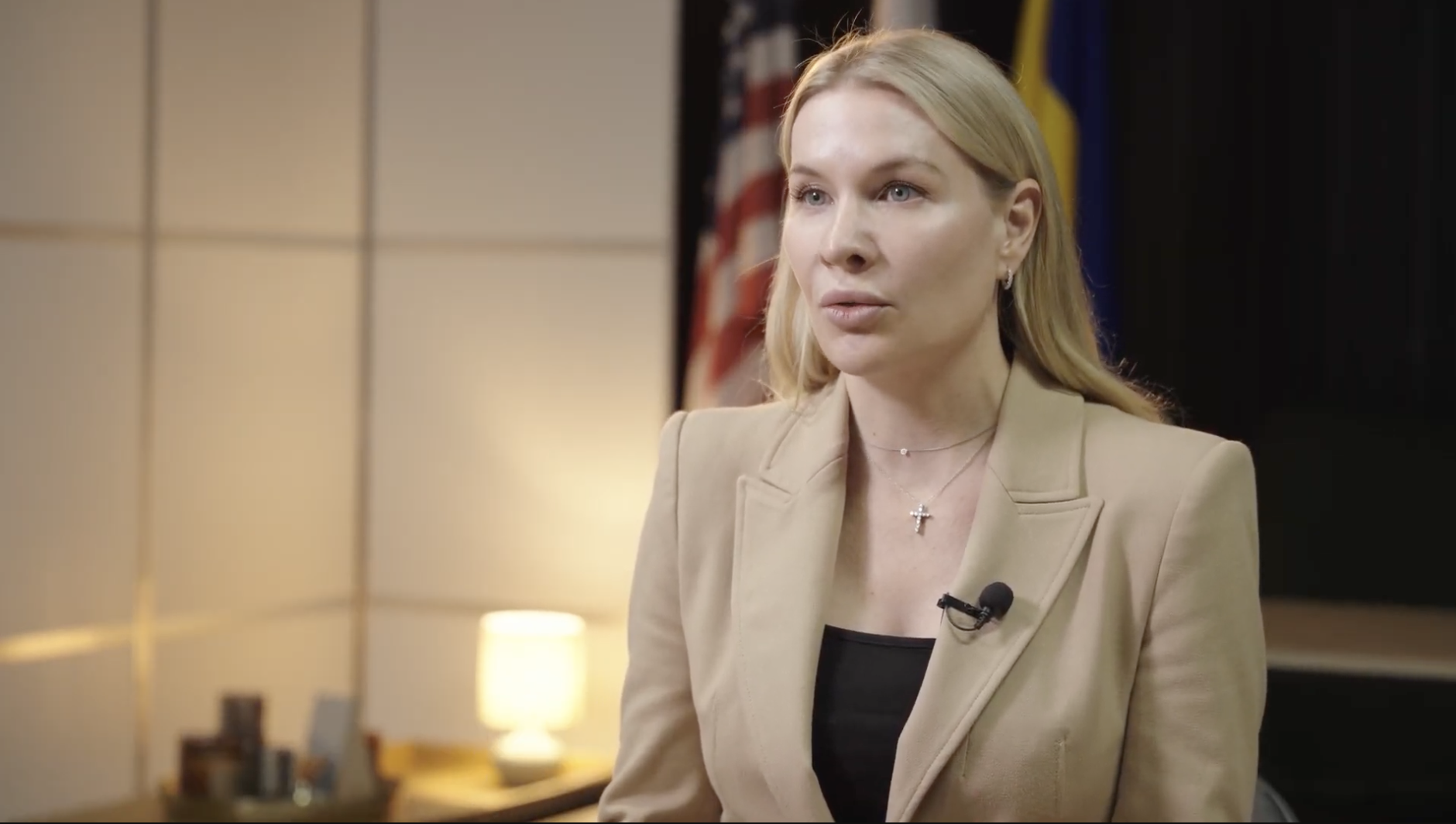
A continued deterioration in the relationship between Washington and Kyiv would be “extraordinarily damaging for Ukraine,” says Meaghan Mobbs, a former U.S. Army officer and president of the R.T. Weatherman Foundation, a U.S. nonprofit that evacuates Ukraine’s wounded, trains medics and repatriates fallen foreign volunteers.
“The reality is that there are no countries on Earth that can provide the type of intelligence that the United States can,” Mobbs tells Independence Avenue Media in Kyiv.
Since U.S. President Donald Trump’s Oct. 9 announcement of a diesel fuel deal with Russia and a subsequent sanctions waiver, Ukrainian officials have said on at least three separate occasions that the United States did not share intelligence in advance of incoming Russian ballistic missiles. The military version of SpaceX’s Starlink satellite system has also been restricted.
Mobbs, a clinical psychologist who is the daughter of former U.S. Special Envoy to Ukraine Keith Kellogg, says the United States loses as well if it does not continue to support Ukraine against Russia.
“If there’s a country stealing children, raping men and women, destroying the values that we believe in, persecuting Christians and destroying churches — if we profess to be a nation that believes in those things, what does it mean about us if we abandon them?” she asks. “We will have lost something that I do not think we will be able to gain back for many, many generations.”
But Mobbs says not to give up on the U.S.-Ukraine partnership — even if Ukrainian President Volodymyr Zelenskyy and Trump are not currently getting along.
“We obviously saw Zelenskyy and Trump come back from that Oval Office blowup. I think it can happen again,” says Mobbs. But, she adds, “irrespective of two men and their relationship, I believe in our countries.”
In the wide-ranging interview, Mobbs also tells Independence Avenue Media that Russia, Iran and China are in a “fight for the American mind.”
The countries, she says, want “to convince us that peace and surrender are the same thing, that there is nothing worth fighting and dying for, and that it is better to simply become a nation in decline than to be willing to make smart decisions to keep ourselves strong and prosperous, even if that means making some sacrifices.”
The interview was recorded on Oct. 20, 2026. It has been edited for length and clarity.
Anna Zynevych, Independence Avenue Media: It’s been more than 10 days since President Trump announced his diesel fuel deal with [Russian President Vladimir] Putin. He said he was doing it because diesel prices in the United States are too high. Has there been any significant benefit for Americans?
Meaghan Mobbs, president of the R.T. Weatherman Foundation: Obviously, I’m an American, and so I would lead with: it is tough for Americans right now. It’s tough for everyone, and the cost of fuel in particular is really harming our farmers, our ranchers and causing a lot of economic pain. But to your point, America is actually a net exporter of diesel. We have an extraordinary amount of energy independence, which is a remarkable thing. And so the reality is, even though diesel is a global market, this diesel deal is not going to systemically drive down diesel prices for Americans. We’re not going to see the benefit, either in the short term or the long term, given how much diesel we already have in our country.
IAM: Why do you think President Trump announced this energy ceasefire that neither Ukraine nor Russia agreed to?
Mobbs: First off, I want to lead with: well, Ukraine didn’t agree to it, but then they adhered to it — because Ukraine inherently is a country that keeps saying yes. And the reality is, if you keep being a country that says yes, it’s going to show everyone the country that says no every time, which is Russia.
I think the diesel deal was intended to be a concession, or a carrot, for Russia to get them to agree to the ceasefire. Unfortunately, diplomatic processes don’t work that way. When you have someone like Russia that’s known to just take rather than give, you can’t give them something and then expect them to do something on the back end. So I think, from a diplomatic sequencing perspective, this was extraordinarily backward. And we’re seeing the result, which is an immediate violation of the ceasefire that wasn’t a ceasefire. Russia immediately hit energy targets in Ukraine. Meanwhile, Ukraine refrained from doing so. And unfortunately, what then happened was a cascading diplomatic effect.
IAM: The relationship between President Trump and President Zelenskyy had come a long way. It’s been over 20 months since that blowup in the Oval Office. But over the past 10 days, it seems like the escalation between the two men is back on track. Do you think there can be any coming back from this?
Mobbs: I’m an inherent optimist. I think you can always come back from something. As long as cooler heads prevail, as long as we recognize that our shared interests — and by “our,” I mean Ukraine and America — are tied together, then I think you can come back from anything. We obviously saw Zelenskyy and Trump come back from that Oval Office blowup. I think it can happen again.
But I would just say that when I think of this war, when I think of this conflict, I don’t think of governments and I don’t think of heads of state. I think of people. I think of the Ukrainian people and I think of the American people. And what I know about the American people is they are unified in their stance behind and supporting Ukraine. They deeply believe in the cause of freedom and the cause of liberty. They deeply distrust Putin. They deeply distrust what he’s doing. And so, irrespective of two men and their relationship, I believe in our countries. I believe in the American people, and I believe in the Ukrainian people.
IAM: President Zelenskyy is now in a difficult position, because on one hand we see this lowering of sanctions on Russia, and on the other hand he’s been asked to stop hitting Russian oil production, which has been perceived in Ukraine as the main way to hit Russia back. What could be the best option here?
Mobbs: This is a difficult time for President Zelenskyy. I think there are no easy options, but I think there are smart ones. What I mean by that is that where President Zelenskyy can create space for himself is by what I said earlier: consistently being someone who says yes. America proposes an energy ceasefire? Yes, we’ll do this. That being said, he still has to wage a war on behalf of his nation. And so having to find a way to navigate those two things is extraordinarily difficult.
One of the net benefits of Ukraine being able to project power — which is exactly what they’re doing when they strike the refineries in Russia — is Ukraine’s ability to project power beyond the size of its country. They are absolutely within their rights, as a country maintaining its sovereignty, to do so. And as I said before, the math doesn’t math. What I mean is that it’s not the war here — it’s not Ukraine striking Russian refineries — that’s driving up diesel prices. It’s the war in the Middle East. So with that in mind, the way we’re going to get to a conclusion in this war is by Russia realizing it is more costly for them to continue than it is for them to stop.
That’s the only way we’re going to get to a peace deal. So my belief is that you have to keep striking. It’s the only way it’s going to work.
IAM: How damaging, in your opinion, could a break in relations between the United States and Ukraine be? And do you see any hints that it could happen?
Mobbs: First off, it would be extraordinarily damaging for Ukraine, but it also would be extraordinarily damaging for the United States of America. Because Ukraine needs America. There’s been a lot of conversation — for good reason — about what they feel to be, or perceive to be, a lack of support from the United States. The reality is that there are no countries on Earth that can provide the type of intelligence that the United States can. And so for Ukraine in particular, losing the support of the United States, from both an intelligence perspective and a sanctions perspective, would be very, very detrimental.
At the same time, I think that in many ways our interests have to be downstream from our values. If we in America profess to be about freedom and liberty and sovereignty and the integrity of a nation-state, and we abandon a country fighting for all of those things at a time that’s extraordinarily critical, then we will have lost something that I do not think we will be able to gain back for many, many generations. So I think it would be extremely damaging for Ukraine, but I also think it would be damaging for the United States of America.
IAM: You’ve mentioned that many Americans are supportive of Ukraine, and we are forever grateful for this. But there are also other Americans who could say we have done enough for Ukraine. What would you say to those people?
Mobbs: I think oftentimes the American people just aren’t aware of the facts. During the previous administration, there were often these major announcements of aid packages and deals involving money being provided to Ukraine. The previous administration would say things like, “We’re sending $60 billion to Ukraine.” Well, that was true and it wasn’t true, because what we were doing was sending a lot of our old munitions and then buying ourselves new munitions. Many American people don’t understand or realize that a huge percentage of all those major supplemental aid packages for Ukraine was actually going back to the United States of America. It created jobs in Alabama, Pennsylvania and the Midwest, and it helped rebuild our defense industrial base. So just as much as it was helping Ukraine, in many ways it was helping America even more.
And so to an American who says, “Oh, we’ve already done too much,” I would actually argue: well, in fact, we haven’t done enough, because what we did was allow Ukraine to survive. We did not allow Ukraine to win, because I think our strategy, our policy, was disconnected from the realities on the ground. And then I would just remind Americans: what do we believe in? What do we believe is worth fighting for? If there’s a country stealing children, raping men and women, destroying the values that we believe in, persecuting Christians and destroying churches — if we profess to be a nation that believes in those things, what does it mean about us if we abandon them? There’s no price tag on those things. So I would say: no, in fact, we haven’t done enough.
IAM: The R.T. Weatherman Foundation has been active in Ukraine since the full-scale invasion. For someone who’s not familiar with the activities of this organization, how would you describe it, and how has the mission evolved during these years?
Mobbs: We repair what war destroys. The war here is an industrial-scale conflict. My country hasn’t seen anything like this since Vietnam — maybe not even Vietnam; more like Korea. And so we believe deeply in helping repair everything that war touches: that’s the body, that’s the mind and that’s the spirit. Our programs cut across those pillars in order to address all of those different aspects of war — whether it’s doing targeted wounded-in-action evacuations to partner hospitals in Europe, helping train medics on lifesaving care in the field, developing novel, innovative treatments for post-traumatic stress disorder, and then making sure that those who have given their lives in service to freedom in Ukraine have their names returned to them and their bodies returned home to their loved ones. We work across that spectrum to do all of those different things.
IAM: One of the very important humanitarian directions, I think, is bringing home the bodies of fallen foreign volunteers. And I believe you’re personally invested in those stories. Were there any stories that stayed with you?
Mobbs: I can tell you the story of the first American that we brought home. There was an American who fought in our wars. His name was Pat Tillman. He was a very, very famous football player. He left a multimillion-dollar football contract in order to fight in our global war on terror. He gave it up. He became a Ranger, an elite soldier. And tragically, he was killed while fighting for our country.
His widow and his family established what became the Tillman Foundation. Underneath this, they had a program called Tillman Scholars. Tillman Scholars are veterans or active-duty military personnel who want to continue to be leaders once they take off their uniform. I had the great privilege and honor of becoming a Tillman Scholar.
And I say all of this because Grady Kurpasi, an American and former Marine who came over to fight for Ukraine, was killed here. In late 2022, I had heard about this fellow Tillman Scholar. We weren’t in the same class of scholars — we were in different classes. But I heard that he had been killed, or possibly not killed, but perhaps he was missing. His family had no information, and no one could find him. And I was fortunate enough to be in Kharkiv, meeting with another American team, when the commander of that team asked if we were doing any work in the Kherson region. I said, “No, why?” He said, “Well, we were supposed to be sent down there to look for an American.” And I said, “You’re not talking about Grady Kurpasi, are you?” He said, “Actually, I am.” And that began an extremely long, deeply moving journey to find Grady Kurpasi’s remains and bring him home.
In carrying out that first mission, the foundation realized there was a huge gap in ensuring that those who come from other countries to fight for freedom in Ukraine can be brought home, and that their service and sacrifice are remembered and honored not only by Ukraine but also by their home countries. And I will never forget bringing Grady home — standing on a runway, on the tarmac in North Carolina, and watching as his remains, covered by the American flag, were placed in a casket, and seeing his wife and 13-year-old daughter climb inside to say goodbye. For me, that means everything, because that is inherently what all of this is about. It’s about service, it’s about sacrifice, and it’s about the fight for freedom.
IAM: As president of the R.T. Weatherman Foundation, you also provide support to the families. And I believe you talk a lot to these mothers, to these wives. How has this experience changed your perception of the Russian-Ukrainian war?
Mobbs: First off, it’s not just me who does that. I have an extraordinary team of Americans and Ukrainians who spend so much time with these families, making sure they feel seen, heard and honored, and that their loved one’s sacrifice is not forgotten by a country they fell in love with.
For me, it reminds me that this war, like every war, is inherently human. It’s inherently personal. And it’s not just Americans or Europeans who have been killed. That same experience is multiplied on an extraordinarily horrific scale among Ukrainian families who are waiting for their son, husband, wife, sister or daughter to come home. So for me and my team, what this has reminded us of is that there are some things worth fighting and dying for. But if someone is willing to do that — if they are willing to fight and die for what they believe in — then those who are left behind, their families, are owed everything. We have an obligation, both to the person who fought and died and to their family members, to do everything in our power to make sure they feel supported and comforted.
IAM: I recently had the honor of meeting some of those mothers. There was an event organized by the Activism Foundation where they met Ukrainian mothers and wives. And they told me that, despite the language barrier, they understood each other perfectly just by looking into each other’s eyes.
Mobbs: Because it’s a human experience. Being a mother is a universal human experience. It doesn’t matter whether you were born in Ukraine or America. If you lose a son or a daughter, that’s a shared catastrophe that transcends every cultural boundary, every language barrier, everything — and it unites people.
But what we heard from those families who came here is that, for the first time, many of them were also able to understand, on a very, very deep level, why their sons came here and why they were so — I don’t want to say happy, but in some ways, why they were joyful warriors for this country. Because of the people, because of the cause, because of the fight. Being able to see that firsthand, being able to spend time with fellow fighters who fought alongside their sons and maintain that connection, I think in some ways gave them peace. But it also gave them clarity about why their boys did that incredible thing.
IAM: You said you’ve been interested in Ukraine since you were a child. But one thing is being interested in the country, and another is visiting it often during the difficult period of the full-scale invasion. Is there anything that happened that made Ukraine stop being just a cause and become something deeply personal to you?
Mobbs: That’s a super interesting question. Because it was a cause at the beginning. For me, it was about being moral and just and clear-eyed about the realities of this conflict. I think it became personal the second I met a Ukrainian for the first time. Because then it’s not some sort of distant, abstract thing. It becomes human. And it is impossible to come here and meet any of the people who are fighting — whether they are foreign-born or Ukrainian-born — and their families, and not feel personally invested in the outcome of this war. It was simply the first time I crossed the border that I realized this is more than just some cause or thing to talk about. It became deeply personal. And now some of the people I love most in the world are in Ukraine. So it has become extraordinarily personal.
IAM: In one of your previous interviews, you said that Europe and America have to decide whether they are willing to accept Ukraine losing. Do you think that perhaps some American officials have already made that decision?
Mobbs: Ukraine cannot lose. That is the reality. If we deeply believe in the American security architecture, if we believe in the European security architecture, and if we say that in order for us to compete with our primary adversary, China, we need a strong Europe, then Ukraine cannot lose. It would be extremely dangerous for us and for the rest of Europe.
And losing isn’t something that just happens. There are choices that are made. There are concessions that are made. Then you put either a nation or an entire continent on that path. And I think, very unfortunately, both the United States of America and Europe have made some very dangerous policy decisions and concessions that have put us on that path. And yet, we’re not there yet. Thanks to the courage of Ukrainian defenders — those who are willing to fight and die every day for the things I’ve been talking about, freedom and liberty — defeat has not yet become a reality. So I think the free world, Europe and the United States of America have an obligation to make sure that Ukraine does not lose, because it would not just be bad or catastrophic for Ukraine; it would be devastating for every country that claims to believe in all the values being fought for here.
IAM: You wrote on X that we are in a war for the American mind, and that it will be the fight for our lives. What did you mean by this?
Mobbs: I actually do a lot of policy work as well. I love my work here on the ground in Ukraine, but I also deeply believe in the policy process and the expression of ideas, to make sure our decision-makers in America have the information they need to make good decisions. Unfortunately, the openness of American society has been weaponized against us. Across social media platforms in particular, we have allowed Russian, Iranian and Chinese influence to begin shaping how we perceive our value systems, how we perceive one another, how we perceive alliances and, quite frankly, the future of America and the future of the West.
So this is a war deliberately waged by our adversaries — particularly those three major powers, Russia, China and Iran — to convince us that peace and surrender are the same thing, that there is nothing worth fighting and dying for, and that it is better to simply become a nation in decline than to be willing to make smart decisions to keep ourselves strong and prosperous, even if that means making some sacrifices. That is the fight for the American mind, because they are waging it against the American people in the hope that the American people will believe all those horrific things. And we have to fight back. We have to call it out. We have to be very, very aggressive in recognizing that this is happening, and then make critical decisions to stop it.
Because if you lose America — if the American people stop believing in the things that make America an incredible country: innovative, joyful, generous and hopeful — then, and I say this because I am an extraordinarily proud American, I think in many ways we lose the future of the free world. Because then you will have these adversarial powers — China, Russia and Iran — ready and willing to fill that void. And then the entire world will be brought to its knees.
IAM: Having spent some of these days here in Ukraine, is there anything about the experience of Ukrainian civilians — people living in Ukraine — that you would like to share with the American people?
Mobbs: Kyiv is a front-line city. There have been many times over the past four or so years when I’ve been in Kyiv and it didn’t feel that way. It was easy to — I don’t want to say forget that there was a war, because that’s not accurate — but it didn’t feel as close to home. It’s always been a bit of a bloody game of roulette, where you never know what’s going to happen. But this has become more pronounced, as they want to depopulate the city. They want to terrorize everyone here into leaving. And that’s obviously for a whole host of strategic reasons.
But what I would say is that this is a war that is now being felt by every single person in Ukraine. Every night you go to sleep and wake up multiple times because of air alerts, air-raid sirens and the sounds of being under bombardment. We are so lucky in my country that we have two huge oceans separating us from our adversaries. We don’t have to worry about such things. So what I would say to every American is: just imagine what it would be like, year after year — and especially over the last couple of months — never knowing whether you’re going to go to bed and wake up alive the next morning.