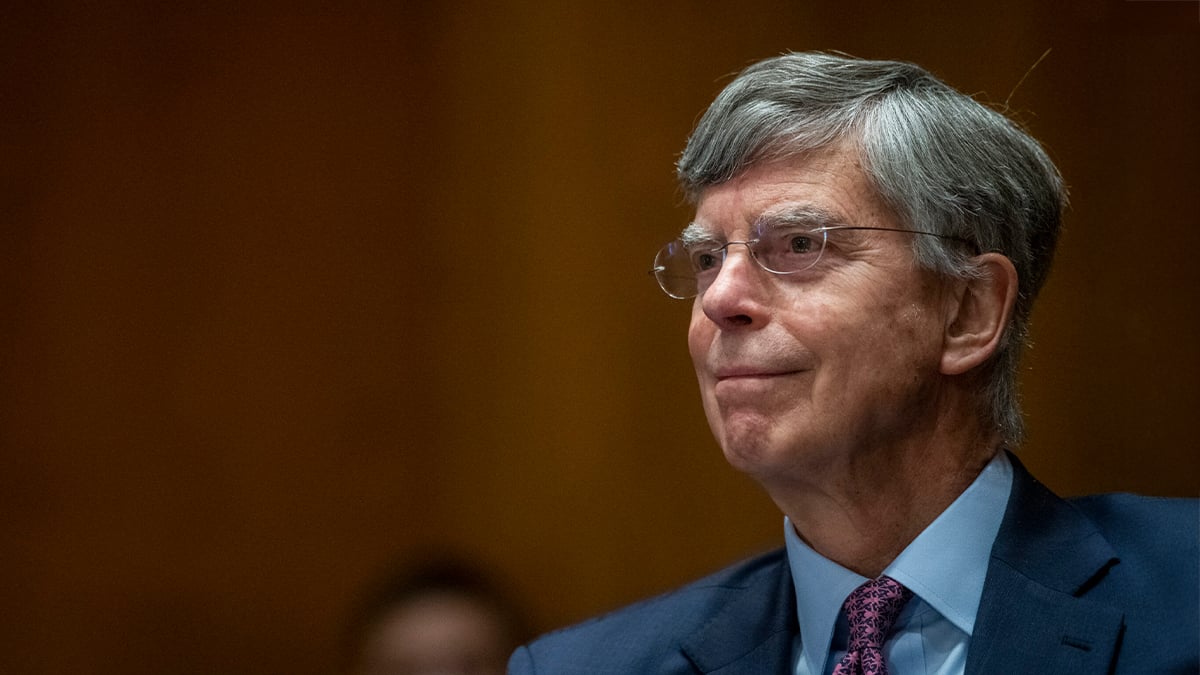
President Donald Trump’s diesel deal with Russia risks weakening American leadership against Moscow without delivering a clear benefit to the United States, says William B. Taylor, the former U.S. ambassador to Ukraine.
“The United States, this administration, is forfeiting the ability to lead in the coalition that it had built against the Russian invasion of Ukraine,” Taylor, who served as ambassador from 2006 to 2009 and as charge d’affaires in Kyiv from 2019 to 2020 in the first Trump administration, tells Independence Avenue Media. “So it damages U.S. interests without benefit to the United States.”
Taylor spoke with Independence Avenue Media on Oct. 13, four days after Trump announced the agreement, amid bipartisan criticism in Congress, questions about its legality and doubts about whether Russian diesel would lower prices for Americans.
The administration’s envoys have presented the deal to Ukrainian officials as a possible way to soften Moscow’s position and restart peace talks, according to Reuters. Taylor says easing sanctions is the wrong approach.
“I think the way to deal with the Russians is to put pressure on Putin so that he will realize that he can’t win this war against Ukraine and must come to the table to negotiate,” he says.
The interview came as Ukraine and its allies weighed Trump’s separate announcement of an energy ceasefire. No Russian strikes on Ukrainian energy sites were reported overnight into Oct. 13, although attacks on other targets persisted and the Kremlin said discussions were ongoing.
Taylor sees a possible opening for an agreement that would protect energy facilities in both countries as winter approaches. But he says it needs clear terms, enforcement and monitoring.
“It can’t just be declaratory,” he says.
Questions about American support also grew after Ukrainian President Volodymyr Zelenskyy said Ukraine had received no early warning from its partners before a Russian ballistic missile attack on Kyiv. Ukrainian Foreign Minister Andrii Sybiha said U.S. intelligence sharing remained in place and attributed the warning delay to the particular weapons Russia used. Zelenskyy did not say that all intelligence sharing had stopped. Trump also said Tuesday that the United States was still sharing intelligence with Ukraine.
During the interview, Taylor called that cooperation “really important.” His broader advice to Kyiv is to keep working with Washington while developing its own defenses and expanding cooperation with Europe.
“Work with the Americans on the hope, on the expectation that the assistance will continue or increase,” he says. “But don’t count on it.”
This interview was recorded on Oct. 13, 2026, and has been edited for length and clarity.
Kartlos Sharashenidze, Independence Avenue Media: Ambassador Taylor, it’s been four days since President Trump said he had reached a diesel deal with Russia. In that time, we’ve seen bipartisan criticism in Congress, questions from energy experts about whether it will bring prices down for Americans, and concerns from Ukraine and European allies. So with that much pushback, what do you think is driving the president’s decision to strike this deal with Russia?
William B. Taylor, former U.S. ambassador to Ukraine: Well, Kartlos, I can’t get in President Trump’s mind, of course. No one can. But all the indicators are that he’s concerned about the price of diesel fuel here in the United States. He thinks that this Russian diesel fuel can help with that. So he has waived these sanctions. As you say, most people are skeptical that this will have very much effect on prices, and certainly very skeptical it will have effect on prices in the next couple of weeks, which seems to be what President Trump is interested in.
IAM: According to sources who spoke to Reuters, U.S. envoys told Ukrainian officials in Miami that the diesel deal could help soften Moscow’s position and restart peace talks. The idea is to show that President Trump is open to working with Russia. How realistic is that approach?
Taylor: President Trump has been open to working with Russia for a decade. So it’s no new news that he’s open to working with Russia. I think that’s a mistake. I think that the way to deal with the Russians is through strength, is through pressure on Putin economically, militarily, diplomatically, financially.
I think the way to deal with the Russians is to put pressure on Putin so that he will realize that he can’t win this war against Ukraine and must come to the table to negotiate. So I think it’s a mistake for President Trump to waive the sanctions on diesel fuel sales.
IAM: How do you see this deal moving forward? Senators from both parties say it goes against U.S. law, while the administration says it’s legal. Could these objections block Russian diesel imports into the U.S.?
Taylor: Unfortunately, Congress is out of session, number one. Even if they were in session, though, Kartlos, it’s not clear to me what they could do, even if it is true that this waiver of sanctions, the sanctions waiver that the administration has executed, is illegal under U.S. law. I guess they could sue. They could go to court. As we know, the courts move slowly. And in the meantime, unless there’s an injunction, unless some judge tells the administration [to stop], based on this suit, this legal action by members of Congress, they will continue to execute these waivers.
It’s not at all clear, actually, that the Russians even are able to export large volumes of diesel fuel. There are complications. I’m not an expert in this, but people who examine this question who are experts say that it’s not easy. There are going to be insurance issues. There are going to be shipping issues. There are going to be higher shipping costs that will make it difficult for the Russian refineries to make any money on these transactions.
The Russian refineries, as we know, Kartlos, are being battered, up until two days ago, by Ukrainian drones. Fifty-one percent, by some estimates, of the Russian refining capacity is offline at any given time. I understand that the Ukrainians have not hit refineries for the past three days out of hope that President Trump would put pressure on President Putin to abide by this ceasefire. So far the Russians have not abided by this ceasefire. So all to say that it’s not clear that there’s anything that will impede the waiver and therefore the attempt at importing these Russian volumes.
IAM: Ambassador Taylor, what do you see as the most damaging impact of this deal, not only for Ukraine but also for U.S. interests?
Taylor: Waiving [U.S.] sanctions on Russia that President Trump has signed into law — most recently, the Graham bill. President Trump also, a year ago at the United Nations General Assembly, at UNGA, in his speech, chastised the Europeans for buying Russian oil. He still does that.
So what this does is it exposes the United States, at least this administration, to charges of hypocrisy, to a lack of leadership. The United States, this administration, is forfeiting the ability to lead in the coalition that it had built against the Russian invasion of Ukraine. So it damages U.S. interests without benefit to the United States.
IAM: President Trump said the deal was the right choice for the American people, saying the European Union has paid Russia $250 billion for energy. Does the president have a point here?
Taylor: Sure, the president has a point that Europeans have purchased oil since 2022. What he doesn’t mention is the dramatic reduction in these purchases that the Europeans have implemented at great pain, at great cost. It’s expensive for Europeans. It costs Europeans dearly to reduce their purchases of cheap Russian oil and cheap Russian gas. But the Europeans have done that. They’ve not eliminated these purchases, but it’s way down.
Most of the purchases that continue are made by Hungary or Bulgaria, by and large not by the rest of the EU. But nonetheless, the president has a point that there are European purchasers of Russian oil and gas. And they should stop. And the European Union is taking measures to do that. But that doesn’t justify the United States changing its policy toward purchasing Russian oil.
IAM: The EU imposed new sanctions just a few hours ago on almost 1,600 people and companies linked to Russia’s arms industry. How much pressure could this put on Moscow?
Taylor: It’s a cumulative pressure, Kartlos. This is, what, the 22nd package that the Europeans have implemented, and this is the largest, with somewhere near 1,600 new individuals targeted for these sanctions. This is on top of all of the previous packages, which the United States had actually mirrored as well.
The United States had sanctions in coordination with the Europeans, and the cumulative effects of those sanctions have hurt the Russian economy, no doubt. Before the Iran war, the revenues that the Russians got from sale of oil and gas had been cut in half by these sanctions. Of course, the Iran war had the effect of driving up the price of oil, and so the Russians benefited from that.
But the point is the sanctions do have an effect. The sanctions on refineries, the sanctions on production, the sanctions on the shadow fleet, they all reduce the ability of the Russians to export oil. And that means that the Russians have less money to use to fund their war on Ukraine.
IAM: With winter approaching, how realistic is a lasting energy ceasefire? There are reports today that Russia did not hit any Ukrainian energy sites overnight, but the Kremlin says talks about an energy ceasefire are still ongoing. Could this be the start of a lasting energy ceasefire? Are you optimistic?
Taylor: Kartlos, I think it’s possible that both sides could see that it’s in their interest to enter into a bilateral, mutually binding ceasefire on energy facilities. I think it’s in both interests, so I think the interests are there. The Ukrainians have not targeted Russian refineries for the past three days. If the Russians have stopped targeting Ukrainian energy facilities, that’s a good sign. That’s both sides taking steps to indicate that they’re willing to enter into this ceasefire. That’s promising.
It can’t just be declaratory. They have to negotiate clear understandings and clear enforcement mechanisms and clear monitoring mechanisms that would allow both sides confidence that the other side is maintaining the ceasefire. That’s going to be very important. But again, if that happens, that’s a very good thing for both sides. Clearly for the Ukrainians, that would be a good thing, as you say, going into this winter.
IAM: Considering all these developments, how do you see the future of U.S.-Ukraine relations? Ukraine’s foreign minister says the U.S. is still sharing intelligence with Ukraine. How secure is that support, along with Ukraine’s access to U.S. equipment paid for by its European allies?
Taylor: So the United States’ direct assistance to Ukraine, as you know and as you’ve said, Kartlos, is way down. Way down. Probably a 95% reduction from the previous administration. So there are no direct supplies of weapons, financing, diplomatic support. That’s all way down. You asked about U.S.–Ukraine relations. Therefore, the United States has much less leverage, much less influence on Ukraine. And so Ukraine has more flexibility, more latitude to take measures that are clearly in their interest.
You mentioned the military intelligence, which apparently continues, and that’s a good thing. That’s a very good thing. That’s really important. And I think the Ukrainians would like to have more support from the United States. I think they would like to have more military support, financial support, economic support, diplomatic support. I think they would like to have that, but the Ukrainians apparently have come to the conclusion, with great reason, that they can’t count on it.
They hear that President Trump is willing to allow them the licenses to manufacture Patriot missiles themselves. But then the next day President Trump says, “Well, maybe not,” and the licenses have not come. And as you say, there are many indications that President Trump has gone up and down on his relationship with Zelenskyy. And what hasn’t gone up and down is his relationship with Putin. That has stayed at a high level.
No one can understand that. No one can understand why President Trump has such a relationship with this dictator, with this indicted war criminal. So no one can understand that, but that seems to be the case. Even though it goes up and down with Zelenskyy, it stays high with Putin.
‘Absolute Shock’ — Former U.S. Defense Official on Trump’s Diesel Deal With Putin
IAM: Ambassador Taylor, what options does Ukraine have in this situation, both militarily and diplomatically? What would your advice be to the Ukrainian government?
Taylor: Pursue a two-part parallel approach. That is, work with the Americans. Don’t stomp out of conversations. Work with the Americans on the hope that the support will continue where it exists right now, and the hope that it will increase, that it will resume to previous levels or in some direction. And the reason they can hope that is there’s strong support for that approach in the U.S. Congress, in the Senate, in the House, within the American people. There’s strong support for that.
So the Ukrainians should continue to work with Americans, continue to work with the U.S. government. But because, as we just said, they can’t count on it from this administration, they should pursue a parallel approach, Plan B, which is to prepare and make preparations for the time when the United States is not there, like right now. So develop their own Ukrainian capabilities. Work closely with the Europeans. Expand the cooperation with the Europeans in defense industrial operations. Work with the European governments on the coalition of the willing. Take all of these measures that don’t depend on the United States to improve the Ukrainian security and the Ukrainian economic activities.
So do both, Kartlos. Do both. Work with the Americans on the hope, on the expectation that the assistance will continue or increase. But don’t count on it. And because they don’t count on it, work the other track, working with the Europeans and themselves, the Ukrainians themselves, to develop the capabilities that they need to defeat the Russians.
IAM: Do you see European allies taking the same approach toward the U.S.? And isn’t that something they should be doing anyway?
Taylor: Absolutely. The approach that I just outlined for the Ukrainians is already being adopted, is already being pursued by the Europeans and the Canadians, by the way. They again would like to have good relations with the United States. They’d like to have support of the United States for Ukraine. They would like to have good trade relations with the United States, but they can’t count on it. They can’t count on it.
So they are also pursuing a parallel approach, their Plan B, which is to develop their own capabilities without the United States. And they are doing both at the same time, just like the Ukrainians.
IAM: President Trump has suggested that Ukraine needs a new president. What would need to happen for Ukraine to hold elections, and how realistic is that while the war is ongoing? President Zelenskyy has said he is ready to hold elections if there is a two-month ceasefire. How do you see this?
Taylor: First of all, Kartlos, Ukrainians decide their president. No foreigner, not even the president of the United States, has any say in who leads Ukraine. So President Trump’s comments are irrelevant in that case, number one.
Number two, President Trump’s comments have probably increased support for Zelenskyy among Ukrainians. This is what happened last time, a year and a half ago, after the Oval Office debate disaster. The support for Zelenskyy went up. I suspect that that will happen again. It’s probably already happening right now, that the support for President Zelenskyy has gone up. It’s going up and it’s gone up in Ukraine, among Ukrainians.
Number three, as you say, you can’t have elections when your country is being bombarded every day and every night, and while your soldiers are on the front line. There’s no way you can have elections just practically in that case. The security is not there. Legally, as you know, the constitution prohibits it when there’s martial law. There’s martial law during wartime. So it’s not going to happen. It’s not going to happen.
President Zelenskyy said the right thing. He said, “Look, we’re ready for elections. We look forward to elections. We need to have elections,” he has said. But for all the reasons that I just said, you can’t do it now. But if the Russians stop bombarding us, if the Russians stop attacking us, both on the front lines but also at polling places and around the country, if the Russians stop that for 60 days, yeah, we can do elections at that time, and Ukraine’s ready for that. Ukraine is eager to go to elections. It’s eager to have a ceasefire for 60 days or more, preferably more. It wants that. But unless that happens, elections are not going to happen.
IAM: Let me ask you one more question about the latest developments in the Black Sea. Two commercial ships were hit by drones off Bulgaria this morning, and one sank. Ukraine says Russia was responsible, and we’ve seen statements from the European Union about the attacks, while Bulgaria has not confirmed who carried them out. What should the U.S. and NATO do to protect shipping in the Black Sea and ensure security in the wider region?
Taylor: So the U.S. and the rest of NATO should extend the coverage of their air defenses well into the Black Sea and well into Ukraine. When NATO sees the threat, the air threat, or any threat for that matter, but the threat from the air by Russian missiles, drones, aircraft coming towards NATO territory through Ukrainian airspace, the NATO allies should adopt a forward defense.
They should, when they see these threats coming toward them, still in Ukrainian airspace, they should take them down. They should shoot at them. They should destroy them. And this should be made very clear that this will be the new policy. And then it should be implemented.
The Russians will then not be able to attack Bulgarian ships or Poland through these drones or attacks on Germany. When these things are coming through Ukrainian airspace, NATO should adopt a forward defense and defend against these at the front.
Christopher Walker: Russia’s Shadow War Needs a ‘Sufficiently Disproportionate’ Response