The Shatterbelt Brief is a weekly column by Brian Whitmore examining the shifting political and geopolitical dynamics of Eastern Europe and Eurasia. The views expressed are the author’s and do not necessarily reflect those of Independence Avenue Media.
Alexander Lukashenko waxed nostalgic for the Soviet past, boasting that Belarus still has squares honoring Bolshevik leader Vladimir Lenin and parks named for secret police founder Felix Dzerzhinsky.
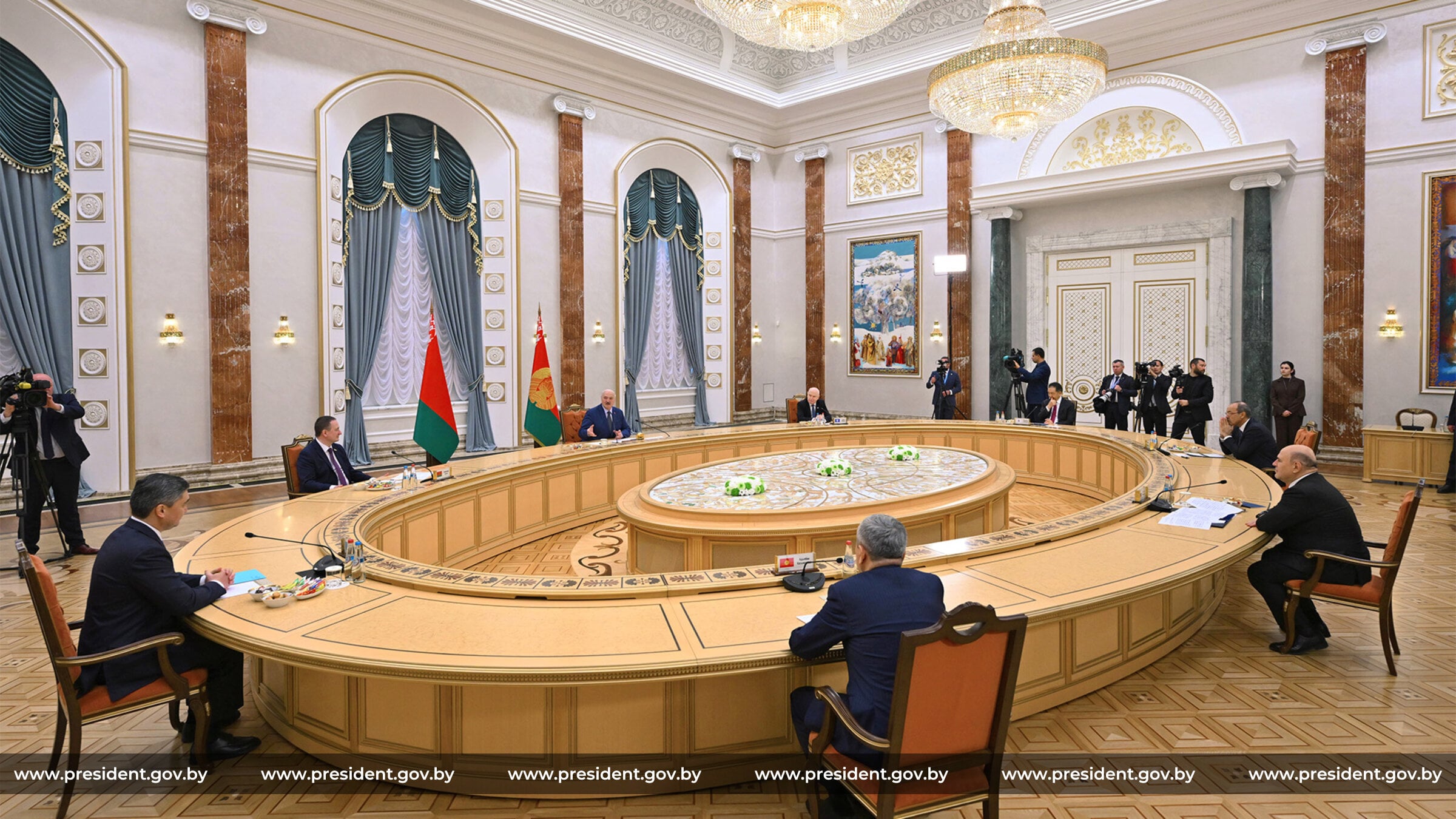
The Belarusian autocrat also warned Armenia about moving closer to the European Union at the expense of the Russian-led Eurasian Economic Union. “Armenia should not rush to throw away what benefits you today. There is no need to leave this common market,” Lukashenko said at a meeting of the economic union’s heads of government in Minsk last week.
Russian Deputy Prime Minister Aleksei Overchuk echoed Lukashenko’s remarks in an interview with state television’s Vesti.
It all reeked of desperation.
In fact, if last week’s meeting of the Eurasian Intergovernmental Council in the Belarusian capital is any indication, Vladimir Putin’s dreams of subjugating and integrating the former Soviet space and turning it into a counterweight to the European Union and NATO are dying on the vine.
One of the key components of the Kremlin leader’s strategy was the Eurasian Economic Union, which Russia founded amid much fanfare in 2015 with hopes of it becoming a competitor to the European Union. In addition to Russia, its other members included Armenia, Belarus, Kazakhstan, and Kyrgyzstan.
Energy-rich Azerbaijan made it clear from the outset that it was not interested in being a member. And as remarks by Lukashenko and Overchuk suggest, Armenia’s current commitment to the organization is lukewarm at best. In May, Armenian Prime Minister Nikol Pashinyan said Yerevan did not plan to leave the organization “at the moment.”
But what is easy to forget is that Putin’s original grandiose plan for the Eurasian Economic Union was for it to include not only Azerbaijan and Armenia, but also — remarkably from today’s perspective — Ukraine.
In fact, it was Russia’s pressure on Kyiv to join the Moscow-led Customs Union, the Eurasian Economic Union’s forerunner. in late 2013 and early 2014 — rather than moving closer to the European Union as most Ukrainians favored — that provided the proximate cause of Russia’s initial armed intervention.
Kyiv had been set to sign an Association Agreement and Deep and Comprehensive Free Trade Agrea with the European Union in November 2013. But Putin pressured Viktor Yanukovych, Ukraine’s pro-Russian president, to scrap that deal in favor of joining the Moscow-led Eurasian Economic Union — which at that point did not even exist yet.
When Yanukovych acquiesced to Putin’s demands, it sparked mass protests in Kyiv. And when Yanukovych, at Putin’s urging, used lethal force against the demonstrators, the protests swelled into what became known as the Revolution of Dignity, driving Yanukovych from power and into exile in Russia.
The rest, of course, is history. Putin responded to losing his ally in Kyiv by annexing Crimea and staging an armed intervention in the Donbas in early 2014 — and then launching his full-scale invasion of Ukraine in 2022.
What all this suggests is that the Eurasian Economic Union was, at least in part, a vehicle for Putin to control Ukraine economically. When that failed, he turned to kinetic military force.
And what the past decade has shown us is that Putin’s efforts to re-Sovietize the post-Soviet space through Moscow-dominated institutions are failing.
As Chatham House’s Kataryna Wolczuk writes, the Eurasian Economic Union “is not a Eurasian version of the EU,” it is “not governed by strong common institutions capable of devising and enforcing a corpus of common rules.” Among its members, she adds, “Russia also fails to uphold regional trade liberalization.” Wolczuk notes that more than 80% of the organization’s trade is with external partners rather than among member states. Just one-third of the EU’s trade is with external partners.
Instead, she says, the Eurasian Economic Union is nothing more than “a vehicle to reverse Russia’s loss of power in the region following the demise of the Soviet Union, rather than to pursue deep economic integration with smaller states.”
But even by this metric, it is coming up short. It’s not just Ukraine and Armenia. Kazakhstan’s interest in the organization has also been tepid from the outset.
And Putin’s other project to integrate the former Soviet space, the Collective Security Treaty Organization (CSTO), founded in 2002 as an aspiring competitor to NATO, has also been a flop. In addition to Russia, it includes Armenia, Belarus, Kazakhstan, Kyrgyzstan and Tajikistan. But the organization’s failure to assist Armenia in its conflict with Azerbaijan in 2020 and 2023 led Yerevan to suspend its membership.
The CSTO was even unable to prevent an armed conflict between two of its own members — Kyrgyzstan and Tajikistan. Those two countries fought a border conflict in April 2021, when both of their defense ministers were in Dushanbe, the Tajik capital, for a CSTO Defense Ministers Council meeting, of all things.
Not long ago, the Putin regime had grandiose dreams of re-Sovietizing the former Soviet space with powerful institutions that would challenge the EU and NATO. These days, those dreams are reduced to a Belarusian dictator droning on about Lenin Square and Dzerzhinsky Park — and practically begging Armenia not to head for the exit.