
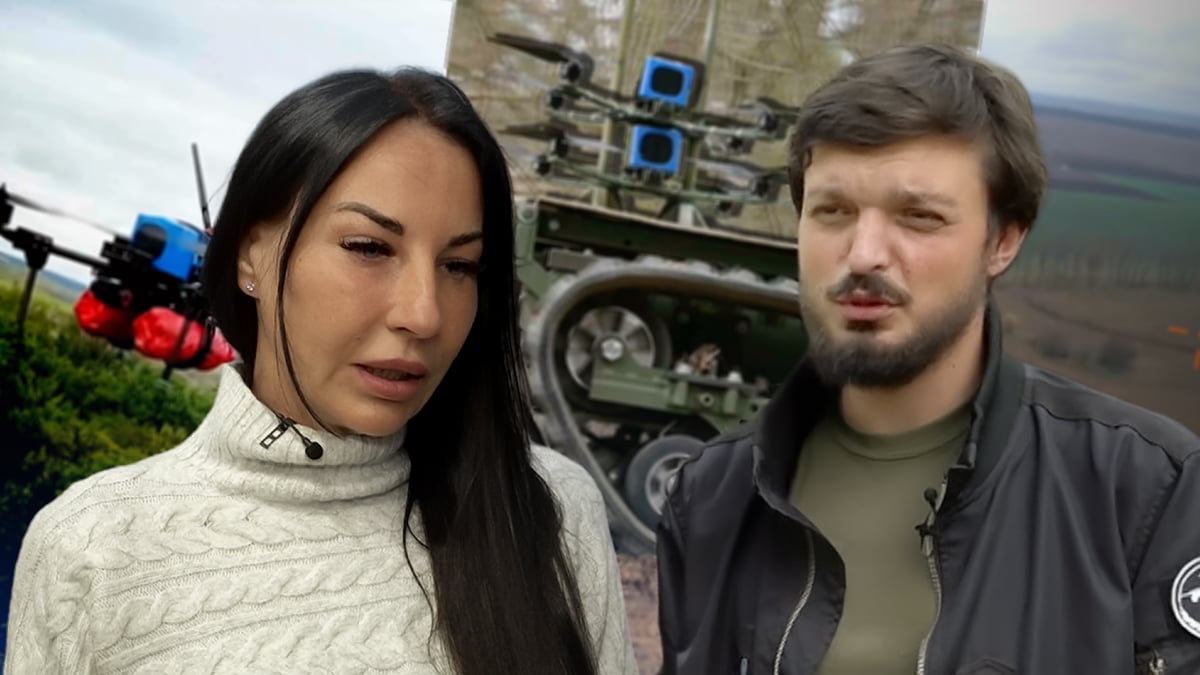
In April 2022, when a relative of Olha Dyda was taken prisoner, her son came up with an idea.
“My son said, ‘Let’s build a drone. Let’s use a drone to look for him where he might be,'” Dyda says. “That’s how we came to the conclusion that we needed to start developing drones.”
The company she founded and now directs has since developed around 30 types of them. It is one of the many small firms in Ukraine that have turned Ukrainian defense needs into a production line — the kind of origin story you would only be likely to find here.
At a testing ground in western Ukraine, its engineers are demonstrating an unmanned ground vehicle that carries six kamikaze drones to a launch site. It can travel up to 25 kilometers, while the drones it carries can fly another 40 — well behind Russian lines.
“It can automatically drive to a designated point and launch drones from there,” says Andrii Malyshev, the company’s chief engineer and co-founder. “You don’t need people to deploy to the position or the drones. It can also simply stay there and patrol the position.”
One of the newest designs flies at up to 120 kilometers per hour, carries a three-kilogram explosive payload up to 20 kilometers, and comes back to do it again.
“We always have a problem with drones in Ukraine when they return from a mission. Many of our own units shoot them down because they don’t know whether it is one of ours coming back,” Malyshev says. “This one is not too large, but it can still carry weight. And if it crosses our positions at high speed, it is difficult to shoot down, so it can return safely to its position.”
Designs often start as requests from troops at the front. They take shape in a laboratory where plastic components come off a 3D printer, then move to an assembly bench. A single bomber drone takes more than three hours to build.
“There are a lot of components,” says Ivan, an engineer. “Everything has to be attached — every element, every nut.” Eight in ten of those components are now made in Ukraine.
“The camera and control module are Chinese. The motors can also be Ukrainian,” Ivan says. “Basically, we have almost everything we can use here in Ukraine except cameras. We haven’t learned to make those here yet.”
Among the company’s engineers is an 18-year-old developer who has been building drones for more than a year. She demonstrates two of the models: the Iron Knight, which carries up to a kilogram and flies for 30 to 40 minutes, and the larger Marena, which carries up to six.
Asked why she does this work, she answers plainly.
“Maybe, in a way, it came from a desire for revenge,” she says. “My father has been missing for almost three years.”