
The story began with a shot glass and a Ukrainian officer in a safe house.
In the early months of Russia’s full-scale invasion of Ukraine, at an undisclosed location, the bottle hit the table before the introductions were finished. Rifles were stacked against the wall, body armor was still on, and a Ukrainian officer had just poured a shot for Sam Lerman, an American veteran who had come to Ukraine to help its government with military procurement.
“Now we do cultural exchange,” the officer said.
In the glass was Ukrainian vodka — horilka.
“Vodka is Russian and can only make you angry,” the officer told him. “Horilka is Ukrainian, and it opens your mind.”
At the time, neither man knew that the drink would become the beginning of a business.
When Ukraine Called
Lerman, the son of two law professors, grew up outside Washington, D.C., and came of age in the shadow of 9/11. He enlisted in the Air Force at 17. He was deployed to assist with relief efforts following Hurricane Katrina, served in Afghanistan, and spent a decade working in procurement in the defense industry.
In March 2022, shortly after Russia launched its full-scale invasion of Ukraine, an old friend of Lerman’s, a recently retired Green Beret, called him.
“Largest war in Europe since World War II, major ally being invaded, completely unprovoked attack, and the world isn’t responding,” Lerman recalls him saying.
A small team of American veterans was putting together an advisory mission to Ukraine — no pay, no insurance, no institutional backing. They needed someone who understood military logistics and procurement. “We leave on Saturday,” the friend said. “Do you want to come?”
Lerman was already packing — body armor, a medical kit, chemical warfare gear, cash pulled from the bank — when his wife, Erin, came to look over the gear laid out on the floor and deliver news of her own: she was pregnant with their second child.
The family decided that Lerman should still go, despite the risks. Erin told him she did not want to look back years later and wonder whether they could have made a difference.
“I was scared to kiss my one-year-old daughter goodbye, not knowing entirely what I was going into. April 2022 was a crazy time,” Lerman recalls.
Homecoming
With his wife’s blessing, Lerman crossed into Ukraine and joined a small advisory team working with the Ministry of Strategic Industries. They were based in a house in a village he still won’t name. The days stretched to 16 to 18 hours around a dining room table, teaching Ukrainian procurement officers how to define requirements and source what their military desperately needed. Russian forces were pushing toward Mykolaiv, Luhansk and Donetsk, while saboteurs and deserters moved throughout the country.
It was there, over that first bottle of horilka, that the seed of a wine and spirits company was planted.
As Lerman settled into the work — and, increasingly, into the country itself — messages began arriving from his mother back home, filling in a family history he had never thought to investigate. Lerman discovered that his ancestors had left Ukraine generations earlier in search of a better life in the United States: Kamianets-Podilskyi in 1890, Berdychiv in 1913, a route from Odesa to Boston.
He was the first member of his family to return to Ukraine in 109 years.
“I felt that everything in my life had sort of lined up to put me in a position to go and try to help,” he says. “I really didn’t want to do anything else.”
His initial trip was supposed to last a week. But when the time came for the team to return to Warsaw, Lerman decided to stay. He remained in Ukraine for several more weeks before eventually returning home to his family.
Lerman spent roughly the first five months of the invasion volunteering for the Ukrainian government. Eventually, Erin told him it was time to get a paying job again. He found one at a defense company that allowed him to stay focused on Ukraine. He never really stopped going back.
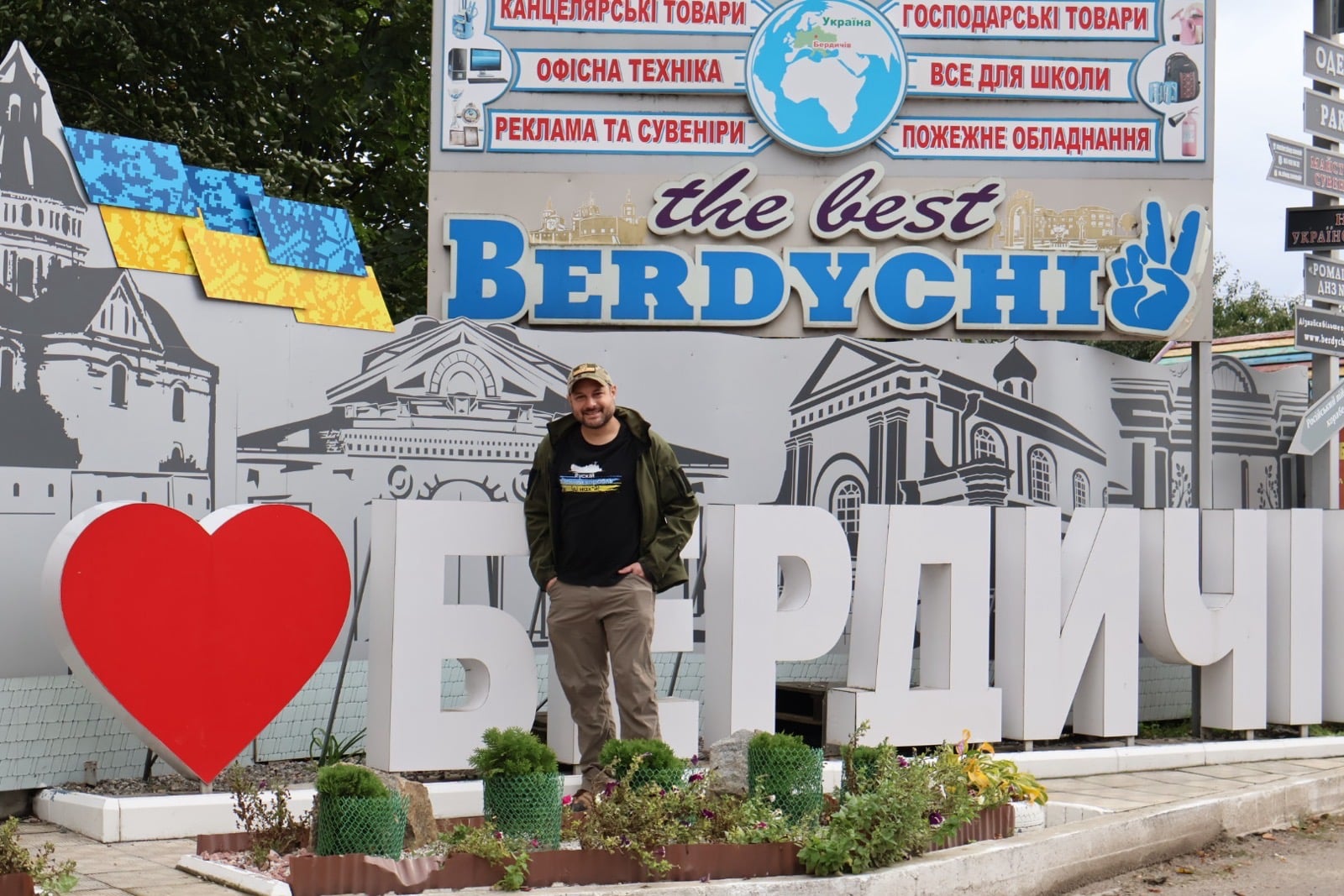
One trip took him to Berdychiv, to the Jewish cemetery where his family’s history began. He found it empty and abandoned — people had evacuated. Lerman bought glass vials at a local shop and filled them with black soil to bring home to his mother and aunt.
From ‘Bootlegging’ to Business
Whenever he came back to the United States, Lerman went to wine shops with large international selections, asking whether they carried anything from Ukraine. The stores either didn’t know Ukraine made wine at all, or knew it was supposed to be excellent and had no idea how to get it.
So, Lerman recalls, “I did what any self-respecting American veteran would do — I started bootlegging.”
Since flights don’t travel to Ukraine and the EU caps personal spirits imports at a liter, he packed suitcases, trained across the border into Poland and flew home declaring the contents to U.S. customs. By early 2023, the “demand” from friends and family who he had been sharing the bottles with had outgrown what any amount of suitcase-smuggling could supply, so Lerman formalized it. He co-founded SPYRT Worldwide with two friends — a retired U.S. Marine officer and a Ukrainian officer he’d served alongside in the safe house. The mission was as much cultural as commercial.
“I wanted to bring the best of Ukrainian wine and spirits to the United States,” Lerman says. “Give Americans something to think about Ukraine that’s not the war, and see Ukraine as this beautiful country that it is.”
Lerman also wanted the business to contribute directly to Ukraine’s war effort. He partnered with Invictus Global Response, a nonprofit founded by American bomb technicians and Iraq and Afghanistan veterans who volunteer in Ukraine, clearing Russian landmines in liberated areas. SPYRT Worldwide donates 10% of its gross profits to the organization and has become one of its primary funding sources, according to Lerman.
The Grape at the Edge of the Black Sea
The business itself has scaled fast. Working through licensed U.S. distributors, SPYRT Worldwide says it has put Ukrainian wines and spirits in roughly 800 locations across 20 states.
Lerman says curiosity may bring customers to the bottle, but the quality and price keep them coming back.
“People will try it because it’s new and they support Ukraine, but once they try it, they’re hooked because it’s incredible,” he explains. “It’s better and at a better price than anything they can get in the United States.”
The hardest part of the pitch, Lerman says, isn’t logistics — it’s disbelief. “People are shocked that Ukraine made wine,” he says, “much less has been making wine for 2,000 years.”
Southern Ukraine sits at the same latitude as Burgundy, warmer because of its sea-level position and hundreds of days of sun a year. Ukraine’s own grape, Telti-Kuruk — “the noble grape of Ukraine” — is a crisp, mineral white variety that grows only in the sandy soil along the Black Sea coast, and gets its name, “foxtail,” from the shape of its cluster. Lerman says master sommeliers who’ve tasted it can’t compare it to anything else: “You can literally taste the salinity of the Black Sea feeding the grapes.”
Now, the products he is importing to the United States are earning recognition on their own. Lerman’s Ukrainian horilka import, legally labeled vodka under U.S. rules, won Best Vodka in the United States in 2025 at the Wholesalers of America wine and spirits show. In Washington, Ukrainian wine now appears on the lists at José Andrés’ Zaytinya and the Michelin-starred Imperfecto. It’s also sold at Dulles and Reagan National airports.
A War That Isn’t Over
SPRYT Worldwide’s growth hasn’t made the underlying situation easier. Because of the Russian attacks on cargo ships in the Black Sea, Lerman had to stop shipping his wine and spirits from Ukrainian ports. It now has to be trucked to Moldova or into the EU and sold from there, adding cost and risk at every step.
Lerman still travels back regularly, aware the danger has only grown as Ukraine’s air defenses have thinned.
“Tens of millions of people live in Ukraine every day and continue the work to protect Ukraine and protect the Western world,” he says. “If I can’t go for short periods to focus on things that need to be done, what does that say about me?”
Lerman says that when the war ends, the whole family plans to go to Ukraine together. Until then, he keeps crossing back and forth between two realities — buying stickers for his kids in towns still recovering from occupation, tasting grapes on a coastline within reach of Russian strikes — convinced that the country has something the rest of the world still needs to understand.
“I think Ukraine has changed warfare forever,” he says. “The rest of the free world needs to wake up and learn the lessons of Ukraine.”
In the meantime, he’s starting with America’s bar carts. Lerman’s next big idea is replacing the Moscow Mule, one of America’s most popular vodka cocktails, with a “Kyiv Mule” — made with Ukrainian horilka and served in a steel cup instead of copper.
“Steel is strong and Ukrainian,” he says. “Copper is weak and Russian.” Bars that make the switch get the cups, laser-engraved, for free.
MORE: How Ukraine Turned Its Postal Service Into a Diplomatic Weapon