Brian Whitmore is a contributor writing for Independence Avenue Media. The views expressed are the author’s and do not necessarily reflect those of Independence Avenue Media.
Vladimir Putin appears to be losing his grip on reality.
In a televised interview with a Russian state broadcaster on June 28, he claimed Russian forces had trapped 5,000 Ukrainian troops on the banks of the Stary Oskol river in Ukraine’s Donbas region. There’s just one problem. There is no such thing as a Stary Oskol river in the Donbas, or anyplace else in Ukraine for that matter. The Kremlin autocrat also claimed that Russian forces had encircled the village of Rubtsi — they have not.
“Putin appeared to be making up facts as he went along,” Simon Shuster wrote in The Atlantic. “The Russian president’s obsession with the details of the fighting appears to have crossed the line into delusion.”
The Ukrainian military playfully pointed out that Stary Oskol is actually a city in Russia’s Belgorod Oblast, more than 100 kilometers from the Ukrainian border — a city, incidentally, where Ukraine struck a Russian oil refinery back in January.
“Regrettably, as of now, we are merely working on advancing toward this city, which, as is known, is located in the northeast of Russia’s Belgorod Oblast,” the Ukrainian Joint Forces Task Force snarkily wrote on Telegram. “However, we are convinced that the Russian leader is better aware of his troops’ combat readiness than we are; therefore, we suggest viewing the talk of battles for Stary Oskol as an announcement on his part.”
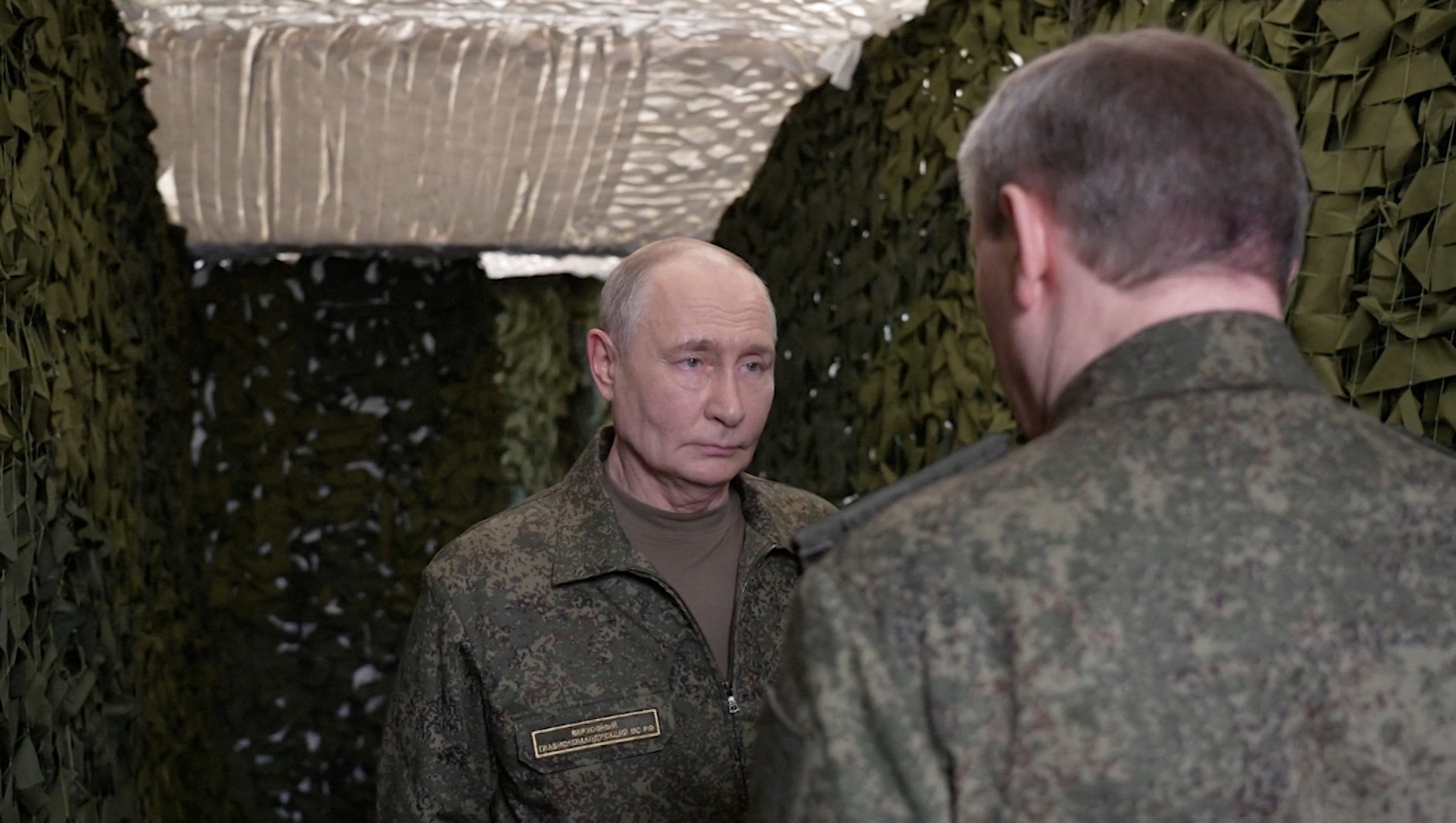
But Putin wasn’t done. On July 3, just days after imagining a Ukrainian river into existence, he donned fatigues and visited what the Kremlin claimed was a military command post in an undisclosed location on the battlefield.
Putin ridiculed what he called Ukraine’s “imaginary achievements” and “successes that we know don’t actually exist.” He mocked Ukrainian leaders as play actors who “don’t really know how to do anything else and haven’t been trained to do anything else.”
What happened three days later was anything but imaginary. Ukrainian deep-strike drones hit the Omsk oil refinery, Russia’s most technologically advanced petroleum processing facility accounting for 10% of the country’s capacity. Before Ukraine bombed it, the plant produced about 460,000 barrels of oil per day. At 3,000 kilometers, it marked Kyiv’s longest-range strike of the war.
So much for “imaginary achievements” and “successes that we know don’t actually exist.”
Here’s the reality. Ukraine has now hit all 11 of Russia’s largest fuel-producing facilities. As a result, domestic production has fallen to 20% below domestic demand. Overall, Ukraine has disabled approximately 43% of Russia’s total oil refining capacity. The resulting energy crisis has now affected nearly all of all Russian regions.
And it’s not just Ukraine’s deep-strike capacity that is turning the tide in the war. At the front, Ukraine has used its impressive medium-range strike capacity to neutralize Moscow’s manpower advantage, disrupt logistics, and slow Russian deployments. Kyiv has also used its medium-range strike capacity to turn Russia’s “land bridge” to Crimea into a virtual death trap for vehicles delivering essential supplies to the peninsula, effectively isolating the illegally annexed territory.
Yet Putin continues to insist that Ukraine’s forces are on the brink of collapse. He claimed that Russia had “completely liberated” the city of Kostiantynivka, even though Ukraine still controls parts of it. And he implausibly claimed that Moscow seized more than 3,000 square kilometers of territory in Ukraine this year. The Institute for the Study of War estimates that Russia’s actual territorial gains between January and July 2026 amounted to a mere 97 square kilometers.
We, of course, don’t know if Putin is simply lying because it comes naturally, if his terrified advisers are reluctant to bring him bad news, or if his outlandish remarks are just a lame attempt at a psy-op.
What we do know is that Putin does not look well. Commentators have noted his swollen face, involuntary twitching in his feet, and leg tapping during public appearances.
There are also reports that the Kremlin autocrat is increasingly isolated and paranoid. A leaked intelligence report from an unidentified European country claimed that the Kremlin has drastically tightened security around Putin amid fears of a coup or assassination attempt. Kremlin staffers working close to Putin have been banned from using smartphones and must undergo extensive screening and surveillance.
Whether or not Putin is sick, the mafia-like system he presides over certainly is. As I wrote for The Bulwark back in 2024, under Putin “the Russian state has become, in essence, an organized criminal enterprise, at least insofar as its internal logic, processes, incentive structure, and behavior resemble those of a criminal syndicate.”
And what happens to an organized crime syndicate when its godfather looks increasingly weak and erratic, when its capos get nervous, and when its revenues dry up?
Given the weak or nonexistent institutions in such a system, court politics and personal networks are everything. Gestures and signals matter a lot. Putin is lamely trying to convey a message that all is well and victory is around the corner. But nobody is buying it. The Kremlin appears to be having a nervous breakdown.
Russia’s war against Ukraine is many things. For Moscow, it is an illegal eliminationist campaign aimed at erasing the Ukrainian nation from the map. For Kyiv, it is an existential battle for survival.
But in its essence, the war is also a test of two systems. On one side is Russia’s top-down, imperial, and autocratic kleptocracy — a crime syndicate masquerading as a state. And on the other is Ukraine’s bottom-up democratic system with its vibrant civil society and innovative startup energy. The mafia state meets the MacGyver nation.
And the smart money is on the MacGyver nation.
More commentary by Brian Whitmore: Putin’s Empire, Interrupted