Brian Whitmore is a contributor writing for Independence Avenue Media. The views expressed are the author’s and do not necessarily reflect those of Independence Avenue Media.
There’s an old adage about Russian politics, used only partially in jest: Never believe anything is true until the Kremlin denies it.
Well, on June 25, Kremlin spokesman Dmitry Peskov denied reports that Russia was pressuring Belarus to open a second front against Ukraine, saying they were “absolutely not true.” But here’s the thing about Peskov. There is also a running joke about him: The easiest way to tell if he is lying is that his lips are moving.
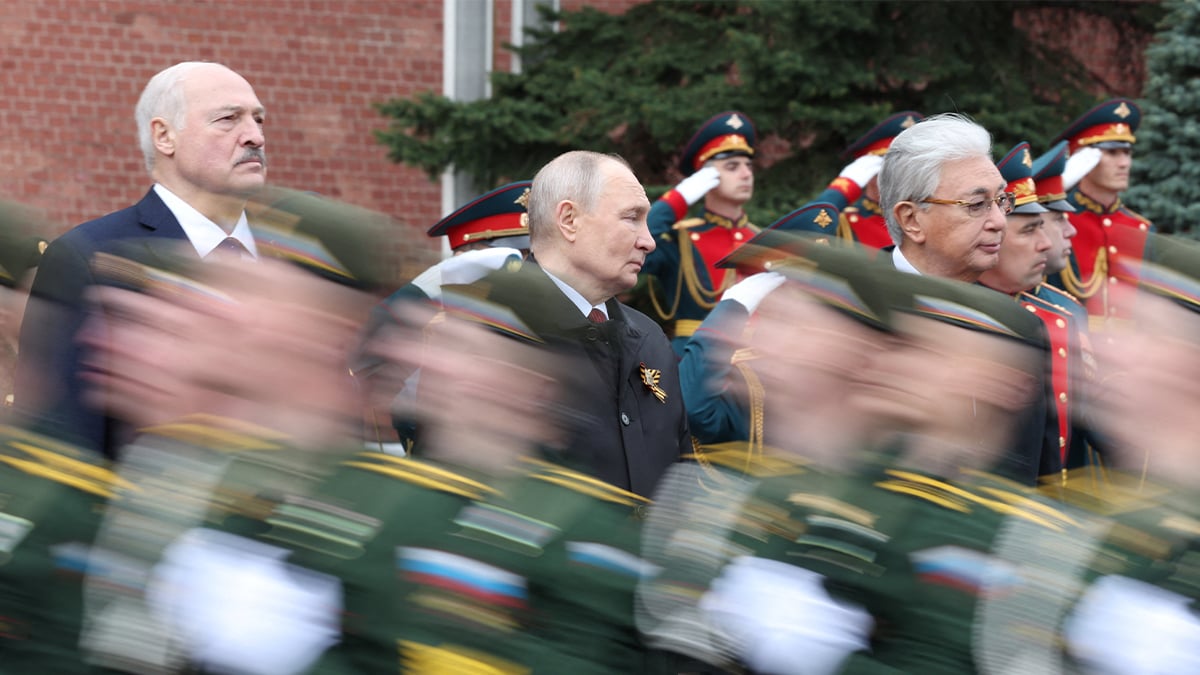
There have now been numerous credible reports that Kremlin leader Vladimir Putin has indeed been pressuring Belarusian strongman Alexander Lukashenko to expand his country’s involvement in the war.
The Wall Street Journal reported June 23 that Moscow is pressing Minsk to allow broader use of its territory to stage attacks against Ukraine and hybrid operations against NATO. According to the report, the Kremlin is effectively blackmailing Belarus by threatening to end financial support for it unless it permits the Russian military to launch drone strikes against Ukraine from Belarusian territory. Moscow also wants Minsk to allow a new front to be opened from its territory, which would force Ukraine to move troops from the front in the Donbas to the Ukrainian-Belarusian border.
And according to a report the exiled Belarusian opposition presented to the Ukrainian authorities, the Lukashenko regime has been quietly preparing the country for war. Military legislation has been amended to ease procurement of weapons systems from Russia, deepening the integration of the two countries’ military-industrial complexes. A bilateral agreement also lays the groundwork for permanent Russian troop deployments. Belarus’ armed forces and reserves have been expanded, schools have been increasingly militarized, and civilian institutions have been mobilized. Lukashenko has also claimed expanded authority to requisition civilian transport and equipment for military convoys.
The Russian pressure puts Lukashenko in a serious bind.
Because, as I wrote in this space last week, Ukraine is done playing nice with Belarus — making it clear that Minsk must take steps to demonstrate that it is not a combatant, or Kyiv will start treating it like one.
Commentary: Ukraine Plays Hardball With Belarus
On May 26, the commander of Kyiv’s drone forces, Robert Brovdi, publicly warned Minsk that Ukraine has compiled a list of 500 targets inside Belarus — including oil refineries supplying the Russian military — that would be struck if Belarus either joined the war or allowed Russia to open a new front on its territory. And on June 19, Ukrainian President Volodymyr Zelenskyy demanded that Minsk dismantle, within a week, signal relay stations in Belarus that Russia uses to steer its drones at targets in Ukraine — or Kyiv would destroy the stations itself. Days later, on June 22, the relay stations went offline.
So Lukashenko is caught between Russian demands that Minsk join the war or risk losing its economic lifeline and Ukrainian threats that Kyiv will use its deep-strike capacity to inflict severe pain on Belarus if it does.
And to be clear, Belarus’ economic dependence on Russia is nearly total. More than two-thirds of its exports go to the Russian market, and Moscow even has control over Belarusian exports going to third countries. Ever since sanctions cut Belarus off from traditional transit routes through European ports, Minsk has become heavily reliant on Russian railways and seaports to export potash fertilizers and hydrocarbons. Moreover, a major source of revenue for Belarus comes from highly subsidized imports of Russian crude that Minsk then exports as refined petroleum products at market prices.
In his dealings with Putin prior to 2020, Lukashenko — whose self-styled nickname is “batka,” or father — was always something of a crafty gamer who viewed his relationship with the Russian leader as transactional. He tried to please the Kremlin just enough to keep the subsidies flowing, while carving out just enough independence to maneuver. When he didn’t get what he wanted from Moscow, he flirted with the West by releasing political prisoners or making other token concessions.
Back in 2017, I described the Putin-Lukashenko relationship as “an asymmetrical dance between a powerful patron with imperial ambitions that needs to effectively bribe an unruly client to keep it in line, and a wily client willing and able to leverage this to extort as much from its patron as possible.”
That all worked until 2020, when Lukashenko unleashed a fierce campaign of oppression against pro-democracy protesters following a rigged election, and later, in 2021, forced a Ryanair commercial aircraft to land in Belarus and arrested an opposition figure who was on board, while also manufacturing a migrant crisis in Europe. Western sanctions were reimposed and strengthened — and Lukashenko was forced back into Putin’s arms. What followed was what I have called Russia’s soft annexation of Belarus, in which Moscow systematically infiltrated the Belarusian armed forces, economy and political system.
Lukashenko allowed Putin to mass Russian troops on Belarus’ border with Ukraine and stage the initial phase of the full-scale invasion from Belarusian territory.
Knowing the war was deeply unpopular in Belarus, Lukashenko stopped short of fully entering it with his own troops. But he has allowed Russia to deploy tactical nuclear-capable systems in Belarus, and the two countries have staged multiple joint military exercises, deepening the integration of their armed forces. Belarus has also been providing Russia with logistical support, including the manufacture and supply of components for Russian missiles, drones, and electronic warfare equipment.
Until recently, Ukraine avoided confrontation with Minsk, hoping to gently nudge Belarus toward neutrality. But no more.
In the aftermath of Zelenskyy’s successful ultimatum over the signal relay stations last week, the Belarusian dictator has been furiously trying to regain his footing. On June 25, Lukashenko told Boris Gryzlov, the Russian ambassador to Belarus, that he stands with Russia, but would not be drawn directly into the war. The next day, he met with Putin at the Kremlin leader’s secluded Valdai residence to discuss trade, joint projects and regional security, although no other details have emerged. Lukashenko then departed for Beijing for talks with Chinese leader Xi Jinping.
It all reeks of desperation. Zelenskyy’s decision to play hardball with Belarus appears to be paying off. And Lukashenko, the onetime master gamer, seems to have gamed himself into a deadly corner.