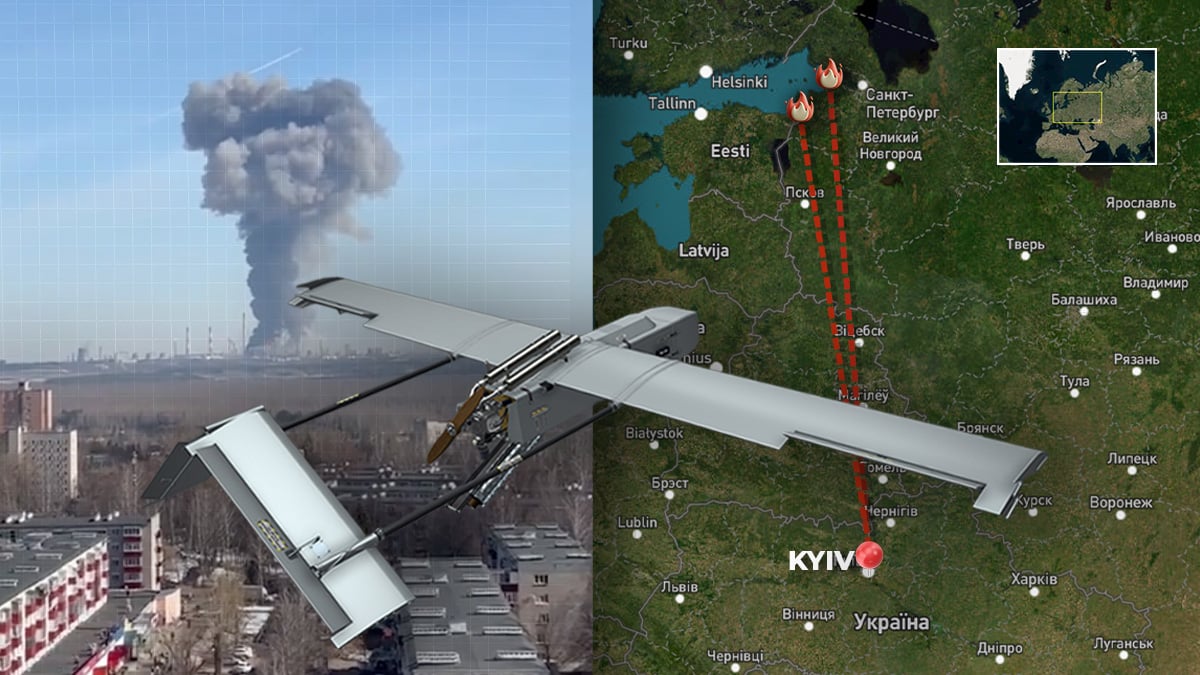
Ukraine’s expanding long-range drone and missile strike campaign into Russia is threatening one of the Kremlin’s most important economic lifelines.
Kyiv has systematically targeted Russian oil refineries since January, but the campaign became increasingly audacious in late March, with Ukrainian drones hitting key Russian export ports on the Black Sea in Russia’s southwest, and on the Baltic Sea, not far from the borders with Finland, Estonia and Latvia, some 1,000 kilometers north of Ukraine.
The strikes, which have disrupted about 40% of Moscow’s export capacity, according to a Reuters analysis, come just as rising global oil prices linked to the outbreak of conflict with Iran deliver an unexpected windfall to Russia’s war economy.
For Kyiv, the long-term aim is to disrupt the entire supply chain rather than simply target refineries, and deny the Kremlin the ability to translate higher prices into a sustained increase in wartime revenue.
USF creates the largest oil supply disruptions in russia's modern history 🛢️🔥
— 🇺🇦 Unmanned Systems Forces (@usf_army) March 28, 2026
Let's pull back the curtain on our latest #DeepStrike operations.
The Primorsk and Ust-Luga ports are critical export nodes, handling up to 50% of russian seaborne oil. Paired with the Kirishi and… pic.twitter.com/gYteVmf8fd
Officials in Ukraine say Primorsk and Ust-Luga, the two Baltic Sea ports hit by Kyiv this month, handle up to half of Russia’s seaborne oil exports — together moving about 2 million barrels of crude per day. They form part of a wider northern energy corridor alongside refineries in Kirishi and Yaroslavl, which were also damaged in drone strikes.
The ports have become even more important since January 27, when a Russian attack damaged the Druzhba pipeline, cutting off supplies of oil to Hungary and Slovakia (both countries have accused Kyiv of slow-walking repairs to the pipeline).
“The most strategically significant development of this war is Ukraine’s ability to strike Russia’s oil and gas infrastructure across vast distances,” says Lt. Gen. Ben Hodges, former commanding general of U.S. Army Europe.
Ukrainian weapons becoming longer-range and more powerful
For more than two years, Kyiv has used drones to hit military and industrial targets inside Russia. Those strikes are now reaching ever greater distances, with Ukrainian drones and missiles consistently able to hit targets more than 1,000 kilometers from the border.
In early March, Ukrainian President Volodymyr Zelenskyy emphasized in an interview with The Independent that every long-range capability Ukraine now possesses — from 500 kilometers to over 1,000 — was developed domestically. It’s a development the Kremlin itself has acknowledged. Sergei Shoigu, secretary of Russia’s Security Council and former defense minister, recently warned that Ukraine’s drone production had reached a pace at which no Russian region can consider itself beyond reach.
We get Storm Shadow from the UK and it's helpful. This is a very good weapon. We also get SCALP from France, and we received a limited number of ATACMS from the United States in the past. But that's it.
— Volodymyr Zelenskyy / Володимир Зеленський (@ZelenskyyUa) March 5, 2026
We didn't get anything else from other countries that goes beyond 200 or… pic.twitter.com/2YauUtjHfl
The recent wave highlights the payoff from Ukraine’s domestic investments in strike capabilities. What began as an improvised drone effort has developed into a more serious long-range program that increasingly combines drones with missile capabilities.
Andrii, a drone pilot in Ukraine’s 109th Territorial Defense Brigade, who asked to be identified only by his first name for security reasons, tells Independence Avenue Media that Ukraine’s defense industry is “developing constantly and dynamically.”
He says the country’s ability to respond asymmetrically to Russian forces is “a very positive thing,” even if many of the Armed Forces of Ukraine’s newest technologies remain out of public view.
“All we can do is be glad that we are becoming stronger and are able to inflict very painful blows on Moscow’s forces,” he adds.
Expanding manufacturing capacity for weapons capable of traveling long distances means the scale and frequency of the strikes will likely grow, imposing ever greater costs on the Kremlin, says Jonathan Lippert, president of Defense Tech for Ukraine. Still, he argues that Russia will likely get better at scaling low-cost interceptor drones and teams, which could reduce the effectiveness of slower systems like Ukraine’s FP-1 and Liutyi attack drones.
Even so, he says, Russia is unlikely in 2026 to fully defend against a large saturation attack like the recent strikes near the Baltic Sea, leaving Ukraine well placed to continue degrading Russian oil export capacity.
Taras Kuzio, a political science professor at the National University of Kyiv-Mohyla Academy, tells Independence Avenue Media that medium- and long-range missiles, together with heavy strike drones, will continue to shape Kyiv’s campaign. Kuzio says that Ukraine is also likely to continue targeting Russia’s shadow fleet — another method of chipping away at the country’s energy sector even if Western sanctions pressure remains inconsistent.
Causing economic pain in Russia
Bryan Pickens, a former U.S. Army Green Beret who fought alongside Ukrainian special forces, tells Independence Avenue Media that the most plausible outcome from Ukraine’s long-range strikes on oil infrastructure is the continued degradation of Russia’s export capacity.
Oko Gora, a Ukrainian OSINT analysis project, for instance, says 70% of the oil storage tanks at Primorsk will be out of operation for the foreseeable future, with half being destroyed in under a week. And a Bloomberg analysis estimated the Baltic Sea strikes had cost Russia $1 billion in the first week.
🤯 Results of the UAV attack on the port of Primorsk in Leningrad Oblast:
— Oko Gora (@oko_gora_tg) March 29, 2026
🔴 Destroyed – 8 tanks, or 44%;
🟠 Damaged – 5 tanks, or 28%;
🟢 Not damaged – 5 tanks, or 28%.
72% of the tanks will be out of operation in the near future.
Reminder: about 30% of all Russian oil… https://t.co/xQpwEQU7gz pic.twitter.com/fz204AJ5Do
These attacks are unlikely to deliver a decisive economic knockout on their own, however. Russia still retains alternative export routes, particularly toward Asian markets, including through pipelines to China. And Alexander Kolyandr, an economics expert at the Center for European Policy Analysis, warned recently in The Spectator that Russia may even benefit in the short term if the strikes shock the price of oil even further.
Nevertheless, the strategic logic is clear.
“Victory won’t come from just one factor,” says Oleksandra Ustinova, a Ukrainian member of parliament from the Holos party. “It’s going to be the cumulative effect of battlefield achievements, sanctions, political disruption and the broader effort to reveal Russia’s vulnerabilities to the world.”