




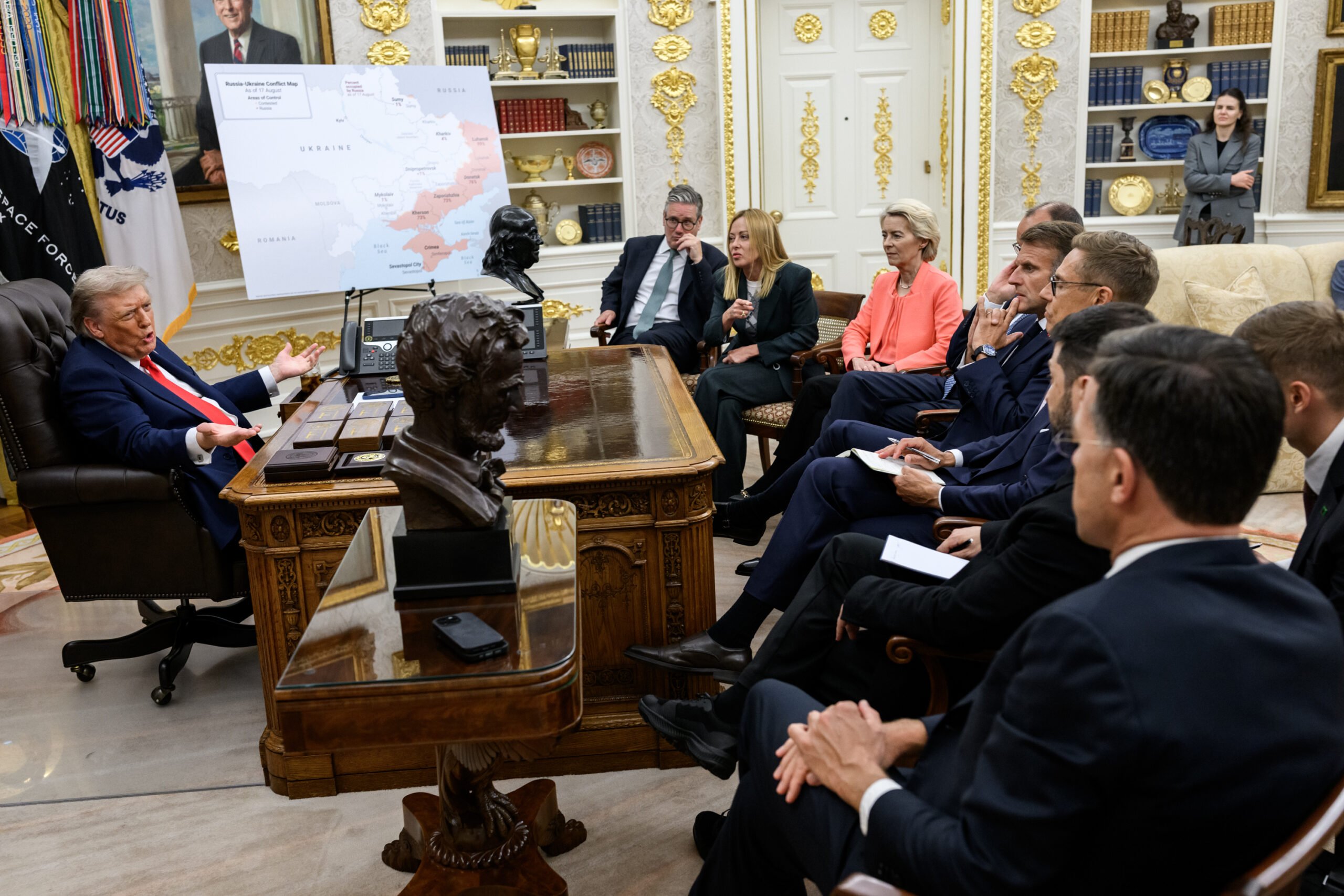
“A dead end” is how retired U.S. Army Colonel Robert (Bob) Hamilton described the U.S.-led process to achieve peace in Ukraine. The American initiative, he noted, not only failed to gain support from Ukraine and its European partners but was also rejected by Russia, despite offering terms far more favorable to Moscow than the European proposal.
In a conversation with Independence Avenue Media, Hamilton, the president of the Eurasia-focused Delphi Global Research Center think tank, explained why diplomatic efforts are unlikely to produce a ceasefire anytime soon. Moscow, he argued, is pursuing a broader strategy aimed at dividing the United States and Europe rather than engaging in substantive negotiations.
Hamilton described the limited options available to President Zelenskyy in this environment and Ukraine’s dependence on European political will as the U.S. refuses to provide new direct military assistance. He also examined the risks Ukraine faces, the leverage Washington still holds, and the careful diplomatic approach Zelenskyy must maintain toward the Trump administration.
Hamilton touched upon how the new U.S. national security strategy is reshaping transatlantic relations and prompting European governments to reassess their own security responsibilities. He also addressed the importance of a Ukrainian victory to European and American security, the challenges of sustaining public support, and the broader implications of the war for the international order.
The following interview, recorded December 9, 2025, has been edited for length and clarity.
Kartlos Sharashenidze, Independence Avenue Media: Colonel Hamilton, how do you see the Ukraine peace process developing at this moment?
Retired Army Colonel Bob Hamilton, Delphi Global Research Center president: There’s a two-track peace process, right? There’s the U.S. process, which seems to be engagement with Russia independently of engagement with Ukraine and often leaving Europe out of it altogether. That process is probably going to lead nowhere because the U.S.-Russian plan was a nonstarter for any of Ukraine’s European partners or for the Ukrainians themselves.
The revised plan, after the meeting between [U.S. envoy Steve] Witkoff and [U.S. President Donald Trump’s son-in-law Jared] Kushner and the Ukrainian delegation in Florida last week, was unacceptable to the Russians. So, I think the U.S.-led peace process is a dead end.
There’s a European-led process that incorporates more of Ukraine’s interests that may lead to a settlement, but Russia will reject that. Russia rejected the U.S.-led process, which was much more favorable to Russia. …
So, I don’t actually see either of them as likely to result in a ceasefire anytime soon. But the European-led process is far more realistic and far more grounded in morality, ethics, laws of war and everything else than the U.S.-led process, which I think is far too favorable to Russia, frankly.
IAM: Are we getting any closer to a deal?
Hamilton: No, … because Russia doesn’t want to deal. Russia believes it can win. I don’t think Russia believes it can win on the battlefield, because it can’t, not anytime soon and not at any acceptable cost, even to Russia.
But I think Russia believes it can either split the U.S. and Europe or split the U.S. from Europe and Ukraine, and that the U.S. will walk away from the process, and that the U.S. will use the leverage it has to try to force Europe and Ukraine into an unfair settlement. … The Russian hope is that the Trump administration gets frustrated. …
IAM: In an interview with Politico, President Trump said that Russia has the “upper hand” because it’s bigger and stronger, and that Ukrainian President Volodymyr Zelenskyy has to start “accepting things” because “he’s losing.” From a military and political perspective, what’s your take on that?
Hamilton: Look, it’s a fallacy to say the bigger, stronger party always wins a war. That’s ridiculous. We know from history that isn’t true. The U.S. lost in Vietnam. The Soviets lost in Afghanistan. The U.S. lost in Afghanistan after 20 years.
Weaker parties routinely defeat stronger parties. Weaker countries routinely defeat stronger countries in war. This is about national will and political will. And Ukraine has it.
To this point, Russia has it as well. It’s hard to speak of national will in Russia just because the Russian people aren’t consulted about this war and are frankly propagandized to the point where they do support it, … but what they’re not seeing is the true cost of the war. … They’re seeing a very sanitized version of the war. And frankly, there’s such a cost for speaking out against the war in Russia that we don’t know what Russian national will is. We know what Russian political will is, and that revolves around [Russian President Vladimir] Putin.
We do know what Ukrainian national will is, and we do know what Ukrainian political will is. And those have both been affected because it’s been a long, drawn-out bloody war. But to this point, I’ve seen signs of frustration in Ukrainian society. I’ve seen signs of frustration and exhaustion in the political class in Ukraine, but I’ve not seen any signs of wanting to give up or wanting to end the war on any terms possible or end the war on Russia’s terms.
This is a contest of wills, and it’ll be a contest of wills until one side decides that it can get a better deal at the bargaining table than it can on the battlefield. And to this point, neither side believes that.
IAM: At this point, what options does President Zelenskyy actually have in these negotiations?
Hamilton: President Zelenskyy’s plan is to rely as much as he can on the Europeans. Understand that the U.S. is not a partner in these negotiations.
He has to say the right things. He’s got to be very careful how he characterizes the Trump administration, the U.S. and President Trump. So, he said all the right things. He knows he can’t be critical. He knows he can’t express frustration. He knows Trump will take it personally. And he knows Trump is vindictive enough that he could do something like the U.S. did last spring, after the first Oval Office meeting in February, when the U.S. cut off intelligence sharing and paused military assistance.
The U.S. doesn’t give Ukraine direct military assistance anymore. In other words, under the Trump administration, we’ve not approved any new assistance, but there’s still billions of dollars of assistance in the pipeline. So, this is stuff that was authorized by Congress and appropriated by Congress under the Biden administration and is still being procured and delivered to Ukraine. So, the Trump administration could pause that, and it could also pause the agreement for Europe to buy U.S. equipment and then forward it and give it to Ukraine. … Unfortunately, the U.S. still has leverage over this process.
So, Zelenskyy has to be careful. He’s got to keep the Trump administration at least neutral or onside, if possible, but I think his best bet and I think his plan is to rely on the Europeans, which is why he met with [German Chancellor Friedrich] Merz and [British Prime Minister Keir] Starmer and [French President Emmanuel] Macron yesterday. He’s got to rely on European political will and European just seriousness and understanding of the stakes of this conflict in order to get a decent outcome.
IAM: Based on the new U.S. national security strategy, how do you see the future of transatlantic relations?
Hamilton: There was nothing good in the new national security strategy for transatlantic relations at all.
Europe understands now that from the security perspective, it’s alone. At least under this administration, the United States cannot be counted on to be a reliable partner for Europe in defending its own security.
In fact, the national security strategy — in the same strategy where it said [that] we’re OK with ideological and philosophical differences, and we will not try to democratize or meddle in the internal affairs of other countries, meaning Russia and China specifically — the strategy actually advocated for interfering in the internal affairs of our European allies and partners to try to bolster or prop up what the Trump administration calls patriotic parties, which are actually right-wing populist parties that try to dismantle democracy from inside.
For Europe, I guess it’s a wake-up call, but many Europeans probably were not shocked, because they had heard these words come out of the mouths of Trump administration officials. But to see it in writing in an official White House document, I think was a little… shocking. …
IAM: President Trump says Europeans need to do more. Are they doing enough?
Hamilton: Europe … has given more aid to Ukraine than the United States has. Especially since the Trump administration came into office, the U.S. has given no new aid to Ukraine.
Europe’s problem is one of capacity — chronic underinvestment in defense for decades — so there are things the Europeans just can’t provide to the Ukrainians that only the U.S. can. … We call it the PURL, the Prioritized Ukraine Requirements List, the agreement between the U.S. and its European allies that the Europeans can buy U.S. equipment and give it to Ukraine. … U.S. equipment being shipped to another country requires the U.S. to approve that.
So as long as that program stays in place, and Europe is willing to spend the money, and the U.S. defense industrial base can produce the equipment at a high enough rate to supply Ukraine’s needs, then Ukraine can still be supplied. But it’s going to take a lot of spending and a lot of political will on the part of European governments that frankly need to do a better job of explaining to their publics why it’s important that Russia lose this war and Ukraine win this war.
IAM: Why is it important?
Hamilton: Because Russia is an acute militarized threat to European security, period.
Russia invaded Georgia in 2008, it invaded Ukraine in 2014, and intervened in Syria 2015, invaded Ukraine again in 2022. It has been a serial violator of the sovereignty and territorial integrity of its neighbors since the collapse of the Soviet Union.
We talk about the 21st-century invasions, but it also intervened in Georgia, as you know, in 1992 in Abkhazia. It intervened in Transnistria, in Moldova.
So, Russia is an acute militarized threat to European security, which at least in my opinion, because of the size, the population, and the concentration of resources and the economic power of Europe, European security is indivisible from American security. So that’s why it’s important that Ukraine win this war and Russia lose this war.
Frankly, neither European governments nor the U.S. government have done a very good job of explaining to their publics why this is important. I think the people would support it. And most of the polls indicate that both [the] European and [the] American public support increased aid to Ukraine, or at least sustained aid to Ukraine, and support the idea of Ukraine winning the war and believe that Russia is the aggressor here.
And that’s without a sustained public relations campaign on behalf of any of the European or U.S. governments to explain to the publics why this matters. But if that were to occur, I think you’d see even greater public support, which could then translate into greater political will. If governments know that they have the people behind them and the people are willing to sacrifice a little bit in terms of increased taxes or reduced services in order to support Ukraine, then governments will have more political will to do this. …
IAM: What are the wider security implications of the outcome of this process? How might it change the current international order?
Hamilton: One of the major questions about the outcome of this war is where the United States stands when it’s over.
There’re two interrelated questions. One is, how does the war end? In some sort of stalemate in a de facto Russian victory and a de facto Ukrainian victory. What role does the United States play in bringing that outcome about? And then what role does the United States play in European security postwar?
Given what the national security strategy that the Trump administration just released says, it looks like the role of the U.S. in European security will be radically diminished. That the U.S. is going to retrench, is going to be focused on the Western Hemisphere, and then also on the Indo-Pacific regions, and appears to be willing to essentially seed a Russian sphere of influence in the former Soviet Union, probably minus the Baltics, which are already NATO members. And to assume that Europe and Russia will come to some sort of what they call in the national security strategy “strategic stability.” I think the assumption on the part of the U.S. is that the Ukraine war ends however it ends. Europe takes a greater role for its own security. And that means it spends much more on defense.
The U.S. wants Europe to spend more on defense by buying American equipment. I think that’s unlikely to happen. Because the Europeans now don’t believe they can trust the United States or rely on the United States as a sole security partner provider, you’re probably likely to see a long-term European reinvestment or reinvigoration in its own defense industrial base, and Europe then building some of these weapons and systems that right now it can only get from the United States — building its own versions of those, and building them at scale so that Europe can defend itself.
I think that’s the likely outcome of the combined effects of the war in Ukraine and the new U.S. national security strategy.
IAM: What gives you the most hope in these developments?
Hamilton: I hope that Europe has awakened. I hope that Europe will emerge as a strategic actor and a strategic counterweight to Russia on the continent of Europe.
… One thing about the Trump national security strategy that is pragmatic and realistic is it says we have to match our ends, or our objectives, with our means, or resources. The Trump strategy is, frankly, correct that many previous national security strategies set these lofty objectives, but they really weren’t willing to put the means, or the resources, toward achieving those objectives.
What I hope is that the U.S. will return to a more internationalist policy, meaning it will care more about NATO, it will care more about allies and partners, it will care more about European security, but it could be a little more restrained in terms of use of military power overseas. I think that that part of the Trump national security strategy is pragmatic and realistic.
We seem to be using a whole lot of military power in the Western Hemisphere against things that are not national security threats. They’re law enforcement and intelligence issues — migration, drug trafficking, things like that. So, I think that’s a mistake.
But I do think that the strategy is a little bit more pragmatic and restrained than some previous strategies. If that were to carry forward, but the U.S. were to bring some of that pragmatism and restraint but then return to its more internationalist role — a role that that actually cared about international institutions and alliances and partners and things like that — I think you could see a more constructive U.S. role in the world. And that gives me hope. That, and the fact that Europe may emerge as a real strategic actor, a military and economic heavyweight.
