
The Shatterbelt Brief is a weekly column by Brian Whitmore examining the shifting political and geopolitical dynamics of Eastern Europe and Eurasia. The views expressed are the author’s and do not necessarily reflect those of Independence Avenue Media.
So apparently it’s time to talk about Belarus again.
Remember those relay stations I wrote about in June? The ones Belarus was using to help Russia guide its drone attacks in Ukraine? The relay stations Ukrainian President Volodymyr Zelenskyy warned Belarusian autocrat Alexander Lukashenko to take offline — or else watch them be taken out by Ukrainian strikes. The ones Belarus reportedly took off line after the Ukrainian threat.
Yeah, those relay stations. Well, guess what? They appear to be back online.
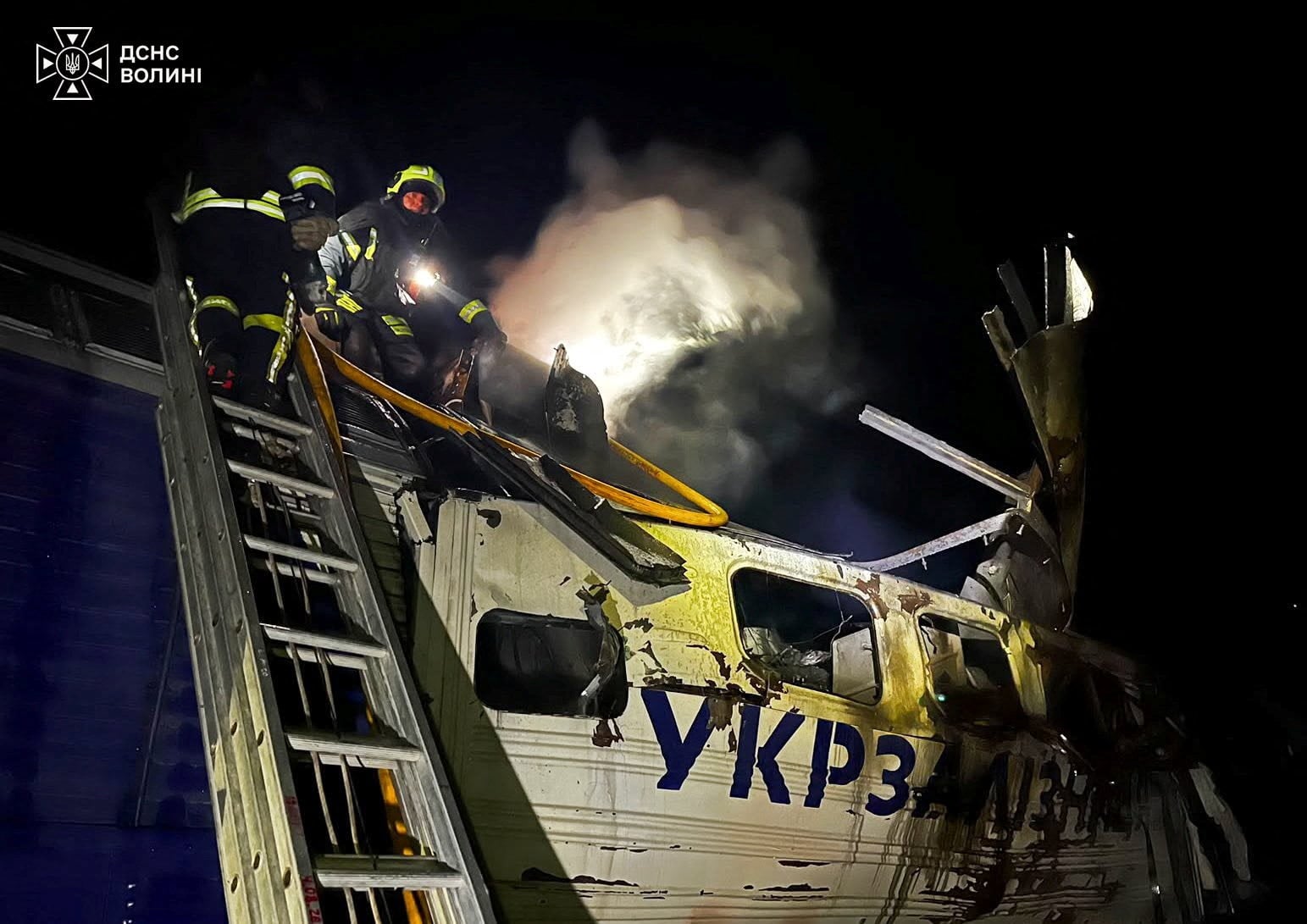
Col. Andrii Demchenko, spokesman for Ukraine’s State Border Guard Service, said the Russian drone attack that hit a train locomotive and a gas station near the Ukrainian-Polish border was guided by relay stations in Belarus. The train had been traveling from Kyiv to Warsaw, and its passengers included national security advisers from several EU countries, as well as former British Prime Minister Boris Johnson.
Demchenko also said that other recent Russian drone attacks in western Ukraine were facilitated by relay stations in Belarus. “We can see that Belarus has not stopped supporting the terrorist country, because airstrikes on Rivne, Volyn and Lviv oblasts were also effectively enabled from Belarusian territory,” he said. “The aerial assets launched by Russia were guided by signals relayed through stations on the territory of that country.”
And it wasn’t just Demchenko raising the alarm.
Serhii Beskrestnov, an adviser to Zelenskyy, said in a radio interview that the flight path of drones that struck western Ukraine in a massive attack on Sept. 12 suggests they were likely guided by relay stations in Belarus.
“If we look at the movement of jet-powered and conventional ‘Shaheds,’ they stay close to the border with Belarus,” he said. “I came to the conclusion that the ‘Shaheds’ probably have connectivity to Belarusian commercial LTE networks.”
Likewise, Oleh Ivashchenko, head of Ukraine’s Defense Intelligence, said that relay stations in Belarus are back online. He noted that the “relay stations are located along the border, and we have identified six of them on the territory of Belarus,” adding, “We have sufficient capabilities to deal with this.”
There are also increased fears that the Lukashenko regime in Belarus is not just acting as Vladimir Putin’s little helper in his war against Ukraine — but also in the Kremlin’s shadow war against Europe. Those fears were heightened this week when NATO fighter jets shot down a Russian drone in Lithuanian airspace. The explosive-laden drone entered Lithuania via Belarus. Lithuanian President Gitanas Nauseda has confirmed that Lithuanian investigators identified the wreckage as a Russian Gerbera drone.
Euronews quoted Vilmantas Vitkauskas, head of Lithuania’s National Crisis Management Center, as saying the drone flew over the town of Lentvaris, close to the Lithuanian capital, Vilnius, before fighter jets shot it down near the village of Pratkunai. “The incident puts Minsk back in focus not only for helping Russia carry out drone attacks against Ukraine, but now, also, as a source of drone threats to NATO territory,” Euronews correspondent Sasha Vakulina wrote.
There is no evidence yet of direct Belarusian complicity in the drone incursion into Lithuania. Nauseda suggested that the drone was originally aimed at Ukraine but was thrown off course and inadvertently diverted into NATO airspace by Ukrainian electronic warfare systems.
Nevertheless, Lithuanian Air Force Commander Antanas Matutis noted that Minsk provided no warning or information regarding the drone as it flew from Belarusian territory toward the Lithuanian border. It was Lithuania’s own air defense systems that detected the breach.
Ukrainian Foreign Minister Andrii Sybiha warned recently that the Kremlin is using Belarus as a staging ground for a destabilization campaign against Europe. Lithuania’s border guards have discovered a network of tunnels under its border with Belarus that appear designed to smuggle people into Europe. A report by the European Council on Foreign Relations in August noted that Russia was intent on using Belarus in its hybrid war against Europe, specifically by manufacturing and weaponizing a migrant crisis.
The renewed focus on Belarus’ role comes as Russia steps up its shadow war against Europe. Last September, NATO fighter jets shot down multiple Russian drones that had violated Polish airspace. In May, a drone carrying explosives hit an apartment building in Romania. In August, a Russian drone packed with military-grade explosives was used in a failed attack at an airport in Leipzig, Germany. And earlier this year, Lithuanian officials arrested nine people accused of plotting assassinations and sabotage across Europe on behalf of Russia’s military intelligence service, the GRU.
The Belarusian people clearly want no part of Russia’s war against Ukraine, nor do they want to join Putin’s shadow war in Europe. Neither, most likely, does Lukashenko. But with the Belarusian economy almost entirely dependent on Russian largesse and the Belarusian dictator’s political survival hanging on Moscow’s will, he is trapped.
Following Zelenskyy’s threat to take out Belarus’ relay stations unless they were taken offline, Lukashenko caved — briefly. But as Diane Francis wrote in the Kyiv Post, he was then “immediately summoned to closed-door meetings with Putin in remote Russia, where he was pressured to join Russia’s war against Ukraine.”
And if the relay stations are working again — guiding drones that kill Ukrainians — Belarus’ role as a combatant in this war should be clear to all.