




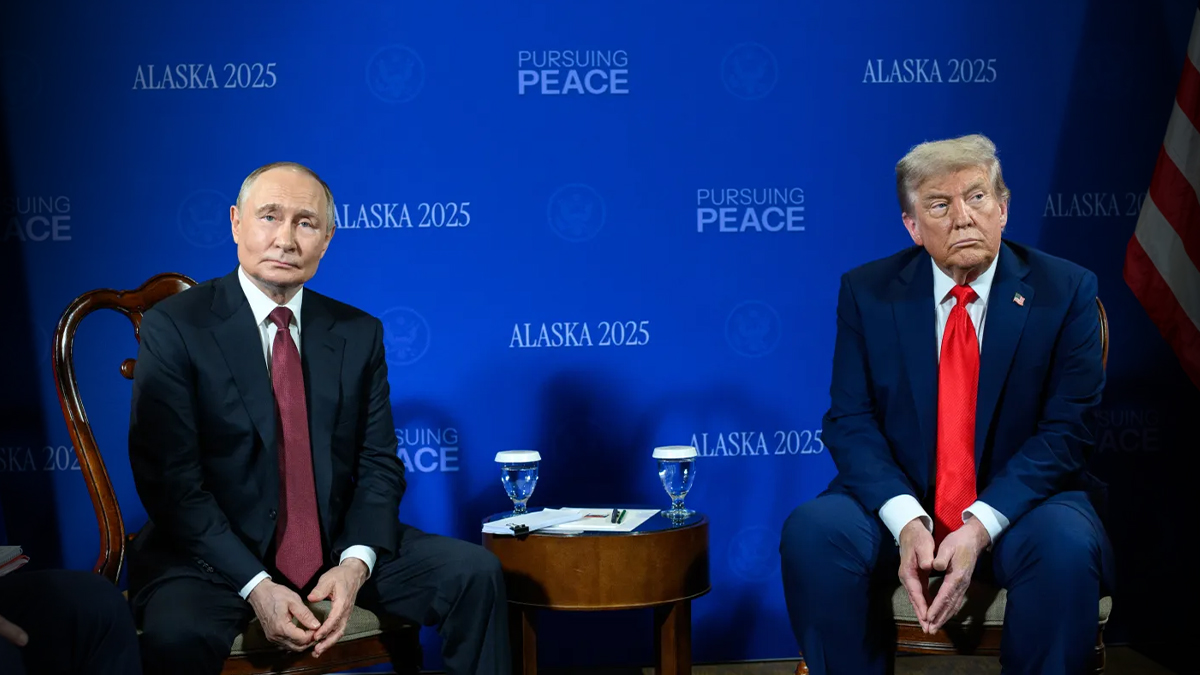
Angela Stent, a Georgetown University professor who previously advised the U.S. government on Russia while serving in the National Intelligence Council and at the Department of State, says that Russian President Vladimir Putin may be benefiting from the U.S.-Israeli military campaign in Iran.
In an interview with Independence Avenue Media, Stent says that the Trump administration has put the war in Ukraine on the back burner — and that Trump’s approach may be shaped by his perception that Putin is winning the war.
“I think [Trump] does believe that Russia is winning this war, or alternatively one could say he believes that Ukraine cannot win this war and that it should stop fighting sooner rather than later,” Stent says.
Russia had begun to show signs of economic pain in its fifth year of full-scale war in Ukraine, but it now stands to benefit from the rising price of oil and the Trump administration’s loosening of sanctions on Russian oil to help mitigate those prices, says Stent.
Conversely, with military resources tied up in the Middle East, Ukraine may struggle to obtain much-needed missile defense weapons.
“The longer the war goes on, the worse it is for Ukraine,” says Stent.
The following interview, recorded on March 10, 2026, has been edited for length and clarity.
Kiryl Sukhotski, Independence Avenue Media: President Trump said he had a good call with President Putin and that Putin was very helpful in the Middle East and wants to be constructive. And then the Kremlin said that Putin offered some fresh ideas for the peace plan in Iran to Trump. What do you think is Putin’s game here?
Angela Stent, professor emerita at Georgetown University: On the one hand, we know that Putin wants to keep on Donald Trump’s good side. He doesn’t want to do anything to lessen the U.S. pressure on Ukraine. He wants to keep the U.S. engaged. He wants to keep President Trump still dreaming about all the economic deals he wants to do in Russia.
Putin also, of course — now that some of these sanctions against Russian oil have been removed — would probably like those sanctions to remain removed. In other words, suddenly this is a boon for Russia, with very high oil prices and [India] can now buy oil from Russia [after being issued a temporary sanctions waiver by the U.S.], and other countries too.
And then, on the other hand, as long as the U.S. is still in this war, all those Patriot batteries that were supposed to go to Ukraine, they’re not going to go to Ukraine. In other words, it disadvantages Ukraine to have the U.S. continue this war. So I think Putin’s game at the moment is to maximize the benefits that Russia gets from this war and minimize any downsides.
I read the Russian account of the call. Actually, I didn’t see what President Trump said about this, but on the issue of Russia sharing intelligence with Iran that helps [identify] American targets, the Russian side didn’t say anything about it — so I’m sure that must have been an element in it too that was discussed.
IAM: And on those reports, President Trump over the weekend played down the importance of this sharing of intelligence information, saying that even if it did happen, it seemed not to help them much. Do you think that draws Russia into this conflict?
Stent: I don’t think it draws Russia any more than it has been drawn in. I think the fact that President Trump downplayed all of this shows that he also doesn’t want to antagonize Putin. And it’s also possible that he didn’t know, or have all the information on this. I think the fact that the Russians are saying that they can still play a role as peacemakers is quite telling as well. Because clearly the fact that this war broke out shows that Russia was unsuccessful in the months leading up to this, trying to put some pressure on their Iranian partners there to come to a deal with the U.S.
IAM: The Kremlin also said that this war in Iran “is not our war.” Was this a message to Washington? How will that be viewed by Russia’s allies in the Middle East and in the wider Global South?
Stent: From the Russian point of view and looking at its role in the wider Middle East and the Global South, so far the Russians haven’t done very much to come to Iran’s assistance. Iran was crucial in the first year or two of the war in Ukraine, by supplying Russia with the Shaheds [Iranian-made drones], which the Russians now can manufacture themselves.
And again, for countries in the Global South looking at this, it just shows that there are limits to what Russia is willing to do — certainly while this war is going on — to support countries that it views as its partners.
I think probably when this war is over, it won’t radically alter Russia’s role in the Middle East. Russia has suffered clear setbacks with the fall of [former Syrian leader Bashar] Assad in the Middle East, and now, again, with the U.S. war on Iran. But I think it’ll probably emerge from this reasonably in the same position as it was before.
But of course, we’ve already seen within the BRICS, for instance, which is an organization that Russia and China clearly tout as the alternative to Western-dominated alliances, differences of opinion. The Indians have been much more careful not to condemn what’s happening in this war because they view their partnership with the U.S. and with Russia, and by the way with Israel as well, as being quite important — so you don’t have unity there. So I think it also exposes the differences between the way that different countries that are seemingly partners of Russia view the war.
IAM: And you said that Putin is trying to find benefits for himself and for Russia in this U.S. operation in Iran. How successful do you think he will be in doing that?
Stent: Well, I think so far he’ll be successful as long as oil prices are this high, $100 [per barrel]. I think [Putin’s special envoy] Kirill Dmitriev the other day said they could go as high as $150. I mean, that’s a benefit. It’s not a permanent benefit for Russia, but at least at a time when the Russian economy is suffering and has been adversely affected by sanctions and then by lower oil prices, I think that’s definitely a benefit.
Also, as long as there are fewer weapons that can go to Ukraine that Ukraine needs, that’s a benefit to Russia. And at least on the Russian readout of the call between Trump and Putin, apparently what the Russians said was that President Putin explained to President Trump that the Russians were making these steady gains in Ukraine. So I think it’s to reinforce the sense with the United States that in fact, as Trump has said to [Ukrainian President Volodymyr] Zelenskyy many times, the Russians are winning this war, which belies the actual reality.
But that’s another thing I think that he wants to impress on President Trump, because clearly the major goal in terms of U.S.-Russian relations for the time being with Putin is to get Trump to force Ukraine, to force Zelenskyy, to give up the part of the Donbas that Russia doesn’t control.
IAM: You said that there are disadvantages for Ukraine. How big are those disadvantages and how concerned should Ukraine be by the developments?
Stent: I think the Ukrainians are very concerned by the developments. If there aren’t these weapons for the Europeans to purchase — particularly the Patriot batteries, but also other weapons from the U.S. like the air defenses that the Ukrainians need very badly — it’s going to put a lot more stress on the Ukrainians to continue fighting this war. They’ve made some territorial gains recently.
The longer the war goes on, the worse it is for Ukraine. Zelenskyy has offered, and apparently the Ukrainians are already helping Jordan and some other countries in the area with their expertise on how to counter Iranian Shaheds, which of course the Ukrainians have great experience with. And Zelenskyy is hoping that in return for that, these weapons will continue coming to Ukraine. But that’s not certain at the moment.
IAM: The U.S. is consumed by Iran right now. Cuba has been mentioned as a potential new destination for political change. Does that mean that the war in Ukraine has been put on the back burner in terms of the U.S. foreign policy? And what are the implications for Ukraine then?
Stent: Yes, I think the Ukrainian-Russian conflict is on the backburner now. I mean, we know that there were supposed to be trilateral talks last week, which didn’t happen, and we have no announcement that they’re going to happen soon. [Trump’s special envoy] Steve Witkoff says that he’s in contact with both the Russians and the Ukrainians on the next round of negotiations. We know that really very little progress has been made in these talks, with the exception of prisoner exchanges and some technical discussions between Russia and Ukraine on how you would implement a ceasefire.
I think the focus is on who’s next — and that could be Cuba. I think one of the things one has to watch for is if, as a result of all of this, the Trump administration decides, or President Trump decides, that he’s really not going to engage very much more in trying to end this war. The implications for that could be quite serious, particularly, again, if the Europeans don’t have access through [NATO’s Prioritized Ukraine Requirements List] PURL Program where they purchase weapons from the U.S. to supply them to Ukraine.
IAM: Throughout the crisis surrounding Iran, President Trump repeatedly said about the talks with Iran that they were not negotiating in good faith. When it comes to the talks in Ukraine, do you think Russia is negotiating in good faith with this administration?
Stent: I don’t believe that President Putin thinks that Russia is losing this war. He thinks Russia is winning the war. And there’s very little incentive for him to end the war now, unless the United States forces Ukraine to give up that part of the Donbas and then into all of the other concessions that Russia is demanding, including reducing the size of Ukraine’s military, promising that Ukraine will never seek to join NATO, and saying that there will never be any troops from NATO member countries on Ukrainian soil to monitor a ceasefire.
So, if Trump were able to force Ukraine to agree to all of these conditions, I think there would at least be a ceasefire for now. Whether Russia in a few years would then reinvade Ukraine remains to be seen. But I think there’s very little incentive for Russia — so I think that they are not negotiating in good faith to end this war, but to try and wear the Ukrainians down, wear the United States down, and of course ensure that Europe is really not at the table, which the Russians don’t want.
IAM: So you said that Putin believes that Russia is winning this war. Do you think there are hints that Trump may believe that Russia is winning that war, and that shapes his approach to this peace settlement?
Stent: If you listen to what Trump says, when he repeatedly tells Zelenskyy that he doesn’t have any cards and that Russia has all the cards, and he has several times, quite recently even, implied that the reason why the war continues is because Ukraine is continuing the war, not because Russia is, I think he does believe that Russia is winning this war, or alternatively one could say he believes that Ukraine cannot win this war and that it should stop fighting sooner rather than later.
IAM: Do you think there’s anything in the U.S.-Israeli operation in Iran — you said that obviously the Kremlin sees quite a lot of upsides there — but do you think there’s anything there that could have unsettled the Kremlin or the Russian elites?
Stent: Yes, we now know that there will be this leadership transition to [former Supreme Leader Ayatollah Ali] Khamenei’s son [Mojtaba]. But I think for [the Russians], maybe at the beginning of this war, certainly, if they had really thought that a government might come to power in Iran that would rethink its relationship with Russia and rethink its relationship with the United States, that would have been very unsettling for Moscow.
Many years ago, a former Russian diplomat was quoted as saying that a pro-American Iran is more dangerous for us than a nuclear Iran. So I think that would be a nightmare scenario for the Kremlin if Iran really switched course. But that’s clearly not likely to happen now. And it’s possible that this could have been something that at least was discussed yesterday between the two leaders in terms of the new [Iranian] leadership.
RELATED STORIES:
- War by Nonmilitary Means: How Russia Negotiates
- Steven Pifer: Conflict in Iran Shows Limits of Being Russia’s Friend
- Targets, Objectives, and End States: A Military Assessment of the U.S. and Israeli Operation Against Iran
- Is It Possible to Reopen Ukraine’s Lviv Airport? Boris Johnson Says Yes
- The Arms Race Is Here — and America Should Embrace It — a National Security Strategist Says
