




Estonia’s ambassador to NATO and a former defense and foreign minister tells Independence Avenue Media that stakes in Ukraine go far beyond the battlefield. If the war ends with a peace settlement that rewards Russian aggression, he argues, it will embolden the Kremlin and weaken NATO’s ability to deter future threats. He says a unified Western effort remains essential for Ukraine to prevail.
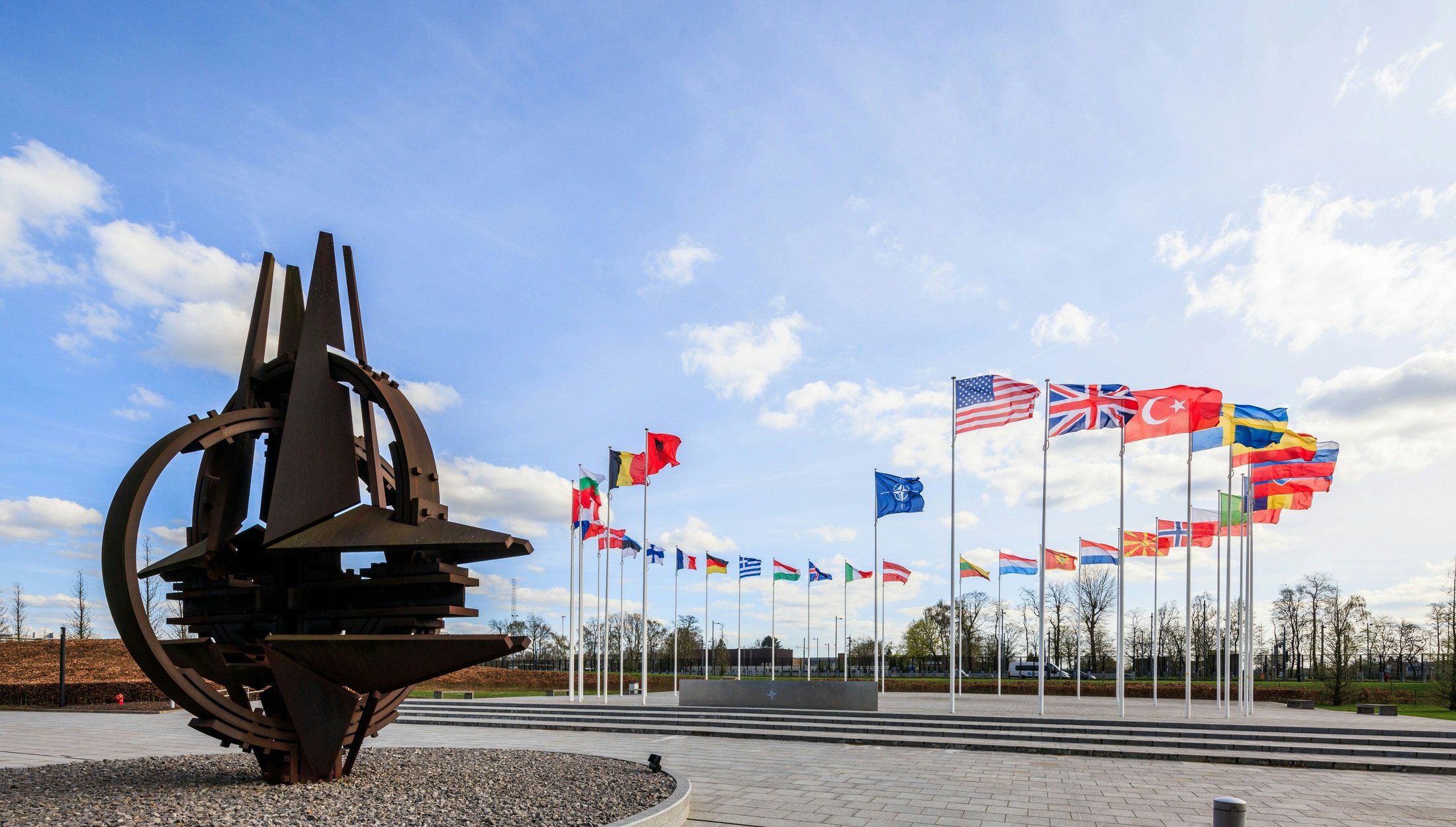
In an interview at NATO’s headquarters in Brussels, Belgium, Luik discusses Washington’s approach to Moscow and Europe following months of U.S. engagement with Russia. He also outlines the pressure points shaping European security — from sanctions enforcement and Russia’s shadow fleet in the Baltic Sea to defense spending targets and developments in the Black Sea and South Caucasus, including Georgia.
This February 4, 2026 interview has been edited for length and clarity.
Ia Meurmishvili, IAM editor in chief: Ambassador Luik, thank you very much for finding the time to talk to us today. Let’s start from the Secretary General’s [Mark Rutte’s] visit to Kyiv. How do you assess it? What signal do you think it sent to Ukraine and to Russia?
Juri Luik, Estonia’s ambassador to NATO: I think the main signal was that the Western community, writ large, and NATO still stands behind Ukraine and we are ready to support Ukraine even — and especially — when the things go very tough. I think it has a lot of symbolic value that Secretary General was there during the bombing. It’s also very important that Secretary General is a very strong supporter of Ukraine in various fields, especially when it comes to providing air defense equipment to Ukraine, especially organizing the special channel where U.S. is providing weapons but Europeans are paying for it. It’s a fairly complex system and obviously not everybody wants to pay. So, to keep it all together and to keep the channel open is really, I think, one of the big achievements of the Secretary General. So all in all, I think a very good visit, symbolic visit, but also a strong message to continue to help Ukraine.
IAM: What’s at stake for Ukraine and for the alliance and European security in Ukraine?
Luik: There are various aspects to it. I would start with the most important and most obvious, which is that deterrent works psychologically, and if Putin can see that in the end, through all the thick and thin, he will win and he gets what he has always wanted, then obviously this strengthens his hand and also psychologically he will be more prone to other actions. If he loses, then it’s another very strong signal and of course it provides a strong added layer of deterrent also for NATO. We are not directly involved in these battles. But of course, indirectly, there’s no doubt that also NATO’s prestige is on the table.
There are also operational and tactical issues when it comes to Russia subduing Ukraine and having a lot of assets and a lot of resources, which theoretically they can get their hands on. But of course, I would say that most dangerous part is that if might makes right and if you can grab land without any consequences, what would stop you from doing it elsewhere? And also it’s a very important signal for Putin about Western unity, because there’s no doubt that Ukraine can prevail only if there is a unified Western effort against Russia. If that is missing, then of course, again, it’s a signal to Russians that everything is basically allowed.
IAM: Peace talks have intensified. What do you think about that process? Do you think we’re getting closer to peace in Ukraine?
Luik: I might caveat my answer by saying that, of course, we are not insiders in a sense that we don’t get daily information about what is happening in the talks between Ukraine, United States and Russia. Of course, there is this strange situation whereby everybody is looking at Ukraine-U.S. talks but of course, Ukraine and U.S. do not have a conflict. So it is not clear. I mean, I would say it’s clear that U.S.-Ukrainian talks go relatively well, or the situation has clearly improved. There are certain commitments on security guarantees, both through coalition of the willing and most likely also through the United States.
But on the other hand, the Russia piece is sort of missing. It seems Russians have not changed any of their positions. If they don’t compromise, it’s difficult for me to see whether these peace talks have any bright perspective.
IAM: How do you assess America’s willingness to engage Russia in this? Because we’ve seen that time and again that President Trump tries to have overtures towards President Putin, but it’s not working. So how does that look from the European, from your perspective?
Luik: Well, again, I think we don’t know all the details. We mainly know what we see on our TV screens. Obviously, this is not the whole story. I think one of the key issues for us is how would this treaty or agreement, which is planned between United States and Russia, bilateral agreement, how this will turn out because there is very little visibility, there is no publicity on what are the delegations talking about, even that we don’t know. I think th jury’s out and it remains to be seen.
On the other hand, there’s no doubt that for Russians, the only country which they both respect and fear is the United States. And they don’t have a feeling that they could do anything against the United States. It was visible when the United States took over one of the tankers from the Shadow Fleet, which had a Russian flag, which was Russian sovereign territory. And Russians basically didn’t do anything or had some meager comments. So it’s clear that U.S. has a lot of power over Russians. The hope is that they will use it in the most responsible way. But I think also that in the U.S. administration, the knowledge about the issues, the details, the stakes have risen. I think there is more understanding now also about the Ukrainian position.
IAM: The U.S. has taken a number of steps to go after the Venezuelan or, as you mentioned, Russian tankers and shadow oil. And there is a feeling that not enough is done in the Baltic Sea. How do you see that? Do you think enough is done to stop the movement of oil through the Baltic Sea? And what else can the Allies do? What else can you do?
Luik: Well, I think for us, when it comes to shadow fleets, the key is unity of effort. Because it’s obvious that if it is only the job of Finland and Estonia to stop the ships, then Russia has an upper hand. I mean, militarily, as you know, they have used warships to escort their shadow tankers and it would be terribly imprudent if it would be only our responsibility to deal with that issue. In fact, it is easier to deal with Shadow Fleet on the other side of the Danish Straits. We know what these ships are, where they are going. Some of them are turning left, if you will, and going towards China and India from one side. There are some who try to go through the Northern Passage crossing for instance, some of the Nordic allies. So, I mean, we basically know every ship, which is a shadow fleet ship. So we can stop them anywhere. We don’t have to stop them, the Baltic. And I think the French have done a lot of good work here. They have stopped ships. They stopped one near Brest, have now stopped. And another one, I hope that all allies would pitch in. It’s obvious that it is safer for doing it even in the Mediterranean.
IAM: Five percent. Do you think it’s achievable, and do you think it’s enough?
Luik: In a sense, it’s achievable if governments are ready to invest that. European countries have a lot of resources which are not used for military purposes. Many EU countries are used to welfare state and are not ready to risk that for, of course, political risks for governments. On the other hand, I think the fact that we managed to agree on 3.5 percent on real hard military spending was quite an achievement. And now it’s important to look at what the countries are actually doing. Whether they are actually spending this money, where are they spending this money, are they creating real new military capabilities, or are they just using this money to pay higher salaries to their officers and soldiers.
IAM: Or did they just agree to the 5% because President Trump asked for it?
Luik: There are clearly countries also who sort of, who bent under pressure from the US administration. It’s a fact that if we ask what has been the kind of the two strongest influences here, it’s President Trump and of course also President Putin by his war efforts. So that has brought home to many countries, especially in Western Europe, that you have to do something. Of course, we have to come to 5 % only within 10 years. And the risk is that some countries will be saying, we don’t do much today, but we’ll raise the budget over time, perhaps on the ninth or tenth year. And that is, of course, something which is unacceptable. Of course, for countries like Estonia, there is no doubt that we have to spend 5%. We, in fact, spend over 5%, and it’s all hard military expenditure. It’s not kind of accompanying measures, soft measures, defense related, where you can really put anything under this definition.
IAM: Do you think this 5% could be an issue at the next summit when President Trump looks at some of the allies and says that this is not what we agreed on at the previous summit, so I’m going to decrease support or I’m going to do something about U.S.’s involvement in NATO?
Luik: I think it’s entirely conceivable that something like that will happen. There’s no doubt that for the United States the Hague Summit was a great success story. But of course when he comes to Ankara there’s also no doubt that even if he doesn’t want to talk about it the media will talk about it and will ask, look, President Trump, you achieved this in Hague, but now doesn’t seem to be going anywhere. What’s your position? So there’s no doubt that he will have to comment on it. And if the figures don’t pan out, then I think he can be very, very critical. I don’t think the U.S. commitment to NATO is at risk here, but clearly that would lead to big problems, especially to countries who don’t spend because the U.S. administration is picking very precisely the countries who they see as they call them “model allies” and those who don’t spend enough.
IAM: The Black Sea, the new renewed sort of energy in the NATO partnership with Armenia and Azerbaijan… and where do you see Georgia in this?
Luik: The Black Sea, of course, especially now when you look at the situation with Russian aggression to Ukraine, is one of the key strategic sort of playing grounds. And obviously it is a complicated environment for many reasons. NATO doesn’t have free access to the Black Sea of course because of the Montreux Convention. So NATO countries who surround the Black Sea, have immense responsibility, including Turkey, Romania, Bulgaria, and they are basically doing their best. Obviously, the situation around the Black Sea should be looked at in wider context, at the regional context.
It’s really true that the agreements and the understandings between Armenia and Azerbaijan have created a lot of sort of positive feeling about the region and a lot of hope. And when you look at the future of Armenian-Azeri relations, then especially considering the positions of the two leaders, leaders of two countries, Pashinyan and Aliev, it seems everything is going in the right direction. I, again, I must say I have to give credit to President Trump and his administration who did a lot of heavy lifting in bringing the two countries who have a lot of difficult heritage to the table. So let’s see, but it’s hopeful.
When it comes to Georgia, I mean, for me it’s an especially sad story. I have always considered myself as a strong supporter of democratic Georgia. I have visited the country many times. I’ve been an there for the Georgian Defense Ministry and to see the Georgian democracy crumbling and to see the Russian influence getting stronger and stronger… it’s very bad for Georgia and for Georgian people, but it’s also very bad for the whole region because Georgia was a beacon of democracy. Georgia was the country which gave hope to other countries. But I hope, of course, also that Georgia will return to the road which I think is supported by the majority of Georgian people, which is democracy.
See more:
