Russian President Vladimir Putin raised the question of Europe’s security order to deflect pressure on Moscow to agree to a ceasefire in Ukraine, former Swedish Prime Minister Carl Bildt tells Independence Avenue Media.
“I think he wants to talk about virtually everything else but the ceasefire,” Bildt says. Europe has leverage, he adds, because its governments “can just say no to any changes.”
Bildt also says that Russian President Vladimir Putin has had considerable success persuading President Donald Trump to pressure Ukrainian President Volodymyr Zelenskyy to accept the Kremlin’s demands.
One reason it hasn’t been effective, he says, is Europe.
“They know that their original thought — do a deal with Trump, and Trump imposes that on Zelenskyy — doesn’t work,” says Bildt, who also served as Swedish foreign minister from 2006 to 2014. “And one of the reasons it doesn’t work is the strong European support, financial and political, for Zelenskyy.”
Bildt contends that Putin pushed to add Europe’s security architecture to the agenda of the U.S.-brokered talks because “he wants to talk about virtually everything else but the ceasefire.”
But, he says, whether or not the Europeans are at the table, they “can just say no to any changes.”
In a wide-ranging interview with Independence Avenue Media, Bildt says the Trump administration’s negotiating strategy has so far failed. He argues that the only way to stop the war is to add to the pressure on the Kremlin, making it eventually realize that continuing is untenable. The Ukrainians, he says, are doing part of that themselves. He points to Ukraine’s recent strikes on the Kerch bridge and on a Russian ship in the Gulf of Finland as evidence that Kyiv is learning to operate without U.S. systems.
“Both must have been done without any Starlink or other connection,” he says. “They’ve found ways of doing that on their own, with different technological solutions. And prolong that by six months or 12 months — they might be even more capable of doing things on their own.”
This interview was recorded on Nov. 24, 2026, and has been edited for length and clarity.
Ia Meurmishvili, editor in chief, Independence Avenue Media: You recently published a piece where you’re arguing that the only thing to talk to Russia about is stopping its war in Ukraine. What prompted you to write that?
Carl Bildt, former prime minister of Sweden: What prompted me to write that is that we have an ongoing war, and the priority is obvious: to end that particular war. Ending the war does not mean peace, because there will be X number of different issues to be dealt with after the guns have stopped blazing or the bombs have stopped falling. But as long as the guns are blazing and the bombs are falling, I don’t think there will be any progress on some of the major policy issues that lie ahead of us.
So stopping the war — a ceasefire — that is the priority. And I think all efforts should be concentrated on creating the conditions for that, and that is to a large extent, or almost wholly, a matter of increasing pressure on Russia and making clear to the Russian leadership — the president and everyone around him who could have any influence — that not only is there no way of them winning, but as a matter of fact they are going to get into increasing difficulties the longer they delay the ceasefire.
IAM: You’ve long been critical of the negotiation tactics from the U.S. side, by special envoys Steve Witkoff and Jared Kushner. Why is that?
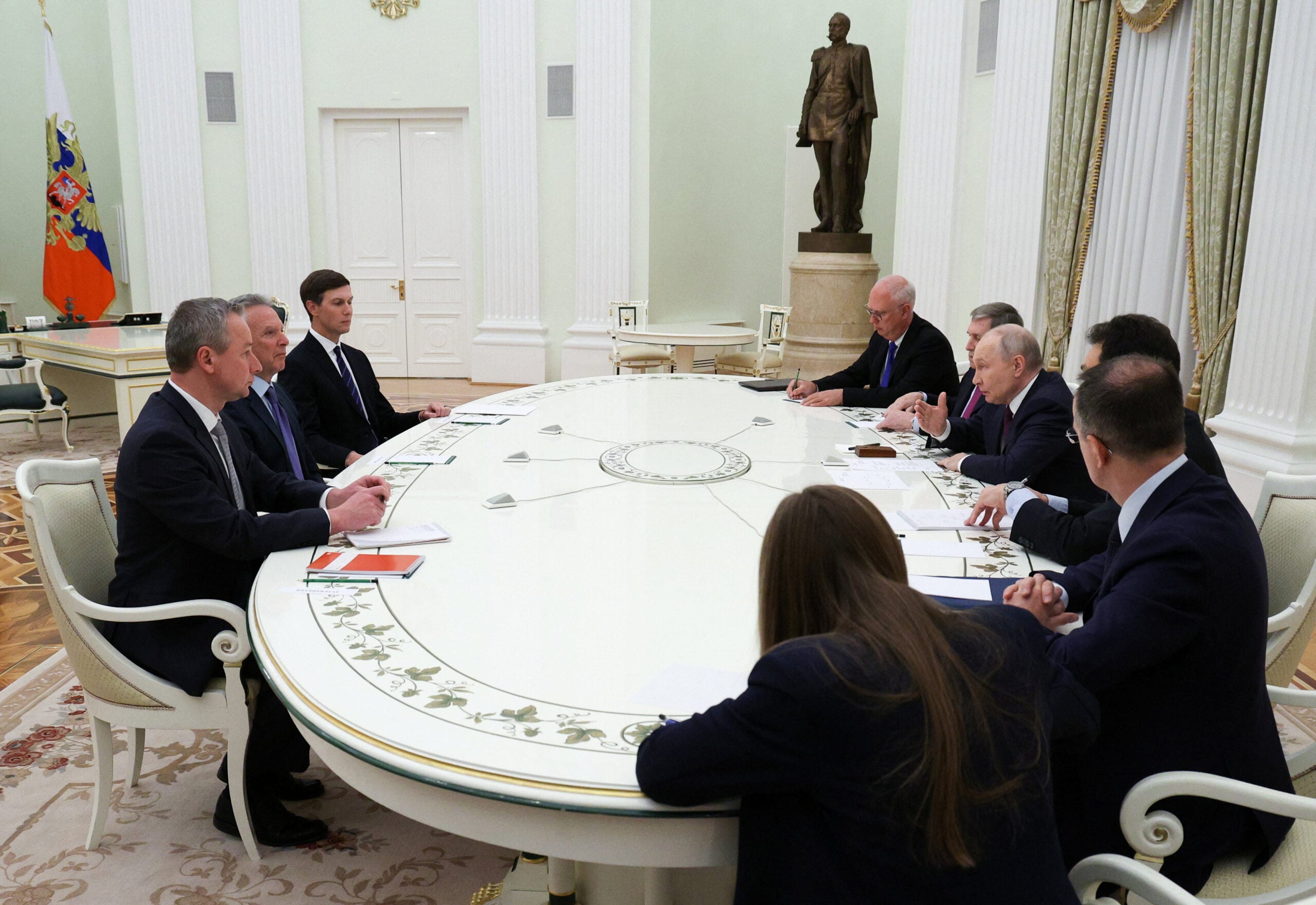
Bildt: President Trump was on the right trajectory, calling for a ceasefire, up until Anchorage [the August 2025 Trump-Putin summit in Alaska]. And in Anchorage he was obviously taken on board by Mr. Putin for another strategy, which was to say: no ceasefire, but we need to have major concessions from Ukraine prior to ending the war.
And de facto, Trump undertook to try to pressure Zelenskyy into agreeing to some sort of version of Russian demands. And that is what Mr. Witkoff has been trying to engineer, and the Russians have been trying to get incentives of an economic nature to Mr. Witkoff in order to facilitate or encourage Trump along this particular path. I think that was bound to fail from the very beginning, and obviously it has failed up until now.
And that is what I think one should concentrate on now: try to get the Americans to understand that even they must now pressure the Russians for a ceasefire.
IAM: Those negotiations have evolved into something different. Initially it was ceasefire or peace negotiations between the U.S., Russia and Ukraine, and now we’re talking about a much larger issue, which is the European security architecture. How did we get here? Why do you think Russian President Vladimir Putin wants to talk about this topic?
Bildt: I think he wants to talk about virtually everything else but the ceasefire. And I think when he threw the European security architecture into the pot, prior to the Abu Dhabi talks a couple of weeks ago, that was to deflect pressure from a ceasefire — a diversionary maneuver. They haven’t put very much on the table. They have reminded people of what they said in December of 2021, which wasn’t taken seriously then and is taken even less seriously now.
And there haven’t been any real talks about those particular issues either. So I think that was a way to avoid the real issue, and accordingly it’s not going to lead anywhere. As I said, after the end of the war, when we go into prolonged negotiations with Russia, there are obviously issues of confidence-building measures, or there might be arms control issues, or there might be issues related to that, that could or indeed should be on the table. But clearly we are not there yet.
IAM: Do you think Europe has the leverage to be a part of these talks? Should Europe be present at these talks?
Bildt: In terms of the European security order, the Europeans have huge leverage. We have a European security order — we have the Helsinki Accords and the Paris Charter and other documents — and the Europeans can just say no to any changes, which I think they should. So no is the answer, and that is leverage.
On the overall talks, I think the Europeans have a lot of leverage in the sense that, with the Americans having gone elsewhere, it is European support that is the precondition for the Ukrainians defending themselves. And accordingly you see the Russians, or the Kremlin, being increasingly irritated with the Europeans for that particular reason. They know that their original thought — do a deal with Trump, and Trump imposes that on Zelenskyy — doesn’t work. And one of the reasons it doesn’t work is the strong European support, financial and political, for Zelenskyy. So they can’t get around the Europeans, however much they want to get around the Europeans. And Europeans might not be at the table, but nothing is happening at that particular table. You can say that Europeans are shaping the table, even if they are not at it.
IAM: You’ve argued that this war will be decided not by negotiations but on the battlefield. And recently you also highlighted the tremendous losses for Russia on the battlefield. How do you see that part of the war going, on the battlefield?
Bildt: I think the battlefield is obviously going to be critical, but the war will be decided in the Kremlin, essentially, when they understand that they can’t win on the battlefield. So the battlefield is critical, but it is the conclusions that the Kremlin draws from its inability to move the battlefield forward that are going to be decisive.
War is by its very nature a very uncertain business, but so far we can note that in 2025 the Russians failed to move the front lines to any significant degree. In 2026 they failed to move the front line to any significant extent. They’ve been talking about some minor percentage back and forth, but essentially they are stuck controlling less than 20% of the territory of Ukraine.
Is there any possibility of them making a major breakthrough — getting the rest of the province of Donetsk, which seems to be their main objective? It could happen. I haven’t met anyone who really believes it will happen. And that’s why, at some point in time, I think Mr. Putin will stop believing in these fake reports that he’s captured one village after the other, and understand that he’s capturing virtually nothing of significance, and indeed he’s starting to gradually lose — and the longer he delays the ceasefire, the worse it will get.
IAM: In addition to the battlefield losses and the tremendous human loss that Russia is experiencing at the moment, do you see anything else to compel him to realize that, OK, you cannot win this war?
Bildt: Yes. In addition to that — that being the critical one, as we agreed — the next important issue is, of course, that he understands that European support is holding up. It might be that he’s been hoping that one or another domestic development in one or another country is going to lead to the Europeans giving up support for Ukraine. That’s not going to happen. There will be debates, there will be discussions in X number of countries, but I see no sign — no sign — of any fundamental breach in the support for Ukraine this year or next year, or — well, the future is unpredictable — but within the foreseeable future.
Then, I do think that even if he has perhaps given up the hope that Mr. Trump will deliver Zelenskyy, the Trump administration is helpful for Russia. And after the midterms, we don’t know how constrained Mr. Trump and his entourage are going to be. But clearly the Kremlin must see that at some point in time, from their point of view, there’s a risk of U.S. policy starting to shift in an even more unfavorable direction. And that could be another incentive for them to at least end the kinetic phase of the war.
IAM: That’s interesting, but would that also mean that they will intensify their efforts at the moment? And if so, what would that look like?
Bildt: They are intensifying it in different ways. They are trying to engage Witkoff and Kushner on different ideas. I think the different economic schemes are still there. I saw a recent interview with Donald Trump — fairly entertaining — in which he told how Putin had told him how the election that Trump lost had been profoundly rigged. So Putin is playing Trump in the most obvious ways, in the hope that he will be helpful in putting pressure on Zelenskyy.
And of course [the Americans] can delay different shipments. There’s a report in the Financial Times, as you might have seen, that they are delaying, from the American side, deliveries of American weapon systems that have been paid for by the Europeans. And whether that is a bureaucratic mess in the Pentagon — not to be excluded — or whether it’s deliberate delays — not to be excluded — we don’t know. And the Russians can clearly hope for these sorts of things to happen, in order to increase pressure on Kyiv.
IAM: Despite those delays and some of the hiccups in this process of providing Ukraine with weapons, we are seeing something very different. Ukrainians sank a Russian ship very close to Libya. That’s quite far from the Black Sea. What does that tell you? Is Ukraine going after Russian assets outside of immediate Ukrainian waters and territory? Do you think that’s a good idea or a bad idea?
Bildt: I think it is an unavoidable consequence of the fact that these are two countries that are at war. And if Ukraine has the capability of striking Russian military assets anywhere else, they are clearly going to do it, and they have, from the point of view of international legality, clearly the right to do it.
We see, to some extent, of course, the same happening here in the Baltic Sea. We had the Ukrainian strikes against a Russian ship supplying Kaliningrad the other day. Exactly how they did it, I don’t know, but this was a moving target in the Gulf of Finland. And obviously the Ukrainians are further developing their capabilities independently of American supplies, and are capable of doing things that I think will impact decision-making in the Kremlin. We saw the strike against the Kerch Bridge, and the Kerch Bridge is likely to have been — apart from the Kremlin — probably the single most defended spot of Russia in terms of different countermeasures and different defensive systems. But the Ukrainians broke through in a rather impressive way.
IAM: How do you see that scenario evolving? Can Ukraine sustain this operation, or intensify this operation, if America becomes even less helpful than it is now?
Bildt: I think they can. It’s going to be more complicated. But take both the Kerch operation and the Gulf of Finland operation. Both must have been done without any Starlink or other connection. So evidently the Ukrainians have found a way — and that applies to some of these other strikes against refineries far away in Russia. They’ve found ways of doing that on their own, with different technological solutions. And prolong that by six months or 12 months — they might be even more capable of doing things on their own.
Clearly they want to have American support. American support is important to them. But it’s fairly obvious also that they are making big efforts to create systems so they can be more independent of the Americans. And also fairly obvious that they are starting to succeed with that.
IAM: Mr. Prime Minister, we just saw two Russian missiles fly into Polish airspace, and therefore NATO airspace. Jets were scrambled and statements were made, including by NATO Secretary-General Mark Rutte, who said that NATO will defend every inch of Polish territory, and therefore NATO territory. What do you make of it? Is Russia testing NATO? And how do you find the response that we saw to that?
Bildt: I haven’t seen the details of it as of yet. Was this a deliberate thing by the Russians, or was it — which I still think is more likely — a couple of cruise missiles that were part of a big attack package against the west of Ukraine happening at that time? We know there was a big package of cruise missile strikes against the west of Ukraine. And it might have been that two or three of them went astray into Polish territory. That’s, I think, most likely. It could also have been a deliberate thing; we don’t know.
NATO reacted with fighter aircraft. They didn’t manage to shoot them down. It might be that the reaction time was too limited. They flew a fairly limited distance into Polish airspace, so it means that the time they spent in Polish airspace before they crashed can’t have been very many minutes, and that makes it very difficult to react sufficiently fast. But fighter aircraft were scrambled, and that was important.
IAM: Do you see a possibility of NATO protecting at least western Ukrainian skies? This conversation has been around for quite some time. The foreign minister of Poland [Radoslaw Sikorski] has been one of the most active proponents of this — to defend western Ukraine from all incoming projectiles coming toward NATO from Russia. Do you think that idea is now gaining more of a foundation? Do you anticipate anything happening in that direction from NATO?
Bildt: I don’t see it at the moment, but I guess that staff people are writing papers about the possibilities. It would have to include deploying quite substantial assets in western Ukraine. Even if you could operate fighter aircraft from bases in Poland, that requires a lot of assets [in Ukraine], and it also would require a system for identification of friend and foe in Ukraine, because Ukraine now has a lot of air defense systems, which are shooting at everything in the sky, essentially, because everything in the sky is hostile. If you have NATO aircraft flying around there as well, you need to sort that out so that we don’t have friendly-fire incidents of different sorts.
So it’s a complicated issue. I don’t see it moving in that direction at the moment, but I hope that papers are written and that there are people who are trying to sort out the complexities of it, to see if there could be a possibility further down the line.
IAM: Post-midterms in the United States, do you think some of the tensions with the European capitals and Brussels will be alleviated? How do Europeans see the results of the U.S. midterms?
Bildt: I don’t see any immediate easing of the situation. The problem hasn’t been Congress. The problem has been the White House. And the only change we’ve seen in the White House is that Stephen Miller has become chief of staff. And you can interpret that whichever way you want, but it’s difficult to see it as something that is immediately going to lead to the easing of the tension across the Atlantic on different issues.
So President Trump and Stephen Miller and whoever — [U.S. Defense Secretary] Pete Hegseth or whatever — they are likely to be there for more than two years. And they are the ones — [U.S. Treasury Secretary] Scott Bessent, [U.S. Commerce Secretary Howard] Lutnick and others on all the trade issues — they are there, and they are, from the transatlantic point of view, the more problematic part. It will be far easier with a Congress that is more open to classical security and transatlantic views. There will be hearings, and they will apply pressure, and they will form opinions in different ways than they could before. But the decisions are still taken in the executive branch, and by the president.