When a Russian strike outside the eastern Ukrainian city of Kramatorsk killed the family he lived with this summer, Nick, a playful, black-and-white husky, was the only survivor. Wounded by shrapnel and concussed, he was extracted from the wreckage of his home by animal rescuers, and given a second chance at life.
But as Russia continues to bombard Kramatorsk and nearby Sloviansk, those rescuers are now struggling to accommodate the thousands of dogs, cats and other animals left homeless by the strikes or by owners fleeing the bloodshed and destruction.
At Animal Rescue Kharkiv, one of several shelters that handle front-line animal evacuations in the Donetsk region, staff say the influx of animals — everything from dachshunds and Siamese cats to farm animals — has increased at least three to four times since the spring. The organization’s three facilities in Kharkiv, about 200 kilometers northwest of Kramatorsk and Sloviansk, have roughly 1,500 dogs and 300 cats waiting to be rehoused.
The internationally funded shelter, which estimates that it has rescued more than 35,000 animals from eastern Ukraine’s conflict zone since 2016, regularly builds new housing for its residents. But, with as many as 40 dogs arriving on one recent night, staff emphasize that adoptions are essential to keep up with the pace.
“If you adopt one dog from us, you’re actually saving two,” says Yaryna Vintonyuk, the shelter’s communications director, who, like other employees, has adopted one of the shelter’s dogs. “Because you’re making room for another animal to come into our care.”
Adoption inquries have come from throughout Europe, Canada and the United States, but, as local conditions worsen, the need has grown. In the first two weeks of September alone, the organization evacuated 280 animals from front-line locations, and fielded 30 applications per day for help, the Kharkiv affiliate of Ukraine’s public broadcasting company Suspilne reported.
That month, an estimated 18,000 people evacuated or independently left Ukrainian-controlled parts of the Donetsk region, local officials say. A mandatory evacuation zone for children has since been expanded following Oct. 8 Russian attacks on Kramatorsk that killed 35 people and injured more than 30 others.
Animals whose owners cannot take them along often are left to the charity of neighbors or the fate of circumstances. Roughly half of the Animal Rescue Kharkiv’s evacuees have injuries or chronic diseases that require treatment. Many arrive starving.
Staff concede that most of these animals will never see their owners again.
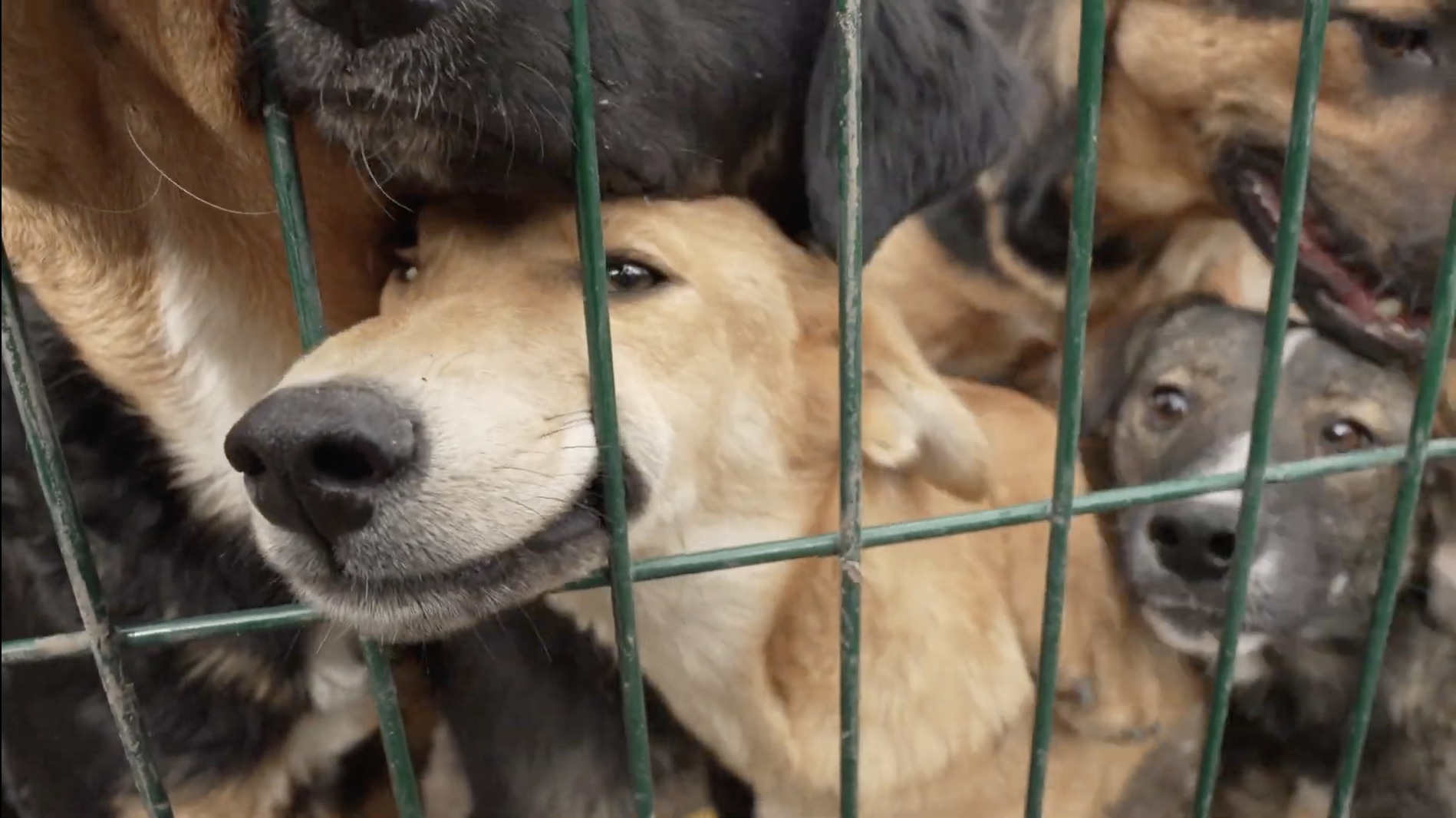
Nonetheless, at the shelter’s clinic, workers vaccinate, photograph and register each animal to identify them in case they do return.New arrivals are walked twice a day until they are assigned an enclosure of their own. To fit them all in, some mid-sized dogs share cages, and larger dogs — including at least one German shepherd — are kept in cages built for smaller animals.
For all these animals, stress levels from the war can run high. Tymosha, a black-and-white spaniel found guarding his abandoned house in the Donetsk region, wears a protective collar to prevent him from biting himself. A small white dog, recently rescued, remains frozen in place from fear, unwilling to eat or move.
“Because they’re under constant stress, their bodies can no longer cope with things they normally could at their age,” says Animal Rescue Kharkiv veterinarian Diana Halilova.
Coping is a challenge for the rescuers, too. In August, a Russian strike on an Animal Rescue Kharkiv vehicle evacuating animals from the Kramatorsk area injured one French volunteer, Florian, and a colleague, Ruslan.
Still, the pair saved seven full-grown dogs, 14 puppies and nine cats.