With defense and intelligence officials warning that Europe is failing to deter Russian “hybrid” attacks across the continent, a longtime Pentagon official says it is time for the West to “move beyond resilience” and begin “fighting back.”
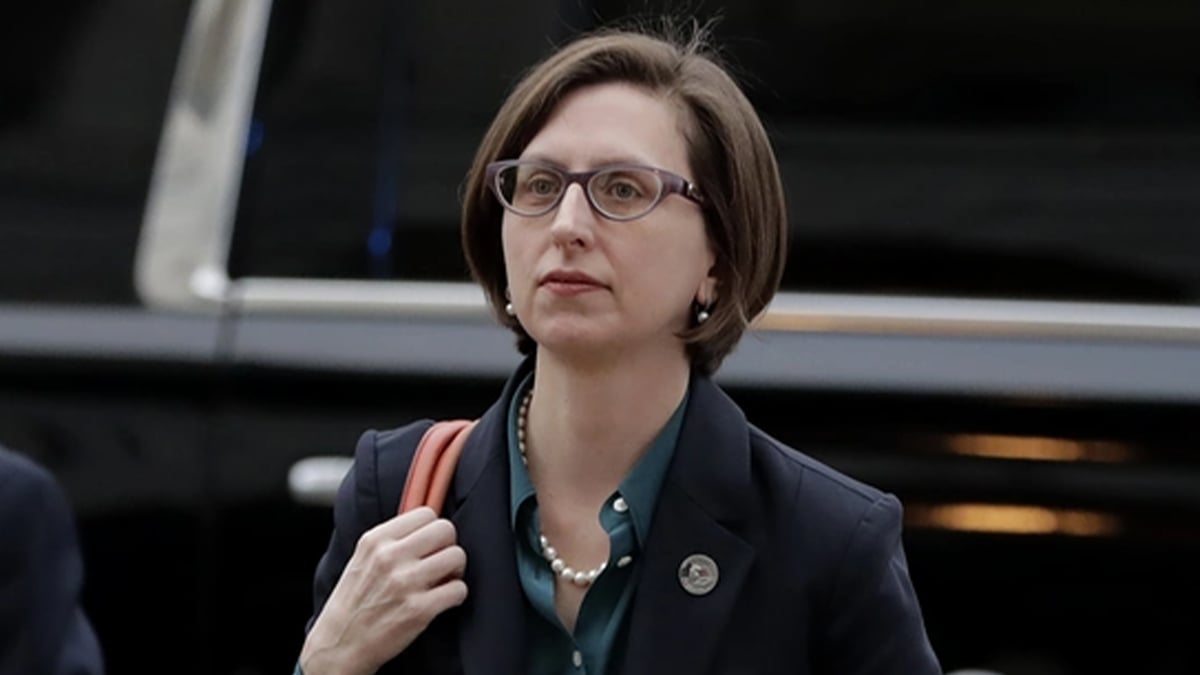
“There’s been a real focus on closing the barn door after the horse has left,” says Laura Cooper, who served as deputy assistant secretary of defense for Russia, Ukraine, and Eurasia from 2017 to 2025. “The reality is that we should have responded more forcefully prior to this point. We shouldn’t have let it get this far.”
On Sept. 2, German officials blamed Russia for a failed August attack at Leipzig airport in which explosive-laden drones targeted planes but failed to detonate. European leaders have also accused Moscow of blowing up railway tracks in Poland, flying drones into the EU and organizing a series of arson attacks across the continent. Cooper says the attacks are meant to destabilize Europe and weaken support for Ukraine without rising to the level of something that would cause NATO to invoke its Article 5 collective defense guarantee.
“In this hybrid space — in this so-called shadow war — we need to be fighting back,” says Cooper. “And some of that is not going to be visible. Some of that will happen in a manner where Russia will see it — Russia might not understand exactly where it’s coming from — but we need to develop those kinds of options as well, and we need to cooperate with our allies on this, so that we’re doing it in a coordinated fashion.”
The wide-ranging interview with Independence Avenue Media took place a day before Jared Kushner and Steve Witkoff, President Donald Trump’s special envoys, visited Moscow and then Kyiv. Cooper says the trip to Kyiv — the envoys’ first after multiple visits to Moscow — is an important symbolic gesture.
“It has created a perception that the United States was siding with Russia,” she says. “And I think having the envoys do some work to reverse that perception is to the benefit of an outcome that is actually peaceful. So I think that’s very, very positive.”
Cooper also spoke about the state of the war, saying that Russia would likely test Ukraine’s resolve for another winter, but that Kyiv’s technological edge and deep strikes into Russia had strengthened its hand — and put Russian President Vladimir Putin in an uncomfortable position.
“He’s always had this kind of social compact with his population: the people who go to fight in this war, the people who are affected by this war, are compensated — they’re given handsome bonuses, death benefits for their families — and the rest of Russia will not feel touched by this war, so he can maintain that support. Well, that is no longer the case,” she says.
This interview was recorded on Sept. 4, 2026, and has been edited for length and clarity.
Glenn Kates, executive editor, English, Independence Avenue Media: Laura, the German government this week blamed Russia directly for a failed drone attack at the Leipzig airport in early August. This is part of what seems like Russian sabotage increasing in both frequency and scale. What’s the danger of this spiraling into something larger?
Laura Cooper, former deputy assistant secretary of defense for Russia, Ukraine and Eurasia: I think at this point it is absolutely imperative that Europe and the United States stand very strongly together to deter any future attacks. Because at this point, if you look at Putin’s mentality, he doesn’t really see the downside to continuing these attacks. What we’re witnessing is increasing not just frequency, but increasing potential lethality of these attacks. So this could get worse, and it could lead to something more severe, unless there is a determined approach. Now, I have to say, I think it’s very positive that Germany has come out relatively quickly on these hybrid attacks and identified Russia as the culprit. And it’s also positive that Germany is looking at actually making their intelligence services able to take action — whether it’s their own sabotage or cyber operations. Now, their parliament still needs to approve this, but this does represent a shift, and I think it’s because our European allies are concerned that this could get significantly worse.
IAM: Those were drones that were supposed to explode and didn’t — what if people had died? What do you think Europe and NATO’s reaction would look like in the environment we’re currently in?
Cooper: Unfortunately, I think NATO and our European allies and the United States are only now really beginning to think about what kind of concrete response actions they would take in the event of loss of life, or more severe attacks than what we’ve seen. The reality is that we should have responded more forcefully prior to this point. We shouldn’t have let it get this far. Because as we know, Russia responds to strength. It does not respond to weakness. So I think that the development of those response options is critical. We have to move beyond resilience. There’s been a real focus on closing the barn door after the horse has left. The drone wall concept [a proposed counter-drone shield along NATO’s eastern flank] is an excellent concept, and it is something that’s important. But in terms of resilience — that will not equate to deterrence.
IAM: Put yourself in your former position at the Pentagon. What would be your recommendations in terms of what European countries, NATO and the U.S. should be doing in this situation?
Cooper: I think it’s a multi-pronged approach. You do need to continue with things like dialogue that aims to prevent miscalculation and clearly telegraphs our policies and our actions. You also need to keep up with conventional deterrence. We know that this is the bread and butter of what NATO has done for decades, but recent questions about the U.S. commitment to that posture have raised doubts, I think, in the minds of both Europeans and in the minds of Russians. So the U.S. needs to signal that we will maintain a sufficient conventional posture to help deter Russian aggression. And then in this hybrid space — in this so-called shadow war — we need to be fighting back. And some of that is not going to be visible. Some of that will happen in a manner where Russia will see it — Russia might not understand exactly where it’s coming from — but we need to develop those kinds of options as well, and we need to cooperate with our allies on this, so that we’re doing it in a coordinated fashion.
IAM: So when we’re talking about hybrid warfare — what does fighting back look like
Cooper: Again, Russia is trying to undermine our unity and create a sense of weakness. We need to find ways to show Russia that they are not immune, and that we are able to reach them where it hurts — where it damages their war effort, where it causes domestic weakness in a way that causes Putin to question what he is doing, question how he is prosecuting the war in Ukraine. And ultimately, the most important objective in all of this is to drive to a peace settlement that gives Ukraine its sovereignty back, and that shows Russia that it cannot win through this kind of aggression in the future.
IAM: And when you talk about things that would make it harder for Russia to fight its war — on the Russian side, we’ve seen attacks on the electrical grid in Germany, we’ve seen cyberattacks. Is that something the West could potentially do inside Russia as well? Is that what you’re talking about in terms of engaging more forcefully in the hybrid war?
Cooper: I don’t think we should stoop to hurting civilians inside of Russia. I think there are plenty of appropriate military targets, and you certainly see the Ukrainians zeroing in on many of those targets. Russia has a pretty vast war machine, and we have been trying to pick apart pieces of that through, for example, strong export controls and sanctions. We’ve seen the Ukrainians take a stronger hand with kinetic strikes. But that war machine is vast, and it includes people, and it includes machinery, that all have their own unique vulnerabilities.
IAM: What do you think Russia is trying to achieve with these attacks inside Europe
Cooper: I think Russia is trying to get the Europeans and the Americans to call it quits with respect to supporting Ukraine. I think they’re trying to undermine that support for Ukraine, and they’re trying to drag out the timeline as well, because they think that time is still on their side. Putin feels like he can pummel Ukraine throughout this upcoming winter, and he knows that Ukraine will not have sufficient ballistic missile interceptors to withstand that pressure. So, in the meantime, his best approach is to try to prevent the allies from continuing to support Ukraine, and keep up the divisiveness, so that any response to Russian aggression — in Ukraine or in a future Europe scenario — is divided, weak and slow.
IAM: And speaking of that future Europe scenario — we’ll get to Ukraine in a little bit — there have been reports that U.S. intelligence is more worried than before about a potential Russian incursion into NATO territory. And in fact, some reporting has said that that’s why CIA Director Ratcliffe flew to Moscow last month. Do you think an actual Russian incursion is likely at this point?
MORE: ‘The Russians Are Preparing Something’ — Why the CIA Director Flew to Moscow
Cooper: I think one thing to keep in mind is that NATO as an alliance has been looking at the potential for Russian conventional — and nuclear, for that matter — aggression for decades. And they have thought about it, they have planned for it, and they have forces aligned for it. So Russia knows this, and I don’t think that Russia would want to play into NATO’s strength. I think what we’re probably looking at is consideration by Russia of a whole range of options. We talked about the hybrid war options — they could involve drones, they could involve sabotage. There are a lot of options in the so-called active-measures space that Russia is familiar with. But you could also imagine incursions with much smaller numbers of forces than the traditional scenario, making it harder to detect, and less of a standard play. So I think we have to look for all of these things. I don’t think that Russia wants a head-on fight with NATO. So if NATO shows that it is prepared to respond, and if NATO does respond to hybrid threats, I think that can actually deter a Russian attack.
IAM: Do you think Russia still sees Article 5 security guarantees as credible?
Cooper: I think Russia is always trying to undermine Article 5 security guarantees. And I don’t know that they would have arrived at a conclusion that they have in fact been successful. But every sign that Washington is in a different place than London or Paris or Berlin, every sign that Washington or any other NATO ally is pulling back from support to Ukraine — this is something that Russia watches closely. And then it seeks to exploit and to test.
IAM: In a Truth Social post this week, President Trump said that the Biden administration had given far more munitions to Ukraine than the U.S. had used in Iran. And he made a point of emphasizing that these were free of charge, as he said. You were, of course, one of the people spearheading Ukraine defense aid in the Pentagon. Do you think his characterization is accurate?
Cooper: There are two aspects here that deserve discussion. One is the falsehoods that are contained within that statement, and the other is the reason why we were doing it in the first place. When you take the facts, it is categorically untrue that the U.S. provided — I think in this quote he probably said something like hundreds of billions; there have been other outlandish figures that have been mentioned publicly. The actual figures were: for security assistance, it’s roughly $65 billion, and for economic assistance, it’s roughly $50 billion from the United States, up until the point where Trump very suddenly and sharply decided to discontinue future U.S. security assistance.
Now, what’s important about these numbers — it’s not just that it’s different from what was contained within that quote from the president. It’s also that the European numbers are very different from the characterization. By the time I left office, in January 2025, the Europeans actually had met our contributions in terms of security assistance, and they had exceeded what we were spending in economic assistance. And now they’re over $100 billion more than what we have been spending. If you look at percent of GDP — which is a classic characterization that we use to measure spending, because you’re measuring it proportionate to the size of a country’s economy — by percent-of-GDP terms, the U.S. was No. 14. So that means 13 other countries were doing more as a percentage of GDP. You wouldn’t know that to hear the statements that come out of politicians who are trying to disparage U.S. investments and trying to make it sound like our allies weren’t pulling their share.
Another thing to consider with this: this wasn’t an IOU. The U.S. Congress, when they appropriated these funds, they didn’t do so with an IOU attached. The reason they decided to invest that much of U.S. taxpayer resources is because they knew that if we didn’t invest a lot up front, the Ukrainians risked being overrun by Russia, and that would threaten the security of all of our NATO allies — that would pull us into something that would be much more costly. And it was better to invest in Ukraine’s defense at the outset than to risk the safety and security of our largest trading partners. Not to mention the signal it would have sent to Xi Jinping or other dictators if Russia had gotten away with this — what would they think they could get away with? So the facts are different, and we can’t forget the rationale for this, because that still holds.
IAM: In terms of the munitions: at the beginning of the Iran war, in the first few days, President Zelenskyy had said that the U.S. had used more Patriot interceptors than Ukraine had used in the first four years of the war. Do you find that accurate, as far as you can tell?
Cooper: So I can’t speak to the precise numbers, because I don’t have the current operational data. What I can tell you is that when we were providing security assistance to Ukraine, I always wanted to be able to provide more than we actually provided. And one of the reasons we couldn’t provide more was because we were very conscious of making sure that we weren’t adversely impacting U.S. military readiness to the point that we would be at a disadvantage in other theaters around the world. We recognized that these munitions needed to be preserved for other potential warfighting scenarios. So while we did provide Ukraine with a tremendous amount of assistance — excellent quantities and capabilities — there were limits to what we could do. But we were responsible in making sure that we were balancing those national security interests, even as we were giving Ukraine as much as we felt like we could.
IAM: Let’s move to the battlefield. I know you visited Ukraine not too long ago. Right now, as we’re heading into winter, there are several things going on at once. Ukraine is continuing its long-range strike campaign against oil and economic infrastructure in Russia. Russia, on the other hand, has been taking advantage of Ukraine’s desperate need for air defenses, like Patriot interceptors, which we’ve talked about, and over the last few weeks in particular has pretty much sustained continued attacks on Kyiv, using ballistic missiles but also more advanced drones with jet motors. The front lines, meanwhile, are barely moving. What’s your prognosis for the next few months?
Cooper: Russia is trying to bring Ukraine to its knees this winter. And this is the same playbook that Putin used last year. He thought that last year he was going to break the will of the Ukrainian people. So he will try that again. He will have an advantage, because of the paucity of ballistic missile interceptors available. But the Ukrainians survived last winter, and they have taken some prudent measures to try to prepare for this winter — like stockpiling natural gas, for instance. So it’s not a clear win for Putin. And in fact, every time he bets on breaking the will of the Ukrainian people, he fails. This is just something that keeps happening repeatedly, and we should have the expectation that this winter will be the same in that regard.
At the same time, those Ukrainian strikes that you mentioned into Russian territory — targeting in particular Russia’s refining capability, in addition to its Amazon equivalent, Wildberries — these types of strikes fundamentally undermine the very basis of legitimacy that Putin has used for this war. Remember, he’s always called it a special military operation. He’s always had this kind of social compact with his population: the people who go to fight in this war, the people who are affected by this war, are compensated — they’re given handsome bonuses, death benefits for their families — and the rest of Russia will not feel touched by this war, so he can maintain that support. Well, that is no longer the case. You’ve had Russians lining up for hours waiting to get gasoline. They’ve seen gasoline prices spike. The war is visible everywhere in Russia. How this plays into pressure on Putin and on his decision-making has yet to be determined. But we have already seen the government showing skittishness. Certainly, they continue to jail people for minor acts of dissent. But they also banned the Yabloko party — an opposition party — after they had allowed it on the ballot for the September parliamentary elections. And it’s very clear that Putin is nervous going into these parliamentary elections later this month. So we’ll have to watch and see how that pressure accumulates, how it builds, and how it might affect Putin’s thinking.
I believe that even as he’s preparing this predicate for a potential attack on NATO — we just heard him in a speech talk about Western sharks ready to devour Russia, trying to show that Russia’s under attack — even as he builds that predicate, he’s still trying to show that he’ll talk to the Trump administration, that he’ll receive Trump’s envoys on the peace process. He’s still trying to keep that avenue open.
IAM: You mentioned Putin trying to keep a line open with Washington. Shortly before this interview, news came out that it’s likely Trump’s advisors, Steve Witkoff and Jared Kushner, might be heading to both Moscow and Kyiv over the weekend. Two questions there. What’s the significance of the visit? And do you think Ukraine has changed the situation on the ground enough that it will change the dynamic with Witkoff and Kushner as well?
Steve Witkoff and Jared Kushner went from meeting Vladimir Putin in Moscow to talks with Volodymyr Zelenskyy in Kyiv — with Washington now pushing to restart trilateral negotiations between the U.S., Ukraine and Russia. For now, diplomacy has been revived. But a comprehensive… pic.twitter.com/7NZAZuo7cN
— Independence Avenue Media (@indavemedia) September 7, 2026
Cooper: So I think what is very significant, if it occurs, is the Trump envoys meeting with the Ukrainian leadership in Kyiv. I think that has been very much lacking in these negotiations so far. It has created a perception that the United States was siding with Russia — Americans, Europeans and Russians all had this perception — and I think having the envoys do some work to reverse that perception is to the benefit of an outcome that is actually peaceful. So I think that’s very, very positive. In other respects, I don’t really see this as likely to lead to a breakthrough, simply because I do believe that Putin is still wanting to push the war over the course of the winter. I think he still sees that his forces could have an advantage in that time period. But you have to lay the groundwork for any agreement, and you have to start negotiations, and it can take a very long time. So it is good to have the beginning of dialogue now. I think it’ll be important to include the Europeans in some way, since they are the ones right now footing the bill. And one of the things that will be really important is how much support we give to the Ukrainian armed forces in the long term. So bringing the Europeans to the table will be important.
IAM: Do you think this is Putin’s last hurrah — to see what he can do this winter? If Ukraine remains standing in the spring, is he more willing to compromise?
Cooper: I think we can’t count on him to throw in the towel after this winter. There are a lot of troubling developments inside his country that I’m sure he’ll be concerned about, but that doesn’t mean that he’ll be ready to give up. The thing to think about, though, is how the Ukrainian advantage can evolve. If the U.S. stays strong and actually resumes security assistance to Ukraine — as we’ve heard some positive rumblings from the U.S. Congress — and if the Europeans continue with their phenomenal support, especially if they unlock Russian sovereign assets in addition to the support they’re providing, and Ukraine continues with its technological development, we could see Ukraine emerge next summer with a formidable ballistic missile capability, with an even better cruise missile capability than they’ve had in the past, with a suite of counter-drone capabilities — including against these jet-powered drones, which they already are making progress at intercepting. And they might even be on the cusp of a counter-ballistic-missile interceptor. So Ukraine needs to hold on, but they have a lot of promise ahead.
IAM: In terms of the technological edge and the partnerships: Mykhailo Fedorov, the former defense minister, was in Washington this week and has started his own fund. His first backer is Alex Karp from Palantir. How significant do you think that is?
Cooper: Fedorov is a very talented person, and I know that he caused many of us a good deal of consternation when it felt like he was veering into politics in a divisive way recently, with his call for elections that most Ukrainians renounced. So I am really heartened to see him in this role of trying to generate Western investment for Ukrainian defense technology. I think it’s something that can leverage his talents and incredible insights into the technologies and the Ukrainian defense industry. And so I really wish him luck in generating additional Western interest.
IAM: And my final question. You mentioned potential U.S. funding for military aid. The Pentagon has reportedly delayed a contract for $400 million in aid to Ukraine that has already been approved by Congress. The funds, of course, would be used to purchase American-made weapons. Why do you think the Pentagon is delaying those contracts? And what happens with those funds if they’re not obligated?
Cooper: Now you’re venturing into the realm of the law, and I am not a lawyer. But I would say that it’s completely inappropriate that the department is not investing this funding that was legally required by the U.S. Congress. It’s not a lot of money, frankly. It’s a little bit embarrassingly low in terms of support for the Ukrainian armed forces, given the needs and given our national security interest. But this is funding that would go to U.S. industry. This would help American jobs. So there’s really no reason why it should be held back. And I think it’s up to the U.S. Congress to take a stand and to be able to enforce the laws that they actually pass.
IAM: And what do you think are the effects of delays like this?
Cooper: At this point, I think overall U.S. credibility has been damaged — in Europe, in Ukraine — because of the lack of security assistance, and because of the feeling that the U.S. is not committed to the success of Ukraine as it used to be. So it’s not just this one assistance package. It’s kind of an overall state, in which Ukraine has always looked to the United States as their No. 1 partner. They have always looked to the United States and our support for freedom — our story of liberty and freedom — and it has been a great disappointment to see how we’ve pulled back.