




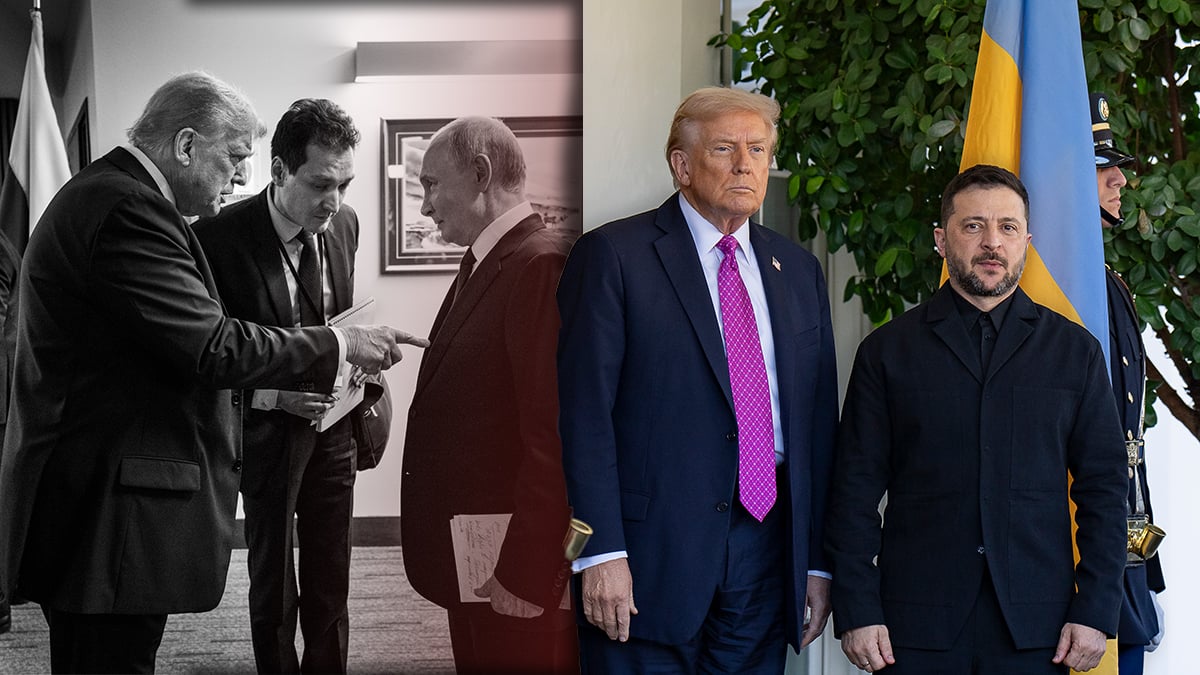
During his presidential campaign, Donald Trump promised repeatedly that he would end the war in Ukraine before or within 24 hours of his return to power.
Nearly a year into Trump’s second term, the war shows no sign of abating. Conflict-related violence killed more than 2,500 Ukrainian civilians in 2025, the deadliest year for that group since 2022, according to a U.N. report.
The year 2026 will not likely deliver a quick peace, but it will determine whether diplomacy can move beyond talk and evolve into a strategy capable of changing the Kremlin’s calculations. What lies ahead, analysts say, is not a breakthrough measured in days, but a complex and prolonged effort to persuade Russia to agree to a ceasefire and return to the negotiating table.
The decisive factor will not be rhetoric, which has largely failed. Instead, experts say, it will be the combination of Ukraine’s military resilience, Western unity, and the willingness of the United States to use real political and economic leverage, including tougher sanctions on Russia and long-term security guarantees for Ukraine.
Russian indifference — or intrigue?
Political scientist Serhiy Kudelia, a professor at Baylor University, told Independence Avenue Media in December that the process toward a ceasefire would take at least six to eight months, in part because of Russian President Vladimir Putin’s indifference to pressure.
“Sanctions do not matter to him,” Kudelia said. “Rhetorically, Russia continues to maintain a highly aggressive position toward Ukraine, using confrontational language.”
Putin’s indifference may stem from his certainty that he won’t be punished if he fails to heed Trump’s warnings. Former U.S. Ambassador to Ukraine Steven Pifer noted that while Trump had repeatedly voiced dissatisfaction with Putin over the year, the Kremlin never faced meaningful consequences for refusing to agree to a full ceasefire— the outcome sought by the United States, Europe and Ukraine.
Trump “set at least five deadlines for Russia to agree to a ceasefire. And the Russians blew past and ignored every one of those deadlines,” Pifer said. “But there were never any consequences, … and that sent Moscow a message.”
Daniel Fried, former U.S. assistant secretary of state for European and Eurasian affairs, sees a different motive behind Russia’s inaction. Peace negotiations stalled, he said, not because of Kyiv’s position or Western unity, but because Moscow’s strategy is to negotiate indefinitely without reaching a conclusion.
“We need to push through this Russian resistance, and we have tools to do so,” Fried said. “But until the Trump administration realizes what it is dealing with, which is Kremlin stonewalling, we will not get where we need to be.”
Putin indicated at a press conference in December that he was prepared to seize more Ukrainian territory, Kudelia said. The Russian leader’s stance, he said, “is a signal that without substantial Western assistance, the negotiation process will not be able to reach any result.”
Economic strategies
Former U.S. national security adviser H.R. McMaster, however, senses vulnerability behind Putin’s stoic façade. Although the Russian leader projects readiness to fight until victory, McMaster said, he faces significant internal problems that could eventually push him toward greater flexibility at the negotiating table.
“The economy is in a shambles as he sits on piles of cash that he can’t convert. His economy is stagnant,” said McMaster, a retired U.S. Army three-star lieutenant general, adding that Ukraine’s damaging attacks on Russia’s fuel infrastructure could also play a persuasive role.
Washington still has unused leverage capable of changing Moscow’s calculations, Fried said. These include tougher sanctions, more effective restrictions on Russia’s access to financial markets, and the use of frozen Russian assets to support Ukraine.
Pifer said that transferring frozen Russian assets to Kyiv would force Moscow to confront the reality that Ukraine would have enough resources to finance its military for another three to four years. He also recommended tightening existing sanctions, increasing the number of Russian shadow fleet tankers under sanction and finding ways to prevent the flow of Western high-tech goods into Russia.
In October, the Trump administration did apply significant pressure on Russia’s economy by imposing sanctions on its oil giants Lukoil and Rosneft, as well as their subsidiaries. According to a Department of Treasury statement, these were due to “Russia’s lack of serious commitment to a peace process to end the war in Ukraine.”
“It kind of looked as though Trump was getting fed up, and he needed to show a bit of steel and finally put some pressure on Putin,” said John Lough, foreign policy chief at New Eurasian Strategies Centre, remarking on the sanctions.
‘People are tired’
The unpopularity of the war among the Russian public might also be a factor in pressing Moscow toward a deal.
Putin set an expectation that the war would end soon, Lough said.
The Russian “people are tired of the war,” he continued. “So if he can’t satisfy that, I think there are going to be many more questions asked about what’s the point of this war.”
Pifer does not rule out that Putin could announce a ceasefire on compromise terms, given the mounting economic strain and the fact that the war has already dragged on for nearly four years instead of the 10 days Putin initially expected.
“The Russian public is going to begin to see that this war is causing defense spending decisions that will impact social spending,” he said.
Security guarantees and the limits of compromise
Yet even if economic pressure and public fatigue begin to narrow the Kremlin’s room to maneuver, experts say they will not be enough on their own. Any ceasefire that emerges from this process will hinge on what comes next — and on whether Ukraine is offered guarantees strong enough to deter Russia from returning to war once the guns fall silent.
Security guarantees have become not only the central issue of the peace process but its most acute point of confrontation. For Ukraine, they are key to survival after the war. For Russia, they represent an unacceptable constraint. For the United States and Europe, they are a test of readiness to move from declarations to long-term responsibility.
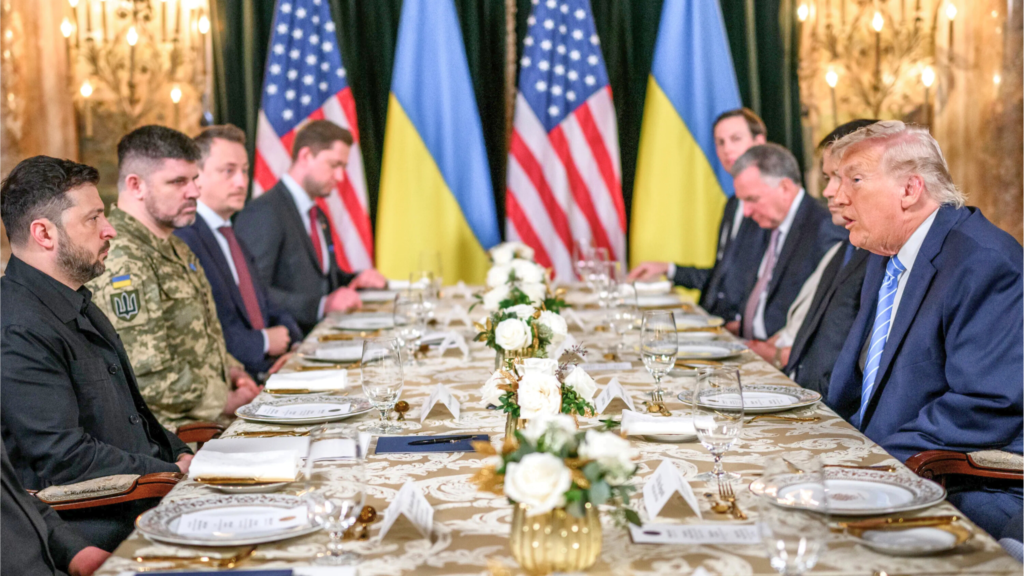
Despite limited progress in negotiations, experts point to one fundamental shift: Over 2025, the Trump administration became more open to the idea of long-term security guarantees for Ukraine than it had been at the outset. The discussion moved beyond political assurances and toward potential international legal commitments designed to deter renewed Russian aggression.
Working with allies at the end of the year, the United States and Ukraine drafted a 20-point peace plan intended to include serious security guarantees.
The development could mark a qualitatively new phase in the Trump administration’s policy toward Ukraine, Lough said, potentially signaling Washington’s acceptance that Ukraine will need something in return if it’s asked to surrender territory it controls.
Following his December 28 meeting with President Trump in Florida to settle details on the 20-point plan, Ukrainian President Volodymyr Zelenskyy said the United States was offering security guarantees for a period of 15 years, with leading European countries also expected to provide guarantees.
Many analysts, however, are skeptical that Russia would agree to a peace plan that includes security guarantees resembling NATO’s Article 5, which Ukraine is seeking, because Putin has repeatedly stated that any foreign troops in Ukraine would be considered “legitimate targets.”
Former U.S. Ambassador to Ukraine John Herbst said he would consider it a mistake if Ukraine traded security guarantees for the parts of the Donetsk region Russians have not been able to conquer, though such a trade-off could make sense under certain conditions.
“If [the Ukrainians] got an ironclad security guarantee from the United States in exchange, that could make it worth it,” he said.
John Bolton, a national security adviser during Trump’s first term, also has doubts about the value of a U.S. security guarantee.
“Honestly, we don’t know whether Trump will uphold Article 5 of the NATO treaty, let alone security guarantees written for Ukraine,” Bolton said.
Ultimately, he said, Ukraine needs NATO membership, adding, “I don’t see how it happens while there’s still Russian forces occupying its territory. So that to me says the victory on the battlefield is really the only way to achieve this.”
He also calls it a mistake for Ukraine to concede territory in exchange for a ceasefire. “Once you acknowledge that 20% of Ukraine effectively is held by Russian forces, it’s very hard to roll that back,” he said.
Furthermore, Bolton said, Putin would simply use the ceasefire to prepare for a third invasion.
Putin is “trying to re-create the Russian Empire,” Bolton said, “ and he’s not going to stop until he gets it.”
Venezuela: Scene stealer?
A recent development outside Ukraine is also shaping the peace process. In the early morning hours of January 3, a U.S. military operation in Venezuela removed its president, Nicolás Maduro, from power, creating a ripple effect far beyond the Western Hemisphere.
Thomas Graham, a former U.S. National Security Council senior director for Russia, said events in Venezuela would likely divert attention — particularly that of U.S. Secretary of State Marco Rubio and Secretary of Defense Secretary Pete Hegseth — precisely as Washington aligns its position with Kyiv and Europe.
At the same time, Graham said, the Venezuela operation sent an important signal to both Russia and China. Both countries are closely scrutinizing U.S. actions and assessing American military capabilities and Washington’s willingness to use force.
Beijing will focus on how such information “might be applied in an Indo-Pacific scenario, specifically with regard to Taiwan,” Graham said. In Moscow, he said, officials likely drew parallels with their own plans to swiftly seize Kyiv in February 2022 — albeit with a dramatically different outcome. Regardless, he said, it should have little effect on either country’s modus operandi.
“The Russians and the Chinese will be concerned. They’ll study this quite closely, but I don’t think it’s going to change the way they operate on the global stage,” he said.
Taken together, the outlook for the second year of Trump’s second term suggests that peace in Ukraine will not come from a single summit or symbolic breakthrough, but from sustained pressure and difficult trade-offs. The United States and its allies may yet succeed in shifting Russia’s calculations by moving beyond managing the process and committing to enforceable consequences and long-term security arrangements. Whether Washington is prepared to make that leap — and whether Moscow believes it — will determine not only when the war ends, but how durable any peace proves to be.
