




Former chief of the Force Structure and Investment Division at the Office of Management and Budget (OMB), Mark Cancian, tells Independence Avenue Media that in the first four days of their military operation against Iran, the United States and Israel achieved something Russia has been unable to accomplish in four years of war against Ukraine: control of the skies.
“That’s quite an extraordinary achievement,” says the retired U.S. Marine colonel. “It means that the United States can use many more aircraft and use much less expensive munitions in the air war.”
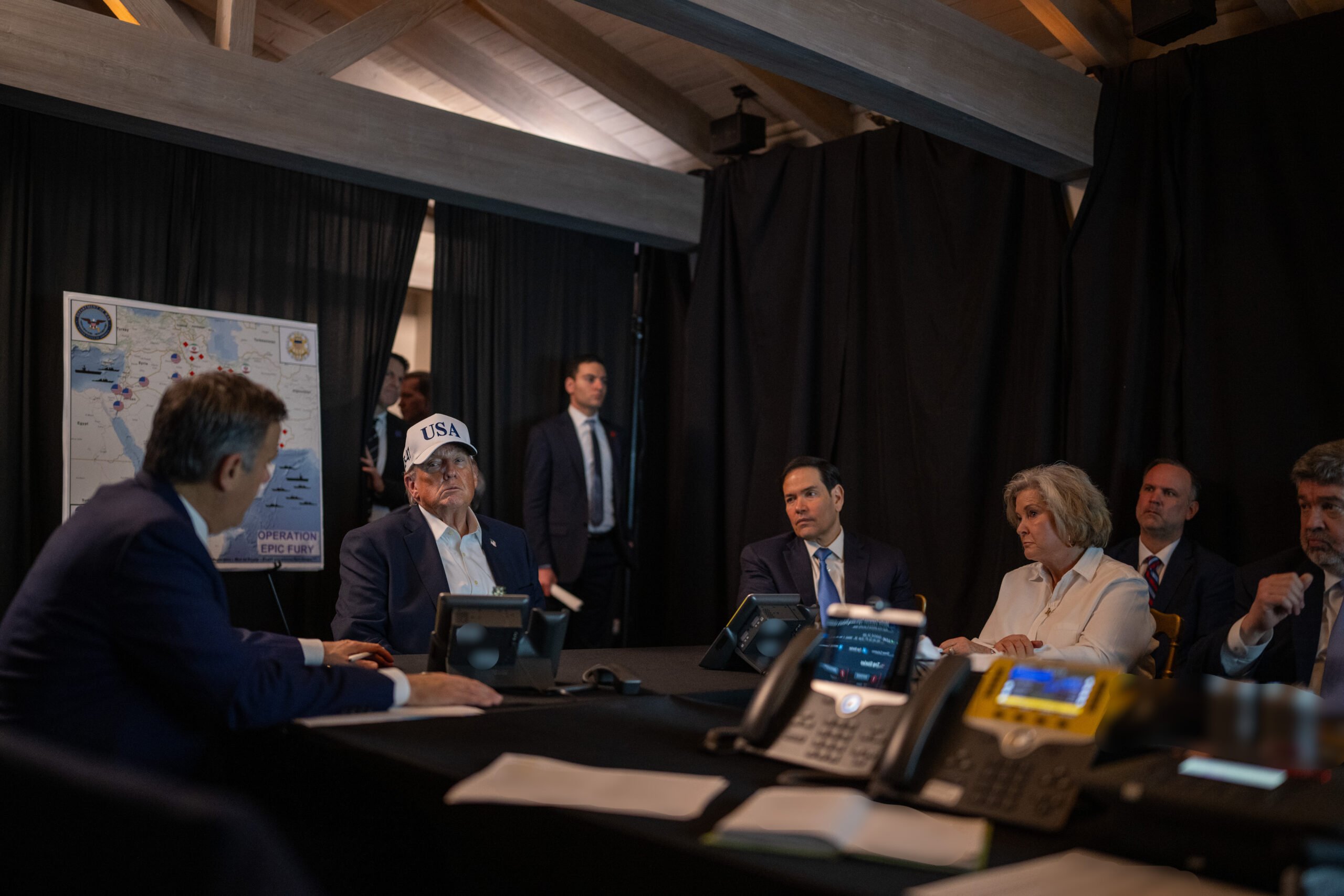
Since the U.S. and Israel launched their joint operation on Feb. 28 with strikes that killed Iranian Supreme Leader Ayatollah Ali Khamenei, the United States and Israel have hit nuclear facilities, ballistic missile production sites, Revolutionary Guard installations, and naval assets across Iran.
Iran has responded with waves of missile and drone strikes that have hit U.S. and Israeli military infrastructure, as well as economic targets like landmark hotels and airport hubs throughout the Gulf states. Iran has also threatened to attack any ships passing through the Strait of Hormuz, a transport point for 20% of the world’s crude oil and natural gas.
What the operation’s objectives are — and what an end state looks like — remains a matter of debate inside the United States itself.
Cancian says despite the initial statement from U.S. President Donald Trump calling for Iranians to force regime change, a deal could be agreed on with a new leadership that forms from the existing government in Iran, or “it could be done with a new government.”
Cancian is a senior adviser at the Center for Strategic and International Studies in Washington. The following interview, recorded on March 4, 2026, has been edited for length and clarity.
Kartlos Sharashenidze, Independence Avenue Media: Col. Cancian, thank you for joining us. Let me start with your overall assessment of the U.S. operation in Iran. Based on what we know so far, how would you characterize the results of the campaign at this stage?
Col. Mark Cancian (Ret.), Senior Adviser, Center for Strategic and International Studies: The campaign seems to be going very well as a military campaign [as of March 4]. People, of course, can argue about the politics of it, but the United States has achieved air dominance after four days, along with the Israelis, and that’s quite an extraordinary achievement. It means that the United States can use many more aircraft and use much less expensive munitions in the air war.
As a comparison, the Russians have been fighting the Ukrainians for four years and have not established air superiority. So what the United States and Israel together could do in four days, the Russians have been unable to do in four years.
IAM: When you look at the targets that have been struck, what do they suggest about the objectives of this campaign? Does this look like a limited effort to degrade Iran’s capabilities, or the beginning of a broader strategic campaign?
Cancian: It looks like a very broad campaign. Keep in mind that there are two campaigns going on side by side — there are the Israelis and the United States.
I think they’ve essentially drawn a line on the map and said everything above that line, which includes Tehran and the western parts of Iran, is covered by the Israelis. The United States covers everything below that, mostly along the southern coast. Gen. [Dan] Cain [Chairman of the Joint Chiefs of Staff] has referred to that as the southern front.
And it’s a broad campaign because the United States and Israel are hitting a wide variety of targets. The Israelis, of course, have been going after the Iranian leadership with the idea of, if not regime change, at least a regime substitution with very different leadership.
But in addition, the Israelis, and particularly the United States, have been going after military capability targets: the nuclear support facilities above ground, the production facilities for ballistic missiles, storage places for ballistic missiles, the Iranian Navy, which looks like it has been really pummeled — and of course this morning the United States sank one of their frigates at sea with a submarine — and also some security targets like the Revolutionary Guards.
We have not seen attacks on the general economy. The lights have not gone out in Tehran. We also have not seen attacks on the military in general, other than the specific capabilities that the United States and Israel want to take out.
IAM: The administration says this is not a war, especially not a so-called regime-change war. But would you call it a war or just a combat operation?
Cancian: I’m going to leave that distinction to the lawyers, because you get into legal questions about whether it is a war and whether there has to be a declaration of war. But there’s no question this is a full-fledged conflict, and many people would call it a war.
We are not holding any capabilities back. We have gone after Iranian vessels in the Indian Ocean. So it really is a war. And [Defense] Secretary [Pete] Hegseth called it a war at one point, but that’s sensitive because the administration also does not want Congress to pass what’s called an authorization for the use of military force, which they feel would limit their options.
IAM: Based on what U.S. officials have said about the objectives of this operation, how do you expect the campaign to develop from here?
Cancian: Well, this is a great question because it’s a debate in the United States regarding what the objective is.
When the president came out at the beginning of the conflict with his video, he implied that the objective was regime change. In fact, he said it was regime change. He encouraged the Iranian people to rise up, to overthrow the government. He said that we would be supporting them.
But as time has gone on, they’ve walked away from regime change. Secretary Hegseth has said it’s not about regime change, that in fact it’s about eliminating nuclear capabilities, the capabilities of ballistic missiles and also, I think, Iran supporting terrorism around the world.
One suspects that if this could be accomplished through the existing government but with a new leadership, that they might go for that. That’s what we did in Venezuela — the Maduro regime is still there, but there’s new leadership that the administration says it can work with.
So I think we are in that different situation where we might make a deal with whatever elements take over the government.
IAM: Do you see any realistic scenario in which U.S. troops could end up on the ground in Iran?
Cancian: There’s been tremendous speculation about that, but I think the short answer is no, for two reasons.
One, the administration is adamant that it will not do that. When you look at their statements before the war, and the National Security Strategy, it’s all about how we’re not going to get boots on the ground. We’re not going to get involved in long ground wars, particularly in the Middle East.
But the other thing is that the United States does not have any ground troops in the region. None at all. There are no Marines aboard ships. There are no Army forces that could operate as a ground force. We do not see any indications that units are getting ready to move either, and those would be pretty obvious.
So for both reasons I think the answer is no.
IAM: From a military standpoint, after the first four days of U.S. and Israeli operations, how capable is Iran of sustaining retaliation or escalating the conflict?
Cancian: Its ability to retaliate has been much diminished. There was a press conference this morning where Gen. Cain, Chairman of the Joint Chiefs of Staff, said that the number of missiles being launched from Iran was down by 75%. If that stays down it will indicate that they just cannot retaliate as effectively. Of course in the first couple of days they were able to have some effects on U.S. installations, but also on Gulf countries.
Iran could probably keep going indefinitely. If it decided that it was willing to take the punishment and endure the sacrifices and the people at least acquiesced, there is nothing that says that they would have to surrender. Now as time goes on, as the economy gets battered and the military gets battered, they might make a decision to negotiate.
Historically air campaigns without some ground forces have not been able to achieve regime change, although they have been able to achieve what you might call policy change — that is a regime that changes policies.
On retaliation, the one wild card is Iran’s ability to launch terrorist attacks across the globe. They have done that in the past. There are rumors about sleeper cells globally and in the United States. It is unclear whether those exist, but they might be able to use something like that in an effort to bring the war back home to the United States or another country.
IAM: Let me ask you about the broader strategic implications of these developments. You already mentioned Russia, so how could these developments change Russia’s calculations, especially in the war against Ukraine, where Iranian drones have played an important role?
Cancian: I’m not sure it’s going to change Russia’s actions in the war in Ukraine, but I think it will make Russia think hard about facing the United States militarily. And that should be good news to countries like Poland and the Baltic countries. They will feel very exposed and very vulnerable to Russia when the war in Ukraine ends. What we have seen here is the kind of striking power the United States could bring. I think it goes beyond what the Russians can do or even may have expected. One hopes that adds additional deterrence.
IAM: Ukraine has spent years defending against Iranian Shahed drones used by Russia. Could the United States and its partners benefit from Ukraine’s experience in countering drone attacks in this conflict?
Cancian: Absolutely. The United States had counter-drone efforts going from about 2015, but they were taking place at a very measured pace. It was the war in Ukraine that accelerated those efforts. At least one of the systems being used is called Coyote — it’s a drone that takes down other drones — which came out of those efforts. There are also a wide variety of other counter-drone technologies and tactics that have come out of the Ukrainian experience.
So the United States, our allies in the region, and the Israelis are all benefiting from what was learned in the war in Ukraine.
IAM: Let me ask you about China. Beijing has developed close economic and strategic ties with Tehran, right? So how might this conflict reshape China’s role in the region? And what context does it create for U.S.–China relations, especially with a potential meeting between President Trump and President Xi Jinping expected later this month?
Cancian: Well, I think President Trump is trying not to bring China in and is not criticizing China’s role in its relationship with Iran, but they are making it very clear that we will not tolerate any interference either.
In general this war and the events in Venezuela have really hurt China and Russia in the sense that both Venezuela and Iran were clients that they had helped economically and militarily — but in both cases the United States crushed them. So that will make other countries think twice before they accept assurances from China or Russia about military alliances.
The United States is also sending a message by sinking that Iranian naval vessel in the Indian Ocean that we do not hesitate to go after military assets in international waters. I think the implication for China is that if you sent your fleet out and there were a war, we would go after them no matter where they were.
IAM: Colonel, if you step back and look at the bigger picture, what would a realistic end state of this operation look like for the United States?
Cancian: Well, we all have questions about how this might end and what that ending might look like.
I think the United States would very much like to get a situation where the Iranians agree to end their nuclear program and that we have inspectors who can actually go on the ground and make sure that they are not restarting their nuclear program — and to find out what happened to the nuclear program that they had, because a lot of it is still underground. We are not sure how badly damaged it was.
I think the same thing will be true of ballistic missiles. We may well make some deal that they can have defensive systems and that we are not trying to disarm them, but that these two weapons are unacceptable.
And that could be done with an existing government, or it could be done with a new government. It would require some negotiations and some real concessions by Iran. In the past they have used negotiations as a way to string things out and gain time, but not to seriously make concessions.
IAM: One final question. How expensive is this operation for the United States, and what does it mean in the long term?
Cancian: That’s a great question because we are doing that calculation at this moment. In fact this morning my research assistant and I have been emailing and working on those calculations.
It looks like the total cost at this point is about $2.5 billion over the four days, of which about $2 billion were not in the budget and about $500 million were already in the budget, so that’s not an extra cost.
And that number will probably go down as time goes on, but it will still be pretty substantial — much more so than operations in the Caribbean, referring to the recent U.S. military operation to arrest former Venezuelan President Nicolas Maduro. The reason is because of the extent of the munitions usage and also the damage that is accruing to bases and aircraft.
See more:
