




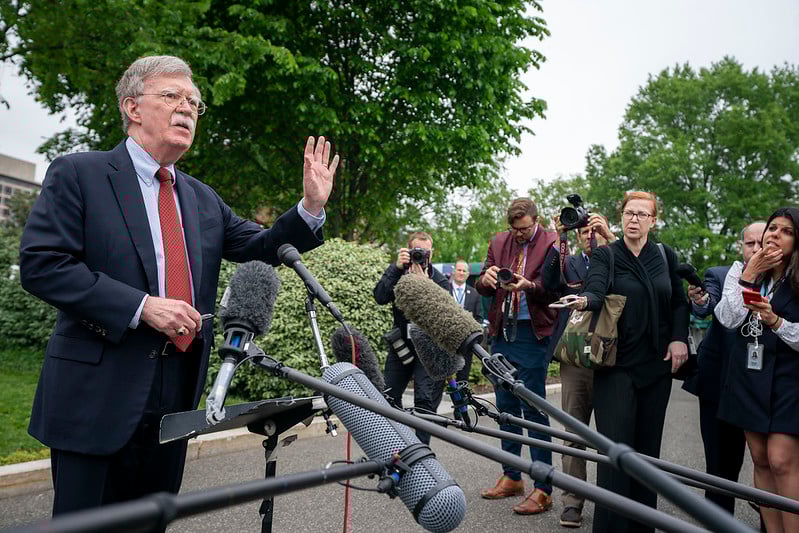
John Bolton, who served as national security adviser during President Trump’s first term, says the unrest in Iran reflects a qualitatively different challenge for the Islamic Republic, driven not only by economic grievance but by deeper structural failures.
Speaking with Independence Avenue Media on Friday, Bolton said that while Iran had experienced widespread protests before without regime change, the cumulative pressures confronting the country today are unprecedented.
As protests continue across multiple cities, Iran’s authorities have moved to isolate the country from the outside world, cutting internet and international phone lines in what rights groups describe as an escalating crackdown. The unrest, which began December 28, was initially tied to economic grievances and the rapid slide of the rial. Since then, it has broadened into direct challenges to the political system.
Iranian rights group HRANA said it had documented at least 62 deaths, including of protesters and security personnel, since the start of the demonstrations.
U.S. President Donald Trump has repeatedly pledged to strike Iran if protesters are killed, a threat that has taken on greater significance since the U.S. military raid that seized Venezuela’s former President Nicolás Maduro in the early morning hours of January 3.
A familiar pattern — with new fault lines
Bolton said the countrywide demonstrations were driven largely by economic grievances. He acknowledged that similar protest waves in the past had been eventually suppressed or dissipated.
This time could be different, he said, because the pressures now facing the leadership are “of a kind that they’ve never faced before.”
One of the most striking indicators of regime weakness, Bolton said, is Iran’s deepening water shortage — an issue he tied directly to long-term policy failure.
“The idea they might have to move the capital from Tehran because they’ve run out of drinking water due to the agriculture irrigation policies for many, many years and that the country is just generally facing water shortages is something they’ve never faced before,” he said.
A collapse of confidence
Unrest in Iran, Bolton said, now extends far beyond economic complaints and touches nearly every segment of society.
“I do think the regime is weak,” he said, adding that opposition comes not only from those struggling economically but also from young people, women and ethnic groups.
The ruling clerical establishment has failed to adapt to these pressures, he said, and “the ayatollahs don’t seem to have any imagination in how to deal with it.” As a result, there is “a general collapse of faith if there ever was much in the government.”
The Bazaar signal
Unrest in Tehran’s Grand Bazaar could indicate further problems for Iran’s theocracy, he said.
“The Bazaaris were protesting,” he said, which “could really spell significant trouble for the ayatollahs.”
Historically, bazaar participation has often coincided with moments of systemic political instability in Iran, including the 1979 Islamic Revolution, according to a Frontline report.
Leadership vacuum and the Khamenei question
Despite the scale of unrest, Bolton said, the opposition still lacks effective nationwide leadership, limiting its immediate ability to translate protests into political change.
Still, he said, the regime faces a looming inflection point tied to its supreme leader, Ali Khamenei.
“They’ll face a regime crisis when the Ayatollah Khamenei dies, which is going to happen at some point,” Bolton said. “Maybe right now we’re seeing the beginning of the kind of disarray the regime could face.”
What role for the United States?
Bolton said the U.S. and other outside actors should look to the opposition itself to determine whether they can be of any help, such as by supplying communications capabilities.
Asked about potential U.S. action under President Donald Trump, Bolton suggested Trump might be willing to escalate pressure on Tehran.
“Trump always has something to say about everything,” he said. “And threatening action against the regime might be something he’s willing to follow through on.”
Washington should openly embrace regime change as its policy objective, Bolton said. “We want the ayatollahs out. We want some kind of representative government for the Iranian people.”
The credibility of such a policy would depend on whether President Trump is willing to follow through, he said, noting that Israel’s attack on the country in June had already altered Tehran’s calculations.
“I think it’s a credible threat after the 12-day campaign against the nuclear program,” he said, noting Israeli concerns that further action may be necessary if Tehran seeks to revive both its nuclear and ballistic missile programs.
Bolton added that if Trump expanded pressure to include protecting protesters, it would further raise the stakes for Tehran.
“I would certainly support it if Trump is actually willing to do it,” he said.
