




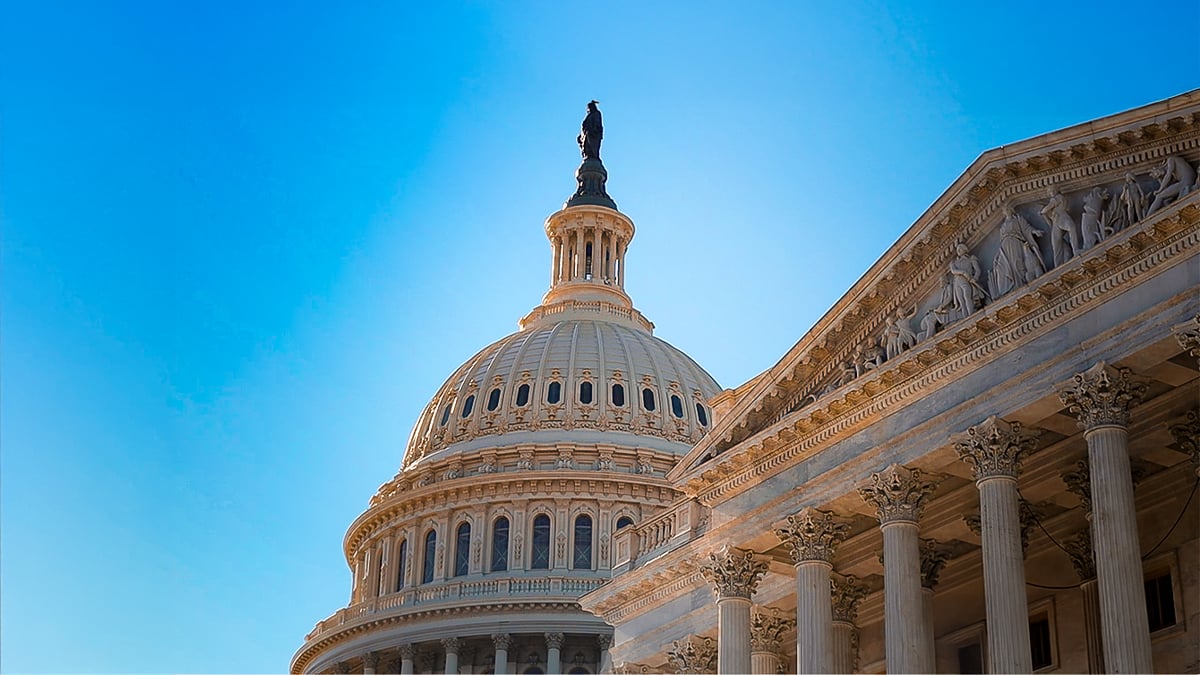
WASHINGTON — Bipartisan leaders in Congress, including chairs of key House and Senate committees, have urged the Trump administration to investigate a report alleging the use of chemical agents against protesters in Georgia.
“The people of America are shocked that in the tradition of [Bashar] Assad — the dictator of Syria using chemical weapons — now there’s a parallel, and that is the regime in Tbilisi,” U.S. Rep. Joe Wilson, R-S.C., said in an interview with Independence Avenue Media (IAM). Wilson said leaders from both chambers had sent letters to the administration, and he expressed confidence the allegations would draw the attention of U.S. President Donald Trump and senior members of his Cabinet.
“We’ve got people in place who want to stand with the people of Georgia,” Wilson said, referring to Secretary of State Marco Rubio and Defense Secretary Pete Hegseth.
The State Department said it was aware of the BBC report, but because it had no further information to evaluate it, the department had no comment.
The allegations and resulting backlash have complicated the Georgian government’s efforts to reset relations with Washington. Instead, Georgian Dream now finds itself facing bipartisan scrutiny on Capitol Hill, international concern over its handling of protests, and growing comparisons to authoritarian regimes.
The allegations, which the Georgian Dream denies, gained international attention November 30, when the BBC, citing expert analysis and whistleblower accounts, reported that evidence suggested Georgian police may have used the WWI chemical weapon camite in the water the riot police sprayed on protesters in Tbilisi to disband massive demonstrations.
According to the BBC, camite was taken out of circulation in the 1930s because of concerns over its long-term health effects.
Some of the protesters described a burning sensation upon contact with the water, the BBC reported, and others complained of symptoms such as headaches, coughs, vomiting and fatigue for more than 30 days after exposure.
On December 3, the U.S. Helsinki Commission, issued a statement calling the findings “deeply disturbing” and urging the U.S. and its democratic allies to verify the reports and impose sanctions if confirmed. The statement also warned that such conduct would place Georgia’s leadership “in league with” authoritarian rulers in Russia and China who use repression to maintain power.
‘A hybrid operation against Georgia’
Georgian authorities have denied the BBC’s reporting. At a December 6 briefing, the State Security Service said that an investigation found no evidence that police had used camite, and that CS gas, the tear gas commonly used in riot control worldwide, was the substance deployed during protests.
Prime Minister Irakli Kobakhidze last week described the BBC report as “fake,” demanded an apology from the British government, and said Georgia would complain to the UK communication regulator and pursue legal action if necessary.
Other senior Georgian officials have also portrayed the investigation as politically motivated. Citing President Donald Trump’s $10 billion lawsuit filed Monday against the BBC, Parliamentary Speaker Shalva Papuashvili said Tuesday that Trump’s case demonstrated “the level of information the BBC is prepared to spread for its own benefit.”
“This was a hybrid operation against Georgia, with the BBC participating as a propaganda tool,” Papuashivili said.
Georgian opposition parties and civil society groups have rejected the government’s conclusions and are calling for an independent international investigation into the allegations.
The Helsinki Commission’s statement also referenced the MEGOBARI Act, a bipartisan bill introduced by Rep. Wilson in January. The bill — formally the Mobilizing and Enhancing Georgia’s Options for Building Accountability, Resilience, and Independence Act, named after the Georgian word “megobari,” meaning “friend” — passed the House of Representatives in May by a wide margin and is now pending in the Senate.
The legislation would require the U.S. administration to impose visa restrictions and authorize asset-blocking sanctions against individuals found to be undermining Georgia’s democratic institutions or obstructing its Euro-Atlantic integration. It would also expand U.S. support for civil society and independent media. Wilson told IAM that he is confident the bill will become law.
Kobakhidze has dismissed the legislation. In remarks to journalists in May, he accused Republican lawmakers backing the MEGOBARI Act of acting on behalf of what he described as the “deep state” rather than as allies of President Trump. Citing Wilson by name, he said the South Carolina congressman was “deep state through and through.”
“I take [it] as a compliment,” Wilson told IAM. He called the “deep state” label misplaced, pointing to his political alignment with President Trump, who has endorsed him for reelection to Congress, and to long-standing Republican opposition to entrenched bureaucracy.
Invoking the ‘deep state’
The “deep state” has become a central theme in Georgian Dream’s political rhetoric since Trump began his second term. Before Trump’s return to power, the ruling party framed its confrontation with Western partners around conspiracy theories involving what it called a “global war party,” accusing foreign actors of trying to draw Georgia into the Russia-Ukraine war by forcing it to open a second front against Moscow.
This month, Kobakhidze again accused foreign actors of attempting to draw Georgia into the war in Ukraine. There had been an explicit call to open a second front against Russia, he said, claiming that Georgian officials were told to “fight from the forests if the country collapsed.”
Kobakhidze made the remarks in response to a question about meetings between Georgian officials and former U.S. Ambassador to Georgia Kelly Degnan, whom the prime minister accused of inappropriate conduct.
“Kelly Degnan behaved worse than banging fists on the table — she would come to meetings in a hysterical manner,” he said.
When IAM asked the U.S. State Department whether the U.S. had ever — at any point since 2022 — asked, encouraged or pressured Georgia to take military action related to the Russia-Ukraine conflict, a spokesperson responded: “These allegations are completely false.”
Analysts say Georgian Dream’s rhetoric reflects an attempt to reposition itself using Trump’s political language. “The Georgian Dream is trying to position itself as a mini-Hungary, a mini right-wing populist government,” said Bob Hamilton, a U.S. military expert and Eurasia analyst. “Georgian Dream is trying to position itself that way to attract the attention of the Trump administration and hopefully get some love.”
“I don’t think it will,” Hamilton said.
Emulating Hungary
Hungarian Prime Minister Viktor Orbán has long positioned himself as a critic of Brussels, clashing with European Union institutions over rule-of-law standards, media freedom, and legislation targeting LGBTQ+ communities and foreign-funded civil society — disputes that have strained but not severed Hungary’s standing within the EU. Georgian Dream has adopted similar postures, pushing through a controversial “foreign agent” law and restrictive LGBTQ+ legislation in 2024 that drew sharp criticism from both Brussels and Washington.
Orbán was also the first EU leader to congratulate Georgian Dream after last year’s disputed parliamentary elections. As EU criticism of Tbilisi has intensified, Orbán has remained one of the few European leaders to maintain close political ties with Georgia’s ruling party, offering it not only diplomatic validation but a model for navigating confrontation with European institutions while preserving power at home.
US ‘just doesn’t care’
Under the new U.S. national security strategy, Georgia’s political situation may be taking a secondary seat to other foreign policy concerns. Hamilton said the Trump administration’s latest strategy reflects a narrower definition of U.S. interests. “In the minds of many people in the White House, Georgia falls under Russia’s sphere of influence.”
“This is a break from previous U.S. administrations, both Republican and Democratic, which have never acknowledged a Russian sphere of influence,” he said. The Trump administration would not state such a position openly, Hamilton said, but “its actions imply that it’s not interested in Georgia. It’s not interested in whether Georgia is democratic or authoritarian or pro-Western or pro-Russian. It just doesn’t care.”
Former U.S. Assistant Secretary of State for Europe Daniel Fried said that Georgia has not disappeared from Washington’s view but has been overshadowed by larger priorities.
“The Trump administration doesn’t devote much time to Georgia,” he said, noting that engagement has increasingly come from Congress rather than the White House.
Fried also questioned Georgian Dream’s assumption that ideological alignment alone could reset relations. While the Georgian government has appealed to elements of Trump’s coalition through rhetoric about values and the “deep state,” he said, its actions often conflict with stated U.S. interests.
“The national security strategy talks about the danger of China and other hostile adversarial countries gaining control of infrastructure,” Fried said. “The Georgian Dream is busy inviting the Chinese in.”
Georgia signed a strategic partnership with China in 2023.
Ideological affinity is “not a stable basis for relationship,” Fried said. “The Trump administration, I think, is not ultimately going to be swayed by ideology if it flies in the face of American interests.”
During the Biden administration, the U.S. State Department suspended the U.S.-Georgia Strategic Partnership, citing Georgian Dream’s anti-democratic actions and its decision to suspend Georgia’s EU accession process.
The following month, the United States also sanctioned Georgian Dream founder Bidzina Ivanishvili, accusing him of undermining Georgia’s democratic institutions and advancing Russian interests. The move marked the most serious U.S. action against Georgia’s political leadership since its independence from the Soviet Union in 1991.
Georgian Dream officials have since argued that relations would reset after Trump returned to office for a second term, pointing to what they describe as ideological alignment with Trump and his political coalition. Nearly a year into Trump’s presidency, however, those expectations have not materialized, and the strategic partnership remains suspended.
