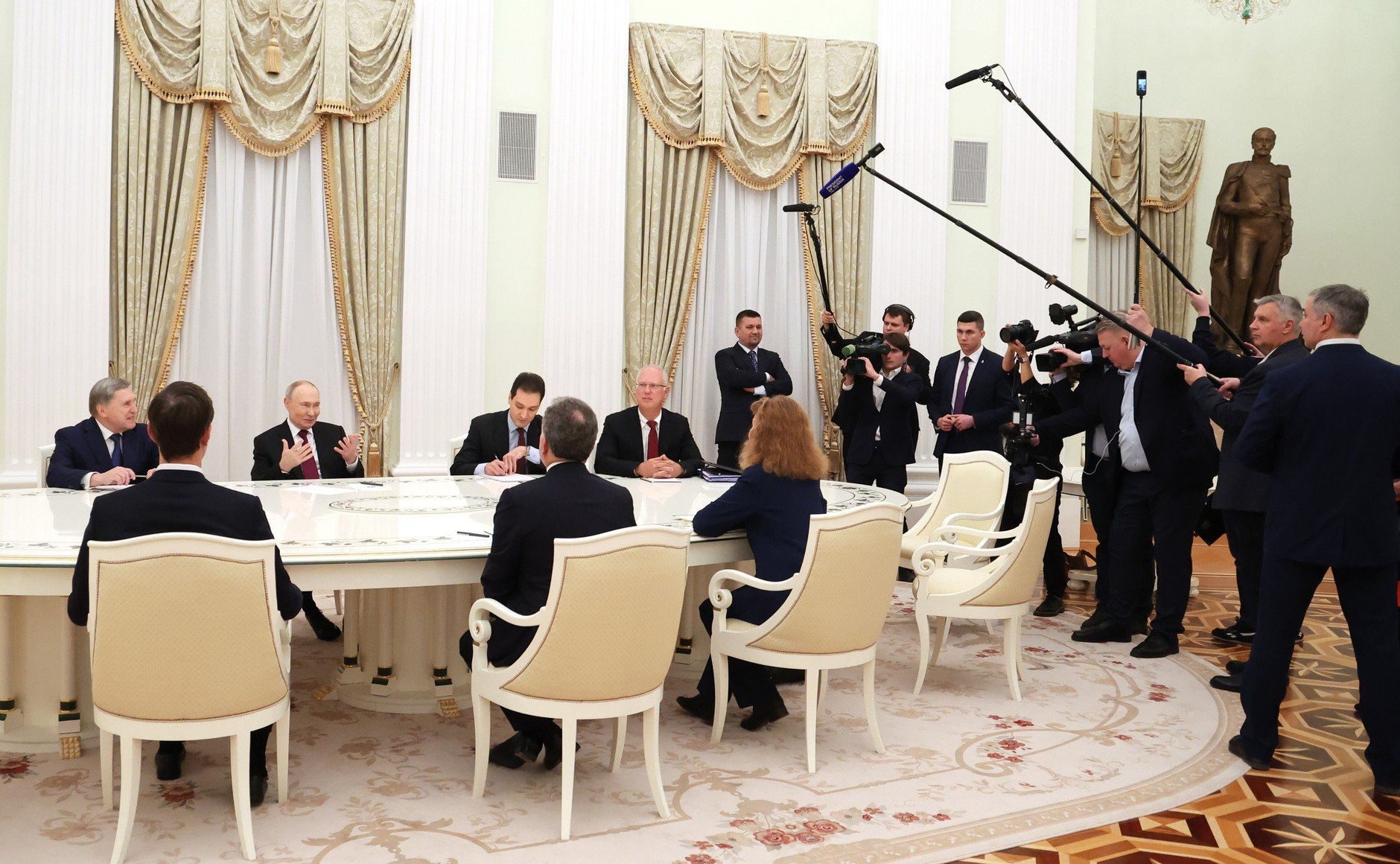
The United States, Russia, and Ukraine are at the negotiating table. Presidential envoys, not career diplomats, are leading the American side. And according to Donald Jensen, the West still does not understand how Moscow operates at the table.
Jensen is not an outsider. He spent decades as a U.S. diplomat, providing technical support for the Strategic Arms Reduction Treaty (START) and Intermediate-Range Nuclear Forces (INF) arms control negotiations with the Soviet Union. In 1988, he was a member of the first American team to inspect Soviet missiles under the INF Treaty. He has seen Russian negotiators up close.
Jensen argues that for Russia, negotiations are not a path to compromise. They never were. From the czarist era through the Soviet period to today, Moscow has approached the table the same way — not to reach agreements, but to win.
The West, he says in a new report released near the fourth anniversary of Russia’s full-scale invasion of Ukraine, still hasn’t figured that out.
Independence Avenue Media spoke with Jensen about what that means for the talks over Ukraine — and what, if anything, can be done about it.
The following interview, recorded on Feb. 23, 2026, has been edited for length and clarity.
Kartlos Sharashenidze, Independence Avenue Media: Dr. Jensen, in your research, you argue that Russia views negotiations as a form of warfare by nonmilitary means. Could you help us understand what that means in practice? When Russia comes to the negotiating table, what does it believe negotiations are actually for?
Donald Jensen, adjunct professor at Johns Hopkins University: I think it’s a mistake we in the West often make, which is misreading how they operate at the negotiating table. And the Russians see negotiations very differently than the United States does and the West does.
The Harvard School thinks that every participant in the negotiations has to compromise, and can have their interests recognized, and so forth. Sometimes they call it “getting to yes.” My view is that the Russians are very different. They don’t see it the way we do. And unless we understand how they operate at the table, we’re going to be at a disadvantage on any issue, not just Ukraine.
I like to call it “getting to ‘nyet’” [Russian for “no”], because the Russians see negotiations as a weapon to advance their interests. Let’s call it warfare, without the kinetic dimension. They want to win, they want you to lose, and it’s not compromise. That’s a fundamentally different approach to the negotiations. The Russians train their diplomats to behave in ways that — you probably know the concept of “reflexive control” in Russian military theory [where a rival is fed information to influence them into “voluntarily” taking a predetermined action] — so that they serve Russia, and get Russia’s interests without compromising. That’s what we’re seeing really in [negotiations with] Ukraine.
So, when the Trump administration talks about a deal as an end in itself, that’s not how the Russians see it. They don’t see a deal as the goal. They see protecting Russia’s interests as the goal. And then sitting and talking to the Americans, it’s just one way they do that. And so it’s a very, very different approach. And until we recognize that, we will be at a disadvantage.
IAM: Has anything fundamentally changed from the Soviet era to today in how Russia approaches negotiations? Do you see the same strategic tactics?
Jensen: The style is very continuous, going back to the czarist era. What you see now is in a way more sophisticated, because they can use information operations, the internet, and so forth to get a narrative out there that makes it more likely they will get what they want.
Now let me give you an example, which is the so-called “Russia has all the cards and is winning the war,” [narrative]. If you believe Russia is winning the war, then the West will behave a certain way. And we’ve seen that in western leaders’ comments.
But I would argue that Russia is not necessarily winning the war. It’s not yet determined. So by portraying Ukraine as weak, portraying the West as divided, Russia increases its chances of getting what it wants.
Negotiations go in partnership with propaganda. That’s how they do it.
If you look at Georgia, that’s exactly how the Russians do it there. They portray Georgia, especially its democratic forces, in a certain way. Many people who don’t follow it closely may agree with that.
If I can give you an example, the negotiations, as you know, are preoccupied with a territorial deal in Donbas, and whether Ukraine gives it up or not — and they don’t want to give it up. One’s assessment of that issue depends on whether you think Russia is winning the war.
In fact, Russia has gained very little land in the past two years. So [Ukrainian President Volodymyr Zelenskyy] is absolutely correct. Why would you give up land Russia cannot conquer itself?
[But] by sitting at the table, talking about this kind of stuff enough — and [the Russians] do it all the time for many, many months — a lot of people seem to be convinced.
IAM: How is Russia tailoring its negotiating strategy to the current talks with the United States and Ukraine?
Jensen: Well, I think that the Russians spend more time studying the West and President Trump than we do studying Russian negotiations.
The Russians, to my understanding, spend a lot of time studying what President Trump’s personality is like, what the other U.S. negotiators are like, and so forth. They calculate their information activity to appeal to that.
For example, we see the heavy emphasis in the negotiations on commercial activity, mutual business partnerships, and so forth. Well, that’s partly because Russia realizes that President Trump, as a businessman, has a natural affinity for that kind of discussion and those kinds of issues.
So this is very carefully planned, and I think probably more planned than we do with the Russian team and the Russian side.
IAM: How would you describe the U.S. approach to negotiations with Russia today? In many cases, it’s presidential envoys — not career diplomats — who are leading these talks, right?
Jensen: I would say it’s a little naive because, like a lot of western diplomats and policymakers, we tend to do what they call mirror imaging. We think that Russia behaves like we do. We think that Russia sees the same goal in negotiations that we do. That’s simply not the case.
So, again, I wrote the paper to try to tell people, hey, look at this. The West will be more successful if it understands how they operate. And it’s very clear how they operate. This is not new.
If you go back and look at a textbook at their diplomatic academy, MGIMO [Moscow State Institute of International Relations], you will see lessons on how to deal with Americans — “Americans like this, they don’t like something else” — and that’s to help their diplomats understand how best to proceed to get Russia’s interests.
And we have to be very, very aware of that, and I don’t think we are anywhere near aware enough.
IAM: From a strategic standpoint, what are the conditions under which Russia would actually be willing to make genuine concessions at the negotiating table?
Jensen: Well, I think that when the Russians want something — it may be an arms control agreement, for example, it may be something they want so much that they will make a compromise. We don’t know, but we don’t seem to try to understand that as well as we might.
If you [use coercion and] put the Russians in a corner, and you say, “we want this, you must agree,” then they may well come around. But the problem is we assume that they have the same goals as we do, which is compromise, that everybody is happy at the end of the day. We say, “win-win,” and what they want is they win and you lose. And that’s how they approach it. It’s very, very different.
Because if you assume that you’re going to get everything, you behave very differently than if you need a compromise. That’s one of the problems we have seen in the last year, which is to say that we think that if we give up land in Ukraine or give up sanctions or something like that, Russia will change its behavior. That’s not necessarily the case.
Russia may just be acting cooperatively because that’s the way they think they can get their way. This is, again, a very — I used to do this for a living with arms control — this is a very, very different way of behaving. And again, that’s one of the [reasons] why the so-called peace process now in Ukraine is so bogged down.
IAM: What are your expectations for the peace talks between the U.S., Russia and Ukraine?
Jensen: I think we’re making no progress at all. Russia’s trying to drag out the talks because Russia wants the West to get tired of supporting Ukraine. Russia still thinks it can win on the battlefield, both of which I have doubts about.
And thus, why should Russia agree now to something where they have a compromise, for example, when they think they’re going to win in six months? They’re not going to compromise. They’re not interested in a settlement. They’re interested in taking over Ukraine.
They’re very flexible about how they do that, but they’re not interested in a peace deal right now at all. There’s no indication. And all you have to do is pay attention to what [Russian Foreign Minister Sergey] Lavrov and [Russian President Vladimir] Putin say, and their goals have not really changed since 2022.
So, we need to be realistic and not be so naive sometimes about how this is going. Putin is calculating that he will win on the battlefield. Putin is calculating that the West will cut off its support. Putin is trying to separate Donald Trump and the U.S. government from our European partners. And you can see that every day, and to some extent, they’ve been successful.
However, Ukraine is still very resilient. The Europeans are stepping up to do their share much more.
Unfortunately, this will go on for quite a few months, I think. But there’s also good reason to think that if we respond properly and vigorously, Russia will not get what it wants. That’s our goal, and we should always keep that in mind.
The West, he says in a new report released near the fourth anniversary of Russia’s full-scale invasion of Ukraine, still hasn’t figured that out.
See more: