NATO is deepening its partnerships with Armenia and Azerbaijan while maintaining its long-standing cooperation with Georgia, offering a rare inside view into how the alliance is approaching the evolving security dynamics of the South Caucasus. As Russia’s war in Ukraine reshapes the region, NATO is working with all three countries to strengthen resilience and defense capacity, with the longer-term goal of fostering closer cooperation — including the possibility of joint training or activities, potentially hosted in Georgia.
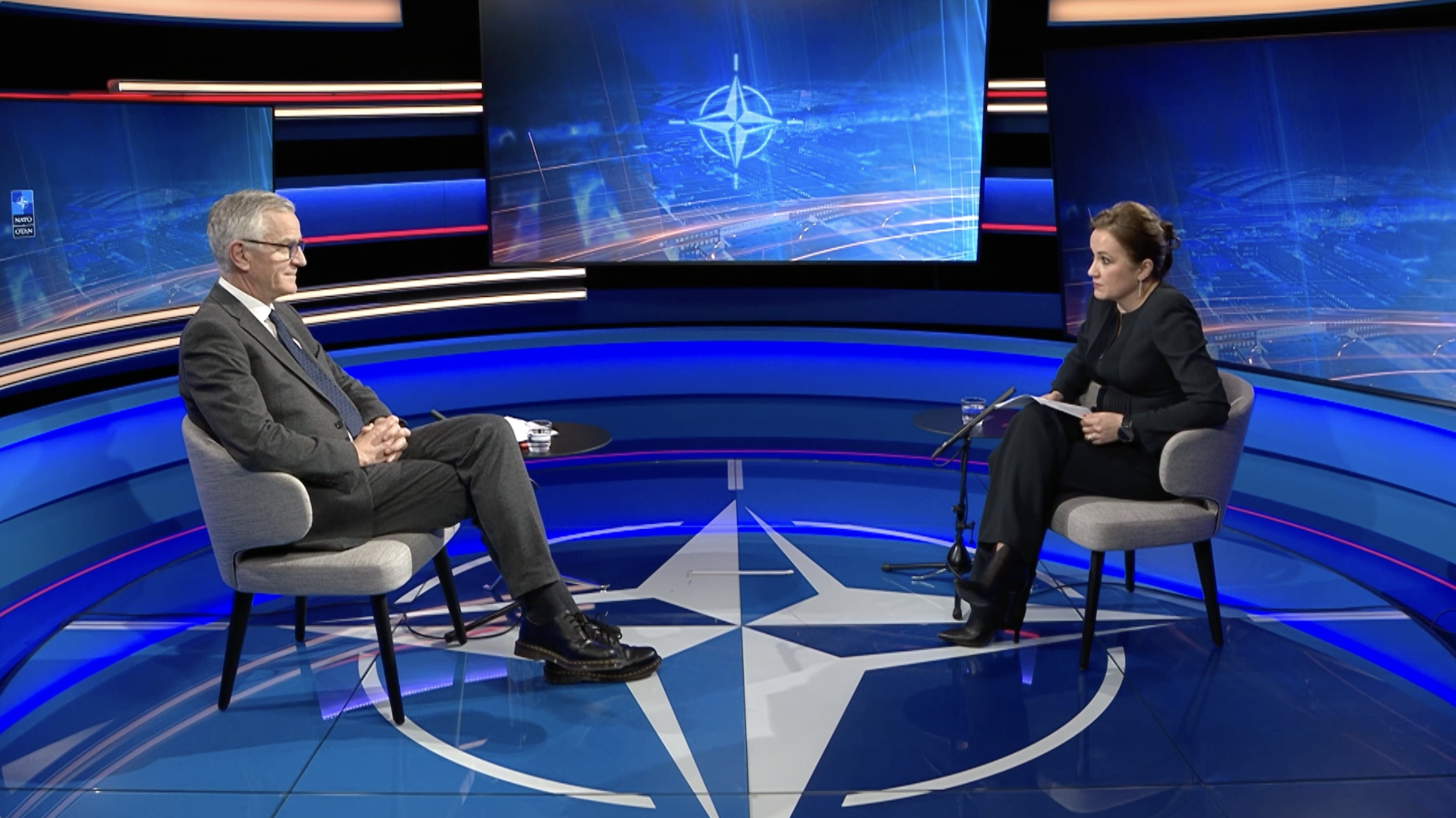
In this interview with Independence Avenue Media, Piers Cazalet, NATO’s director of defense and security cooperation, outlines how the alliance works with Armenia, Azerbaijan, Georgia, and Moldova to build institutional resilience without forcing political alignment. He discusses NATO’s approach to partner cooperation, the impact of Russia’s invasion of Ukraine on alliance strategy, and why stability in the Caucasus and wider Black Sea region matters to Euro-Atlantic security.
The following interview, conducted on February 3, has been edited for length and clarity.
Ia Meurmishvili, IAM editor in chief: Let’s start with the Caucasus — Armenia and Azerbaijan. The NATO deputy secretary-general was just in the region in the past couple of months, and it seems like there’s a new momentum there related to these two countries. What programs or methods is NATO using to help these countries increase their resilience and think about defense and their overall partnership with NATO?
Piers Cazalet, NATO defense and security cooperation director: Historically, the Caucasus has been a region of great interest for NATO. We have other countries in the region. There’s Turkey, which is right next door. And the three countries of the Caucasus — Georgia, Armenia, and Azerbaijan — have strong relations with different NATO countries. So, NATO has always been interested in the region and has always wanted to work with those countries in the region.
With Armenia and Azerbaijan, as you mentioned, the deputy secretary-general, Radmila Shekerinska, has recently been to the region. She’s visited both countries. I think this is an indication of the importance that we place in the relationship with those two countries, but with Georgia as well. And the relationship with Georgia has been over many decades.
In terms of the practical cooperation that we have with the countries, firstly, with Georgia, as I said, we’ve developed that over many, many years and that’s a very deep relationship, in particular with the Georgian Defense Forces, who have fought valiantly alongside NATO soldiers in different regions. They continue to serve alongside NATO forces in some places. This cooperation is very, very appreciated by NATO.
With Armenia and Azerbaijan, the levels of the relationship have been less, they’ve been lower. But we’re now beginning to step up and look at how we can cooperate more deeply with both of those nations.
You mentioned resilience. Here, resilience is something which is very important for all NATO countries, but for our partner countries as well. So, looking at how they can better protect and defend themselves well below the threshold of a conventional conflict or a conventional attack.
We see in the world today, there’s all sorts of threats out there, be it cyberthreats or threats to energy infrastructure, disinformation. And if we work together as allies and with partners as well, we can help build our security against these threats.
IAM: Armenia has elections coming up. It’s pivoting away from Russia and getting closer to NATO. Are there any defense assistance programs for Armenia that you envision, whether for conventional defense or against hybrid operations?
Cazalet: There are a lot of possibilities for us to work with Armenia. One thing I should say right from the outset, though, is that any cooperation we have with any partner country has to fit in the intersection of what’s in NATO’s interest but also what the partner country wants and what is in the partner country’s interest.
So, we never force any cooperation on any partner, and Armenia is the same. So here we have fairly regular discussions with Armenian officials about the sort of cooperation that we can develop together. For the time being, we have quite good cooperation in the field, for example, of defense education, and we have a very well-established program working with the Armenian Ministry of Defense and Armenian armed forces on defense education, but also a program that we call Building Integrity, which looks at anti-corruption and transparency in the defense and security sector. And we can develop more strands of work like this with Armenia going forward.
IAM: Do you envision any sort of joint cooperation between the Caucasus countries, or are we not there yet?
Cazalet: I would very much hope that we will be able to do more along those lines. We have had cooperation between at least two of the Caucasus countries working together in different formats in recent years. So, we have different projects. And for example, we have projects under our Science for Peace and Security Program, which does joint research cooperation between allies and partners. And here we can have cooperation between different partners. Over the future, at the end of the day, the Caucasus geographically is a fairly small region. And if we can find ways to bring the countries together to cooperate more closely, that would be great — Georgia could be a good venue for this going forward for example.
IAM: Talk to us more about capacity building when it comes to Russian information threats — again, hybrid operations, overall malign activities that are not conventional military threats but still threaten the security of these countries. Do you have specific programs in each of the countries or maybe a regionwide program? How do you address this particular threat coming from Russia toward the region?
Cazalet: While we certainly consider Russia the biggest threat as far as NATO is concerned — and for some partner countries, that is also the case — we don’t particularly address our programs against any one country. It’s more looking at building capacity, building resilience in partner countries, whatever the threat actor. We’ve seen other countries such as China or Iran, for example, that use the same hostile tactics as Russia against partner countries. So, we try to develop those capabilities in a way that countries can use them to protect themselves against any threat, wherever the threat comes from.
Here we have a number of programs that we’ve developed within NATO, and we use with partners as well. You mentioned strategic communications and here, for example, we do a lot of work with other partner countries, including Moldova, some partners in the south like Jordan as well. So, looking at how those countries can strengthen their publics against disinformation, misinformation coming from outside or indeed from inside the country from different threat actors. So, we do a lot of that already, and we can always do more in the region.
IAM: Talk to us more about Moldova, a country that’s also in a difficult situation. It seems like the U.S. is paying more attention to Moldova, much like it has with Armenia and Azerbaijan. What are the overall expectations of Moldova-NATO relations moving forward?
Cazalet: We have a very strong partnership with Moldova, which has developed over many decades. Now we do a lot of practical cooperation with Moldova, given their geographic situation sandwiched between Ukraine and Romania with part of their territory occupied by Russia as well. It’s a classic case where NATO can help them develop their defense forces and defense capabilities to better provide security for themselves. In recent years, we’ve worked with them quite a lot.
Disinformation is one of the topics that we work with them on, but also cybersecurity, for example, but also just general capacity building for their armed forces. This includes work on, for example, recruitment into the armed forces so that they have a more modern set of forces to better be able to defend the country.
IAM: From your vantage point, do you see Moldova becoming more active with NATO? Because they’re a neutral country, they have not applied for a membership. Do you see any change, especially since [Russia’s full-scale] invasion [of Ukraine] in 2022?
Cazalet: They have their neutrality, and a lot of the partners that we work with, including, for example, Austria and Switzerland, also have neutrality. So different partner countries can have different types of neutrality, but that doesn’t stop a level of cooperation that we can develop with the countries.
Going back to a point I made earlier, anything that we do with Moldova is at the request of Moldova. We don’t force anything on the country. Whatever they want to work with us on, we can find a way to work with them.
It has changed since 2022. They felt more exposed. They felt more vulnerable. They’ve identified areas of weakness that they need to be able to address to be able to better defend themselves. This is where they’ve come to us to ask us for a particular help and support, and we’ve been able to provide it.
IAM: How has the Russian invasion of Ukraine affected NATO’s outlook on the region in terms of resilience, capacity building, and the assistance NATO provides its partners?
Cazalet: Before 2022, NATO had a strong relationship with a number of individual partners. But in terms of practical cooperation, with most partners, it was at a fairly low level. But after the invasion, allies began to realize the importance of partnerships more generally. They recognize the importance of the capacity-building work that we’ve done with Ukraine before the full-scale invasion, the benefits that that gave Ukraine, and how elements of that work helped Ukraine resist the initial Russian attack.
Now more value is placed in the work that we do with partners. This has allowed us to step up the work with countries such as Moldova but also Bosnia-Herzegovina, for example, which has a different exposure and a different set of vulnerabilities. We have a lot more capacity to be able to work with these countries to help them develop their defense and security.
IAM: How optimistic are you about the Caucasus — specifically about the relationships between its three countries and NATO — and the wider Black Sea region? What do you think the future holds?
Cazalet: For the Caucasus region itself, I’m very optimistic. What we’ve seen over recent months and in August last year, the agreement between Armenia and Azerbaijan, has given a momentum to further settling in a peace process in the region. If we can solidify that, make that more concrete, we can get really strong cooperation between the countries in the region.
That will be of benefit to NATO, individual NATO nations, and wider Black Sea security as well. So, I’m optimistic. At the same time, there’s a lot of work that’s got to be done, there are a lot of issues that need to be resolved, but I think if we work hard on these, we’ll be able to make progress.
IAM: You mentioned that NATO’s partnership with Georgia continues. Tell us more about the history of the partnership, where we are now, and how you feel about it moving forward.
Cazalet: It’s a long historic partnership, and I think everybody in NATO recognizes the contribution that the Georgian Defense Forces have made to regional security, but wider security in the Euro-Atlantic area. The Georgian contribution, for example, in Afghanistan is remembered by all NATO nations, and I think Georgia could be proud of the contribution that it made.
We maintain those relationships, in particular with the Georgian Defense Forces and with the Ministry of Defense as well, and we have a lot of practical cooperation work which is going forward.
Obviously, the political chapeau, if you like, in the country now is much more complicated. NATO and NATO nations have expressed clear opinions about the direction of travel in Georgia right now. We hope that we’re going to be able to maintain and then rebuild a relationship along the lines that we had previously. We have a lot of joint interests potentially between Georgia and NATO and NATO nations. We’d like to go back to building on those joint interests.
See more: