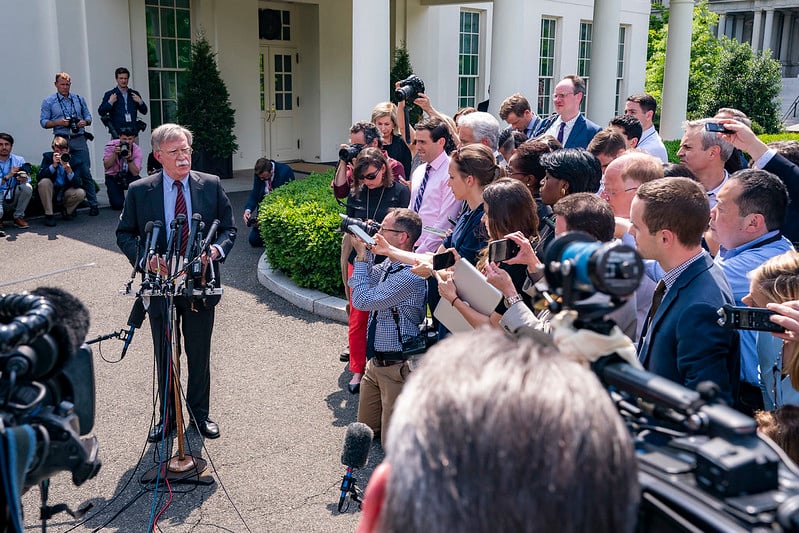
Russia and China are each trying to secure what John Bolton described as their own spheres of influence — Moscow in Eastern Europe and the former Soviet space, and Beijing in the Indo-Pacific. He warned that the United States would weaken its global position if it accepted a world divided into zones of control.
In an interview with Independence Avenue Media, the former U.S. national security adviser discussed Russia’s war in Ukraine, U.S. policy in Venezuela, China’s growing role in the Indo-Pacific, and President Donald Trump’s approach to NATO and U.S. alliances. He also addressed the balance of power in the South Caucasus and what he sees as the strategic stakes behind current U.S. foreign policy choices.
Bolton said that U.S. interests and partnerships are global, not regional, and that dividing the world into spheres of influence would give U.S. adversaries an advantage while leaving allies exposed.
The following interview was conducted on January 9, 2026, and has been edited for length and clarity.
Kartlos Sharashenidze, Independence Avenue Media: Let me start with your broader view. When you look across the global landscape today — protests in Iran and President Trump’s comments on possible U.S. action, the U.S. operation in Venezuela, statements from the administration about Greenland, the state of U.S. relations with Europe, Russia’s ongoing war against Ukraine, and China’s military drills around Taiwan — what do you see taking shape? I mean, some of these challenges are not new, but what, in your view, is different about this moment?
John Bolton, former U.S. national security adviser: There’s a lot of confusion in the world. The U.S. under Trump has contributed to a lot of confusion. And the developments overall show that it’s a very threatening world, that for the U.S., we ought to be trying to concentrate on how to use our alliances and trading relationships around the world in a much more coordinated fashion than we are. Trump’s decision-making style is totally incoherent, and it’s not based on a geostrategic framework. It’s based on whims and what Trump thinks benefits him. And in the near term and the long term, it’s not going to help the United States, and it’s not going to help our alliance partners either.
IAM: Let me ask you about Venezuela. How did you view the U.S. operation as it unfolded? And at this stage, what should be the priority for U.S. policy going forward?
Bolton: It’s been policy for a long time [that] the Maduro regime has to go. We tried to overthrow it in Trump’s first term, working with the opposition largely through economic pressure. We didn’t apply enough pressure, and the opposition’s effort failed, unfortunately, for the people of Venezuela. The national security interests today for the U.S. are even more acute.
The Russian Cuban presence was a significant issue for us in Trump’s first term. It’s just as significant today. The Iranian presence was a problem for us then and is a problem for us today.
But significantly different is the Chinese presence is much greater. Their interest in Venezuela and oil is much greater. Their influence is potentially much greater. So, the security threat to the U.S. and stability in the Western Hemisphere is very, very real.
What Trump has done so far is take Maduro out of the picture but leave the Maduro regime in place. I don’t fully understand why he’s doing it. I don’t think stability is a reason to leave this murderous regime in place. They’re the people who are still there, absent Maduro, who helped bring the Chinese in, have been sided with Iran and Russia and Cuba. They’re not going to change. Their objective right now is regime preservation, preservation of their own positions. They’ll do a lot of what Trump wants, but they’re not going to negotiate themselves out of power.
So, we may end up with the worst of both worlds. We’re taking all this grief for having captured Maduro, but we haven’t really changed the regime. And certainly, the people of Venezuela are not benefiting. The reports we have is repression now is, if anything, worse than it was before.
IAM: Former White House Russia adviser Fiona Hill said back in 2019 that Russian officials informally suggested a trade-off of greater U.S. influence in Venezuela in exchange for a freer hand for Russia in Ukraine. What do you recall about that episode from your time at the White House?
Bolton: I think it was an idea somebody floated. I think we dismissed it very quickly. I think that’s Fiona’s recollection as well. And it was a nonstarter back then. It should be a nonstarter now.
This is not about dividing the world up into spheres of influence. The U.S. has interest everywhere, and it has friends and allies everywhere. The Russians may just have what they want as a sphere of influence, and the Chinese are focused on their Indo-Pacific periphery. We have worldwide interest.
If anybody were foolish enough to say we should divide the world into spheres of interest, we would be giving away a lot of our friends and allies. So, I just think it’s an incorrect idea what’s happening in Venezuela, utterly dissimilar to what’s happening in Ukraine, which was a war of Russian aggression, and has really nothing to do with China’s interest in Taiwan or the potential aggression that China might engage in there.
IAM: In Eastern Europe, in general, some people believe that the United States, Russia and China may be moving toward dividing the world into spheres of influence. Do you see that happening? And what would that mean for countries neighboring Russia? China?
Bolton: I can assure you, Trump doesn’t think in conceptual terms like that. That’s not his idea. There may be people around him who are saying that. They’re wrong if that’s what they’re saying. They misapprehend the nature of American interests, which are global, and they misapprehend our capability to protect our interests and protect our friends and allies.
So, dividing the world into spheres of influence is a negative for the United States because it would reduce our influence and enhance the influence of adversaries, which is what Russia and China are. And if Trump ever came out and said that was his objective, that would really generate a lot of opposition in Congress, particularly among Republicans who are beginning now to speak out against some of the things that Trump is doing.
IAM: Let me ask about Ukraine. What are your expectations for the current peace process? And how do you view the idea of U.S. security guarantees for Ukraine?
Bolton: It’s a mistake for Ukraine to agree to a ceasefire that basically has every prospect of creating a new de facto border with Russia. Although Putin appears fully content to continue fighting it out and hoping that his war of attrition will prevail, he gets more out of the ceasefire than Ukraine does. Once you acknowledge that 20% of Ukraine effectively is held by Russian forces, it’s very hard to roll that back.…
Even if Russia accepts a ceasefire, it’s simply to prepare for the third invasion. But what Putin is pursuing, … he’s trying to re-create the Russian Empire, and he’s not going to stop until he gets it. And you don’t have a Russian empire in his mind unless you have Ukraine. So, for him, this would just be a pause. It’s not anything like a lasting solution. I don’t think the Kremlin negotiates seriously until their troops are moving backwards, not forwards.
IAM: Ukraine President Volodymyr Zelenskyy has said that the United States is offering 15-year security guarantees, which as we know could be ratified by the U.S. Senate. Does that change anything in your perspective?
Bolton: Honestly, we don’t know whether Trump will uphold Article 5 of the NATO treaty, let alone security guarantees written for Ukraine. And they can be 15-year guarantees. They can be 50-year guarantees. The problem is the next three years. Putting faith in any security guarantees is not the answer. Ultimately, we need NATO membership for Ukraine. I don’t see how it happens while there’s still Russian forces occupying its territory. So that to me says the victory on the battlefield is really the only way to achieve this.
And we’ve made a mess of our assistance to Ukraine for four years. There has never been a strategic look at how Ukraine wins and how we and other NATO members supply assistance on a strategic basis. And that went on year after year after year, which explains now why we’re in gridlock on the battlefield. So, this may not be a happy outcome, but I don’t see negotiating with a country that’s determined to have all of Ukraine and hoping, “Well, if we just acknowledge 20% is gone, maybe they’ll leave us alone.” It’s not going to happen.
IAM: Let me ask you about the South Caucasus. As Russia’s war in Ukraine continues and attention is directed to other regions, how do you see the balance of power shifting in the South Caucasus? And what role, if any, should the United States be playing there now?
Bolton: After the breakup of the Soviet Union, the emergence of the new republics was a real opportunity to hem in an expansionist Russia if it fell out of democratic circles, which is what it did. But what we have allowed to happen in Georgia and now in Armenia and Azerbaijan is the Russian influence, maybe not as great as it was before the breakup of the Soviet Union, but it’s pretty close. And Putin has unfortunately played this pretty well from his perspective. He hasn’t tried to incorporate any of these other former Soviet republics yet, but he’s worked in the Caucasus, he’s worked in the Central Asian republics, he’s used brute force in the case of Ukraine. He’s basically already got Belarus; he’s working again on Moldova through Transnistria.
He’s just steadily doing exactly what he said he was going to do, which is create the circumstances where the Russian Empire would exist again. And we’ve made mistake after mistake all across the map of the former Soviet Union. And in the Caucasus today, our influence is weaker than it’s been really since the breakup of the Soviet Union.
IAM: Considering everything we’ve discussed, how do you see the future of transatlantic relations — the relationship between the United States and Europe, and NATO?
Bolton: They’re in real trouble. Trump has put enormous strain on the North Atlantic alliance, and he’s never seen the value of it. Europeans have made mistakes when they think, “Well, he’s friendly with Zelenskyy. One day, NATO must be OK.”
He said yesterday when asked if it were a choice between using force to seize Greenland and losing NATO, what would he do? And he said, “Well, that’s a choice that may come.”
That is as close to saying he doesn’t care about NATO as I can imagine. So, it’s in a very dangerous position. I think the collapse of NATO would be a catastrophe for the United States. It would certainly be a catastrophe for all the European members. And I hope it doesn’t come. But Trump doesn’t understand NATO. He doesn’t see what benefit it is to the United States. And his hold to it is very tenuous at this point.