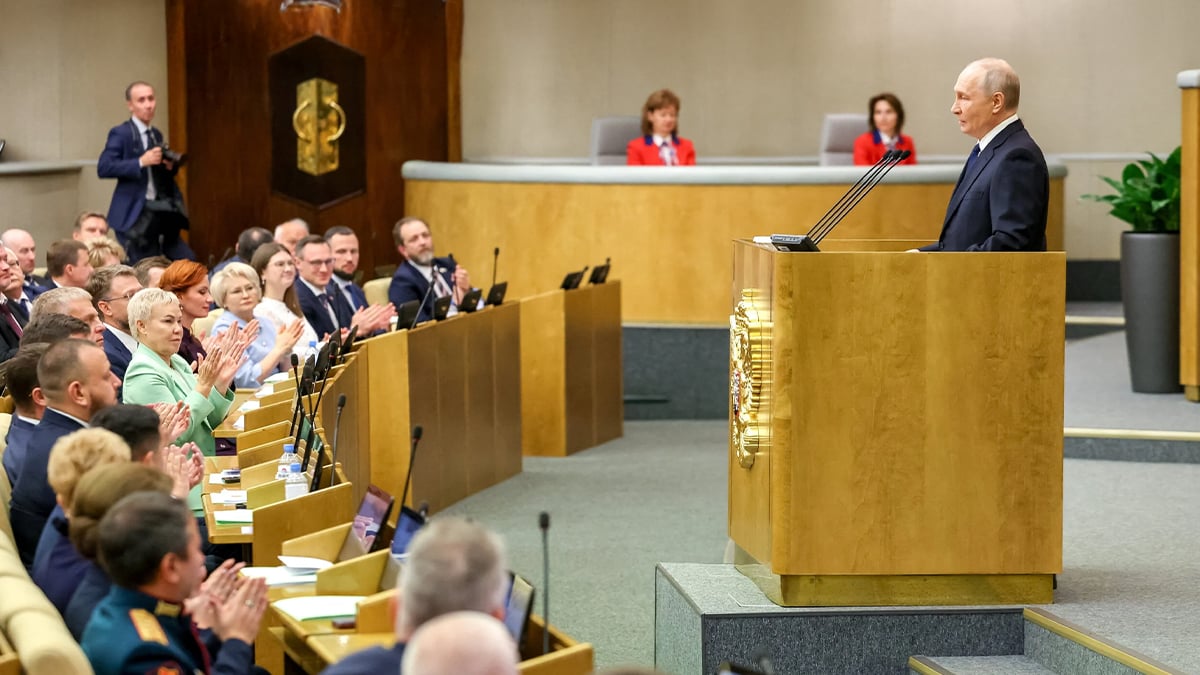
Russia has convened its new State Duma, the lower house of parliament, with the Putin-endorsed United Russia party holding a record-high supermajority. United Russia won nearly 58 percent of the vote, taking 349 out of 450 seats, according to the Central Election Commission. The 60% turnout was the highest since 2011.
The Sept. 18-20 vote, which was preceded by a monthslong state media campaign, took place without the participation of any genuine opposition parties — Yabloko, the only antiwar party was barred from the ballot in August — and without international election observers. Residents of four Ukrainian regions partially occupied and illegally annexed by Russia in 2022 also took part in the vote.
According to Ella Pamfilova, 46 of the deputies are people who have participated in Russia’s war against Ukraine.
But a week after the country’s highly managed vote, which an RFE/RL analysis argued was heavily padded in United Russia’s favor, Independence Avenue Media looked at what — if anything — the results actually mean.
Russian President Vladimir Putin has portrayed the vote as a public mandate to continue his war against Ukraine, despite the Russian army’s struggle to break through on the front lines, a Ukrainian deep-strike campaign inside Russia and mounting financial challenges.
But is it? If not, what was it for? And what would it take for public opinion on the war to meaningfully change?
Timothy Frye, a Columbia University political scientist and author of “Weak Strongman,” Samuel Greene of King’s College London, co-author of “Putin v. the People,” and Maria Lipman of the Wilson Center’s Kennan Institute took up those questions at a Kennan Institute “Long View” discussion on Sept. 22.
Their condensed remarks below have been edited for length and clarity.
What Message Was The Election Meant To Send?
Frye says the election was about signals — from Putin to Russian citizens but also to Putin himself. But unlike, democratic elections, he says, it tells us very little about Russian society itself.
Putin seemed to put his thumb on the scales much more toward United Russia in this election. He might use this to call for increased spending on the war, increased sacrifices from the public.
The election is sending multiple signals: to Putin, about how hard he has to work to manufacture this result; to elites who might be interested in challenging Putin, who try to decipher how much of the support is real and how much is just intimidation and coercion; and also among the mass public, who are looking around and thinking, okay, United Russia got roughly 58% of the vote — is that about what I expected?
I think we learn more about the Russian state from this election than we do about Russian society, which is not the way it usually works in elections. Typically we’re uncertain about what society thinks, and that’s precisely why we hold the election. Here it was really a referendum on the Russian state and whether it’s able to produce a result like this.
Greene adds that the very act of mobilizing the bureaucratic machinery of the state sends a strong message to elites who might think about challenging Putin:
To cheat on this level requires mobilizing an entire machinery of bureaucrats up and down the system, the length and breadth of the country. So it shows that this is still a system that’s attuned to him, and one that will operate in his interests regardless of whatever anxieties people have.
It also communicates something very important to the elite, which is that anybody who might seek to challenge Putin is going to have to be able to do better. He’s saying: I have this personal relationship with 60% of 140 million Russians. Anybody who wants to challenge him is going to have to be able to challenge that relationship and that arithmetic. That’s potentially a very difficult thing to do. Maybe not quite as difficult as he wants it to seem, but potentially a difficult thing to do.
Can public opinion on the war — and the West — be changed?
Greene says Putin has never given the Russian public a vision for the future. That has become dangerous as people now find it difficult to even “imagine” what victory in Russia’s war with Ukraine looks like:
I don’t have polling data on this, and I can’t actually imagine what that would look like, but I’m seeing it in focus groups I’ve been running with a Russian colleague: people are finding it increasingly difficult to imagine victory. I think that risks becoming a real challenge for the Kremlin. It used to be that if you thought Russia needed to find some victory in this war, you could articulate various different versions of what that would look like. People right now are really struggling to do that.
Putin has done well by manufacturing this kind of futurelessness. He’s never really given the Russian public a vision of what a future would look like after the war.
And right now I think people are really struggling to envision any kind of nice future after the war. At some point the Kremlin probably has to pivot to picking an outcome, and then almost whatever outcome he picks, he’ll be able to sell it to the public. What he can’t sell is just this, forever.
Anxiety is going up, but is it enough to break public apathy?
Lipman says that even Russian government-run pollsters are showing anxiety ticking up in the population.
There is one question, asked not by an independent polling agency but by a government polling agency, about the mood of those who surround you. It is asked every week. People are asked a very simple question: what is the predominant mood of those around you — is it calm, is it anxiety? Over the past months, actually I think since spring, we see that people say “anxiety” more often than “calm.” This was not the case for months and years before that.
Frye says it may be easier to get the public behind a negotiated settlement with Ukraine than a mobilization:
One of the things that’s very difficult to capture in public opinion research is cost. You often get the sense, looking at a survey in total, that the sentiment is: yes, I’m in favor of this war, just don’t ask me to sacrifice anything in order to win it. We’ve done work where we have hypothetical candidates who take different positions on the war, and even back in 2023 we found that candidates proposing to hold negotiations with Ukraine were not penalized at all, and candidates who backed a partial mobilization lost a lot of hypothetical support. That tells you something about the depth of people’s support for the war.
Greene says the Kremlin has come close to crossing the public’s line of patience, but seems to know when to walk it back:
The government has repeatedly walked up to the line of making life more difficult. Partial mobilization in the autumn of 2022 did make life more difficult. The state backed down. The internet restrictions we saw in the run-up to the election also were demonstrably making life more difficult. It’s bad enough that you don’t know where you can find gasoline for your car, but then you take away the device people are using to figure out where to find gasoline for their car. So again the Kremlin walks up to that line and then walks it back, because it’s not willing to put itself in a situation where it could become not just unworthy but illegitimate.
The Russian public is a factor in this war, because the Russian public is allowing the Russian government to do everything it wants to do, with some limitations.
So to me the future-facing question is: what would the Kremlin need to do to break that? I think it would need to become much more interventionist.
Frye says there will need to be a combination of events — on the battlefield, in the economy and in state institutions — that will make “people wake up”:
Apathy, and great concern without an ability to act upon it, are observationally equivalent. They look exactly the same. And I think a lot of Russians are paying attention.
There’s not going to be one thing that all of a sudden makes people wake up. Some kind of continued economic decline, continued struggle on the battlefield, governance problems — if heating breaks down in the winter and people are cold, something that could really be pointed directly at the officials — in combination with some Putin fatigue, war fatigue, economic uncertainty and gloom about the future. It would take some combination of these events together for the latent dissatisfaction that I think we capture very well in these surveys to gain some kind of political voice.