Brian Whitmore is a contributor writing for Independence Avenue Media. The views expressed are the author’s and do not necessarily reflect those of Independence Avenue Media.
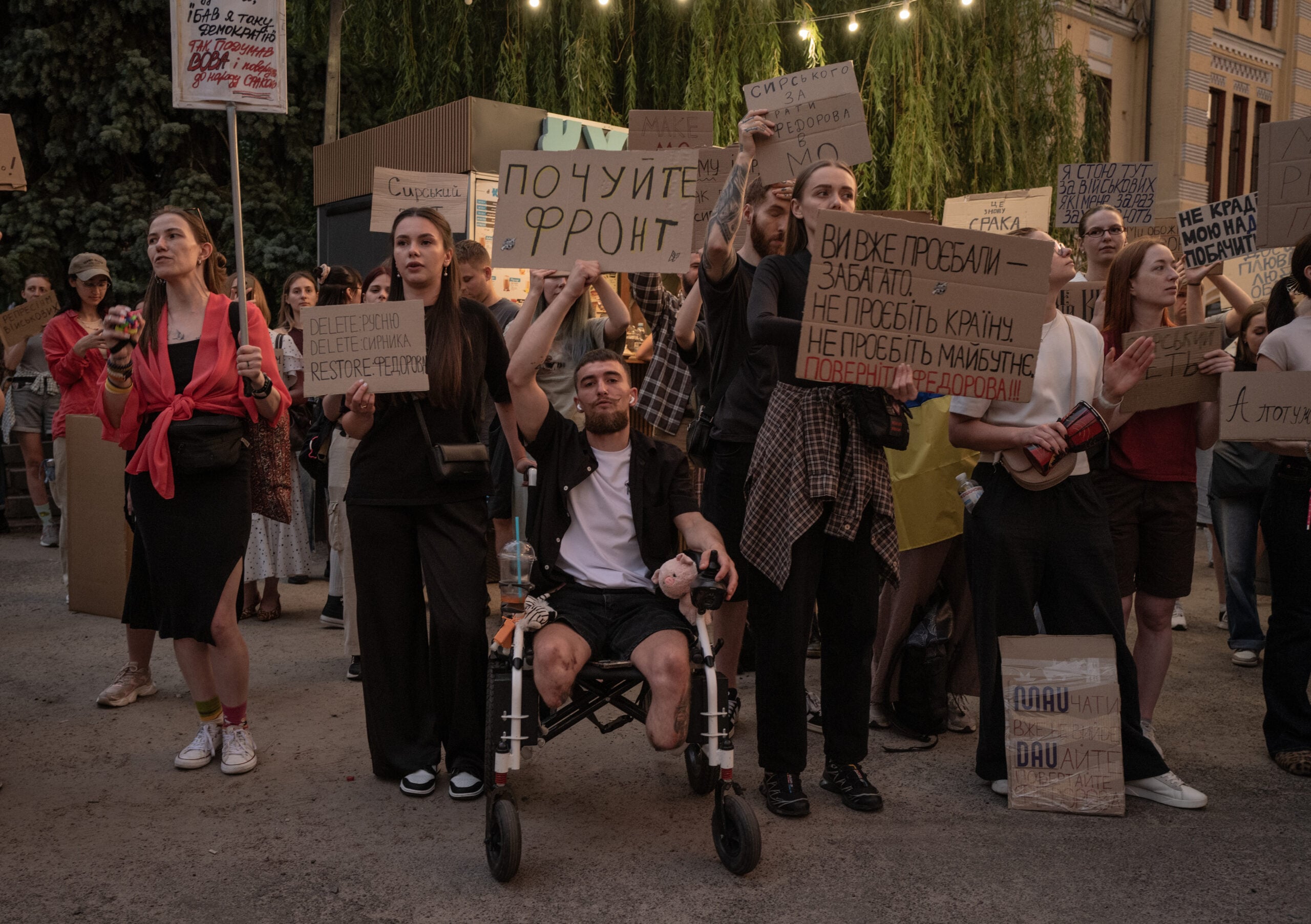
This week, something that has always been implicit suddenly became explicit. Ukrainian civil society made it clear to the government that Ukraine’s heroic defense of its homeland, its independence and its sovereignty is The People’s War.
When Ukrainian President Volodymyr Zelenskyy acquiesced to the demands of protesters in more than a dozen cities throughout the country and sacked Gen. Oleksandr Syrskyi as commander in chief of Ukraine’s armed forces, it illustrated that the voice of Ukraine’s vibrant civil society cannot be ignored, even when it comes to military matters — or more aptly, especially when it comes to military matters.
“In a country where civilians actively fund, supply and man the front lines, the line dividing state and society naturally dissolves,” Yuriy Boyechko, founder and CEO of Hope For Ukraine, a nonprofit providing aid to civilians affected by Russia’s war against Ukraine, wrote on Substack.
In a related post on LinkedIn, Boyechko added, “For Ukrainians, military modernization and institutional accountability are matters of existential survival. The right to shape the leadership protecting their future is not a privilege granted by the government — it is a sovereignty earned on the battlefield.”
The event that sparked the protests, of course, was Zelenskyy’s decision to fire his young, popular and highly effective defense minister, Mykhailo Fedorov, on July 15. Fedorov was sacked after he repeatedly clashed with Syrskyi over strategy and tactics.
The firing was a massive own goal by Zelenskyy. It is difficult, if not impossible, to argue that Fedorov’s six-month tenure as Ukraine’s defense minister was anything but a resounding success.
His half-year in office directly correlated with the war turning decisively in Kyiv’s favor. At the front, Fedorov’s reforms helped Ukraine innovate its way out of its manpower disadvantage, leveraging mid-range drone strike capacity to disrupt Russian deployments and logistics, effectively grinding Moscow’s advances to a standstill.
This same mid-range drone capability has turned the annexed Crimean peninsula into an isolated and vulnerable island — and a liability for Russia. And under Fedorov’s leadership, Kyiv’s deep-strike capacity has taken out up to a third of Russia’s oil refining capacity, disrupting the aggressor’s economy and causing debilitating fuel shortages.
“Fedorov revealed himself to be the most effective defense minister on the planet. He seemed to choose all the right priorities for Ukraine and improved performance in them all,” Phillips P. O’Brien, a professor of strategic studies at the University of St Andrews, wrote recently.
Or, as a defense-tech representative identified only as Anton told Business Insider, Fedorov “was driving innovations, visionary goals and very brave practical operations that gave President Zelenskyy his cards.”
When Fedorov took the helm in January, Ukraine was struggling and arguably losing the war. Six months later, Ukraine is winning. So he clearly wasn’t fired for cause. Instead, he was likely sacked because he bumped into entrenched interests.
Much of the reporting on Fedorov’s dismissal and the political crisis that followed has focused on his conflict with Syrskyi, a grizzled 60-year-old whose traditional approach to warfare and leadership reflected his formative training as a Soviet officer. This clashed with Fedorov’s approach, which stressed artificial intelligence, automated battle management systems, and the massive deployment of cheap, expendable drones.
But the tension in Ukraine’s military establishment runs much deeper than a generational spat about strategy and tactics between an aging boomer general and a smart, ambitious upstart millennial defense minister.
At its core, the dispute was also about business — particularly the business of defense procurement.
Since taking over the defense ministry in January, Fedorov brought a Silicon Valley-style mentality to Ukraine’s military-industrial complex. His innovations in defense procurement focused on speed, transparency and data-driven solutions. He restructured the drone-purchasing process so demand is generated automatically using front-line battlefield data, eliminating subjective human intervention and reducing opportunities for corruption. Fedorov also simplified procurement procedures. If a piece of hardware was successful in the field, its path into the official supply chain was expedited. And he replaced closed, negotiated military contracts with transparent competitive tenders.
The approach was reminiscent of reforms Fedorov initiated as minister of digital transformation from 2019 to 2026, where, in addition to spearheading a massive drone procurement, manufacturing and training program, he launched a complete digitalization of Ukraine’s public services, enabling citizens to pay taxes, register businesses, and access digital passports, tax IDs and driver’s licenses through their smartphones.
But Fedorov’s innovations in defense procurement, while popular with the rank-and-file military and newer tech defense firms, were not so beloved among the insider networks and entrenched interests that have long dominated — and profited from — opaque military contracts. This was not lost on protesters, who chanted “corruption kills” at demonstrations supporting Fedorov.
A big unknown going forward is the fate of Fedorov’s procurement reforms.
But Zelenskyy’s choice to replace Syrskyi with 43-year-old Gen. Mykhailo Drapatyi, who openly supported Fedorov throughout the crisis, indicates that the Ukrainian president has gotten the message that the public — and the troops — favor generational change at the top. Fedorov called the appointment “a breath of fresh air and a new source of hope in the fight of free people for freedom and justice. It is the voice of change that could no longer be ignored.”
Fedorov’s job remains vacant for the moment, with Gen. Yevhen Khmara, who also supports his strategic vision and modernization program, serving as acting defense minister until Zelenskyy decides on a replacement.
Sensing victory, protesters are still demanding Fedorov’s reinstatement. But whether or not Zelenskyy heeds their wishes, Ukraine’s civil society reinforced its seat at the table this week — and won’t be relinquishing it anytime soon.
More commentary from Brian Whitmore: Ukraine’s Coalitions of the Willing — And Able